



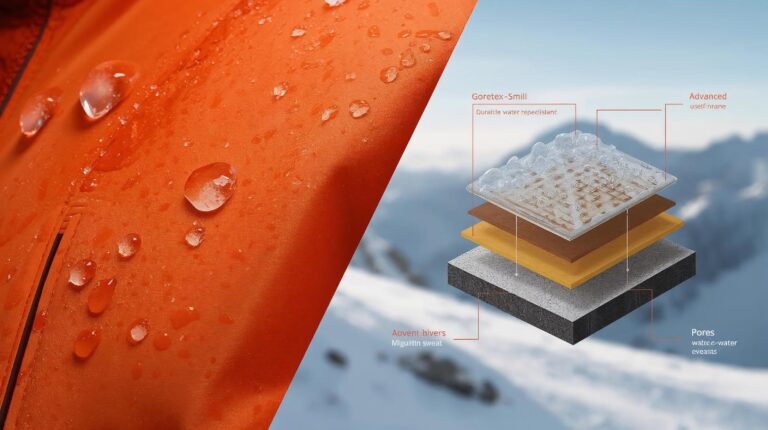
What does "Water Column" actually mean when choosing ski equipment?
Water Column is the main indicator of water resistance. It is measured in millimeters (mm) and shows how much water pressure the fabric can withstand before it lets moisture through to your body. In the laboratory, this is tested by placing a tube full of water on the fabric.
When you are looking ski equipment in Bansko, you need to understand the scale:
- 3,000 mm: It withstands very light snow or drizzle.
- 10,000 mm: Standard for mid-range equipment.
- 20,000 mm+: Professional grade, designed for extreme conditions.
Pressure: The Hidden Factor in Pirin
Many skiers make the mistake of buying a low water column jacket, thinking, „I don’t ski in the rain.“ But waterproofing isn’t just about protection from precipitation. It’s about protection against the pressure, that you exercise on the snow:
| Action | Equivalent pressure |
|---|---|
| Sitting on a wet chairlift seat | ~ 5,000 – 8,000 mm |
| Kneeling in the snow (snowboarders) | ~ 12,000 – 15,000 mm |
| Pressure from backpack straps | ~ 10,000 mm |
Breathability: Why is the „sauna effect“ dangerous?
The second key number on the label is breathability, measured in g/m²/24h. This is the jacket’s ability to wick away sweat. If your jacket has a high water column but low breathability, you’ll get wet from your own sweat.
In Bansko, where there is often a large elevation change (from 2560 m to 990 m), your body goes through different load regimes. When you stop after an intense descent on Banderitsa, the accumulated moisture under the jacket cools down instantly, leading to a risk of hypothermia.
Breathability scale for active skiers:
- 5,000g: Suitable only for walks or very leisurely riding.
- 10,000g – 15,000g: The golden environment for cross-country skiing in Bansko.
- 20,000g+: A must for freeride and ski touring (hinge).
Expert Advice: The Three Layer System
To make your darling work ski equipment, you must follow the rule of layers:
- Base layer: Thermal underwear (merino wool or synthetics) – wicks away moisture.
- Middle layer: Fleece or down jacket – retains heat.
- Outer layer (Shell): Your membrane – protects against wind and snow.
Forget about cotton t-shirts! Cotton absorbs moisture and ensures that you will be cold all day long.
The specificity of Pirin: Humidity and "heavy snow"„
Bansko is known for its „Mediterranean“ climate. Unlike the dry cold of the Rocky Mountains, the snow here is often wet, especially in the lower part of the ski area (Chalin Valog). This snow has the property of „soaking“ into fabrics faster. That is why we recommend that your trousers always have a higher water column than your jacket.
Maintenance: How to maintain the properties of the membrane?
Buying high-end ski equipment in Bansko is an investment that can last for years if you take proper care of it. Membranes (like Gore-Tex) have microscopic pores that get clogged by regular detergents.
“Never use fabric softener on technical clothing! It literally 'seals' the pores of the membrane and your jacket stops breathing forever.‘
DWR coating – the first line of defense
DWR (Durable Water Repellent) is the invisible layer that makes water bead up. When you see the fabric starting to „drink“ water and darken, it’s time for a waterproofing spray. This restores breathability by preventing the outer fabric from getting soaked.
Conclusion: What to buy for the next season in Bansko?
The choice of ski equipment should be based on your riding style:
- Track lovers: 10,000 mm / 10,000 g – a perfect balance.
- Snowboarders: Minimum 15,000 mm for the pant.
- Freeride and ski touring: 20,000 mm / 20,000 g with fully taped seams.
Prepare intelligently so that your only concern on the piste is whether to make another run down Tomba, or is it time for lunch at Banderishka Polyana..