


The Razlog Valley is not just a geographical concept. Enclosed in the majestic embrace of the three colossi – Pirin, Rila and the Rhodopes, it is a natural amphitheater of the spirit. Here, where the clouds touch the peaks, history is embedded in the stone of the churches in Bansko and the region.
This guide will take you through the centuries – from the mysterious early Christian basilicas to the monumental temples of the Bulgarian Renaissance. You will understand why the churches in Bansko are not just architectural monuments, but fortresses of Bulgarianness, survived through cunning, faith and diplomacy.
The Renaissance: The Merchants Who Became Temple Builders
At the end of the 18th and beginning of the 19th century, Bansko experienced its “Golden Age”. Local merchants crossed Europe, reaching Vienna and Venice. Returning, they brought not only gold, but also European self-confidence. Seeing the Western cathedrals, the people of Bansko decided to bring this grandeur home, creating the most emblematic churches in Bansko.
1. Holy Trinity Church-Monument: The Symbol of the City
The history of this temple is worthy of a movie script. Under Ottoman rule, the construction of new churches was prohibited. Only the reconstruction of old temples on existing foundations was allowed.
The legend of the “discovered” relics
To circumvent the law, Mayor Lazar German (Grandpa Lazko) resorts to an ingenious trick. He secretly buries an icon and a cross on his property. Then a "prophetic dream" is organized, which indicates the location. The "discovery" of the relics gives the authorities reason: „"There used to be a church here, we're just restoring it"“.
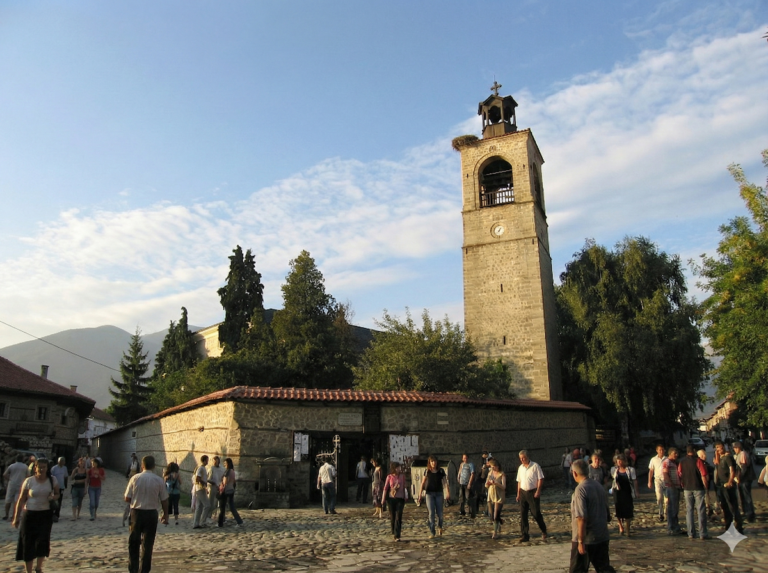
The result, illuminated in 1837, is stunning and dominates all churches in Bansko:
- Scale: A three-aisled pseudo-basilica with stone walls over a meter thick.
- Architecture: Strong Italian influence, bringing a sense of spaciousness.
- The bell tower: Built later (1850), 30 meters high - a symbol of the transition to modern times.
2. The Church of the Assumption of the Virgin Mary: The Secret Faith
If the Holy Trinity is the cry of freedom, then the Assumption is the whisper of prayer. Located in the cemetery park, it is a classic example of an 18th century „hidden church“ – one of the oldest preserved churches in Bansko.
Its exterior is distinctly ascetic and half-buried in the ground. But the interior hides a real treasure – the famous „"Bathroom iconostasis"“. This is a masterpiece of openwork woodcarving, where biblical scenes are intertwined with floral motifs. The spirit of Toma Vishanov (Molera) is also preserved here, who dared to paint the saints with human faces and smiles.
Sacred wonders in the region: Dobrinishte, Razlog and Banya
The spiritual wealth does not end with the city's sign. The surrounding area offers unique sites for religious tourism.
The Miracle in Dobrinishte: Church of St. Peter and Paul„
Built in 1835, this church witnessed a miracle in 1913. When the city was set on fire, the flames engulfed the temple. A Greek officer, struck by its grandeur, ordered the fire to stop. Due to a lack of buckets, the soldiers put out the fire with water carried in helmets and fezzes. This is how the priceless Byzantine cross from 1194 was saved.
Razlog and Banya: Between modernism and antiquity
In Razlog rises „"Holy Annunciation"“ (1939) – a white nave with a 26-meter bell tower. In the village of Banya, the church of St. George bears the marks of history literally on its facade – traces of bullets from the wars of liberation, testifying to the turbulent past of the region.
Bansko Art School: The Faces of the Saints
The unique ones churches in Bansko are home to a distinctive art school. In contrast to the strict canons, the masters from Bansko introduce realism, softness and landscapes.
| Generation | Representative | Style and contribution |
|---|---|---|
| The Founder | Toma Vishanov (Molera) | He studied in Vienna. He introduced an expressive “Baroque style” and bright tones. |
| The son | Dimitar Molerov | Balances innovation with canon. Master of psychological portraiture. |
| The grandson | Simeon Molerov | It affirms the style with precise drawing and rich ornamentation. |
Practical tips for visitors
If you are planning a tour of the churches in Bansko, here's what you need to know:
- Working hours: Most temples are open from 08:00 to 17:00, but Holy Trinity is often open until later in the summer.
- Clothing: Decent clothing is required (covered shoulders and knees). Holy Trinity Church has scarves available at the entrance.
- Shooting: In most churches, photography inside is prohibited or requires a fee/permit. Always ask the priest.
- Best time: Visit the temples during major holidays (Easter, Christmas) to hear the unique church choirs.
Archaeological Bonuses: The Nameless City
For the most curious, the area of "St. Nicholas" hides the foundations of an early Christian basilica from the 4th-5th century. This proves that Christianity in Pirin was not "imported" late, but was alive at the dawn of the new era.
The sacred architecture of Bansko is the stone chronicle of a people. From the hidden underground "Assumption of the Virgin Mary" to the majestic tower of "Holy Trinity" - each temple is a document of struggle and hope.