



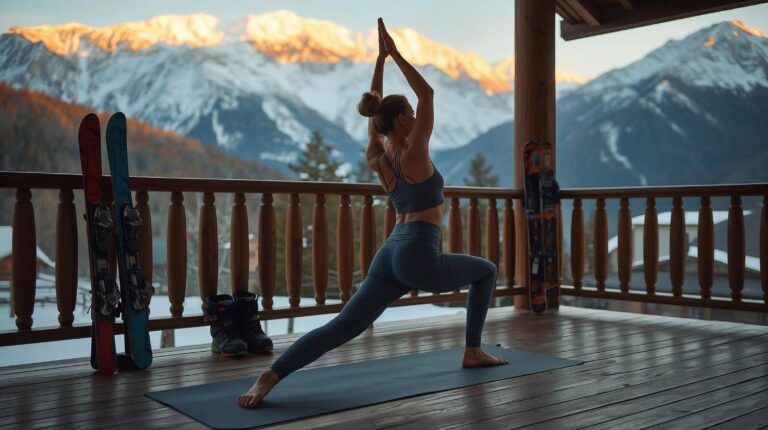
In this guide, we'll look at why your yoga mat is just as important as your helmet, and how to prevent injuries through proper stretching tailored to the terrain you're on. Bansko.
Why is Yoga a skier's best friend?
Skiing and snowboarding are sports that require tremendous explosive strength and endurance, but often at the expense of flexibility. The body position when descending – slightly crouched, knees forward, abs tight – keeps the muscles in a constant shortened (concentric and isometric) state.
Here's how yoga for skiers specifically helps:
- Restores muscle length: It counteracts the shortening of muscle fibers after 6-7 hours of exercise.
- Accelerates recovery: Stretching improves blood circulation and lymph flow, which helps clear metabolic waste (such as lactate) more quickly.
- Balance and proprioception: Yoga practices improve the sense of the body in space, which is key for stability on the icy sections of Tomba.
Top 5 Yoga Poses for Recovery (DIY Program)
You don't have to be an expert to perform these exercises. You can do them in your hotel room in Bansko right after a hot shower, while your muscles are warm and supple.
1. Low Lunge (Anjaneyasana)
Purpose: Hip flexors (pelvic flexors) and quadriceps.
Why it's important: Skiers spend their days with their hips flexed. This position “opens” the front of the thighs, which directly relieves tension in the lower back. Hold for 5-8 deep breaths on each leg.
2. Downward Facing Dog
Purpose: Calves, back of thighs (hamstrings), spine.
Why it's important: Ski boots hold the ankle at a fixed angle, which dramatically shortens the calves and Achilles. This pose stretches the entire posterior chain of the body. Try “walking” in place, bending one knee at a time.
3. Pigeon Pose (Eka Pada Rajakapotasana)
Purpose: Glutes (buttocks) and outer thighs (IT band).
Why it's important: This is the “gold standard” in the category yoga for skiers. Releases deep pelvic tension that builds up from constant balancing and carving turns. If you experience knee pain, perform the supine variation (needle's ear pose).
4. Seated Forward Bend
Purpose: The back of the thighs and lower back.
Why it's important: It relieves compression in the spine, accumulated from vibrations and bumps on the track. Don't force yourself to touch your toes - the goal is to feel a pleasant stretch in your back.
5. Child's Pose / Balasana
Purpose: Complete relaxation of the back, shoulders and neck.
Why it's important: The perfect ending. Allows the nervous system to switch from sympathetic mode (“fight or flight”/adrenaline) to parasympathetic mode (“rest and recover”). Stay here for at least 3 minutes.
Injury Prevention: Flexibility is Strength
Statistics from the mountain rescue service in Bansko often show that most injuries occur in the late afternoon (after 2:30 p.m.), when the body is tired and the muscles have lost their elasticity. Cold weather further tightens the tissues, making them more fragile.
Regular stretching doesn't just relieve pain today – it's an investment in tomorrow. An elastic muscle is like a new rubber band – it can take a load and return to its original position. A tight muscle is like a dry rope – with a sudden movement (fall or difficult turn) the risk of tearing is much higher.
Yoga studios and relaxation zones: The new wave in Bansko
If you don't want to practice on your own, Bansko offers excellent options for professional help. More and more hotels and resorts are integrating specialized yoga classes into their SPA centers.
Attending a yoga class after the race offers:
- Controlled heat: Some studios offer “Hot Yoga,” which is perfect for deep relaxation after the sub-zero temperatures outside.
- Professional instructor: He will make sure you perform the poses safely by correcting your posture.
- Atmosphere: The combination of aromatherapy, quiet music, and stretching is the fastest way to mental relaxation.
Don't forget the power of mineral water. The combination of a yoga session followed by a dip in the mineral pools in the village of Banya (just 5 km from Bansko) is perhaps the best restorative procedure known to local skiers.
Conclusion
Being a good skier is not just about going fast, but also about taking care of the “machine” that makes it possible – your body. Take 15-20 minutes after your skis to do this routine. Your legs will thank you the next morning when you step on the first lift for the “Gondola up”.