



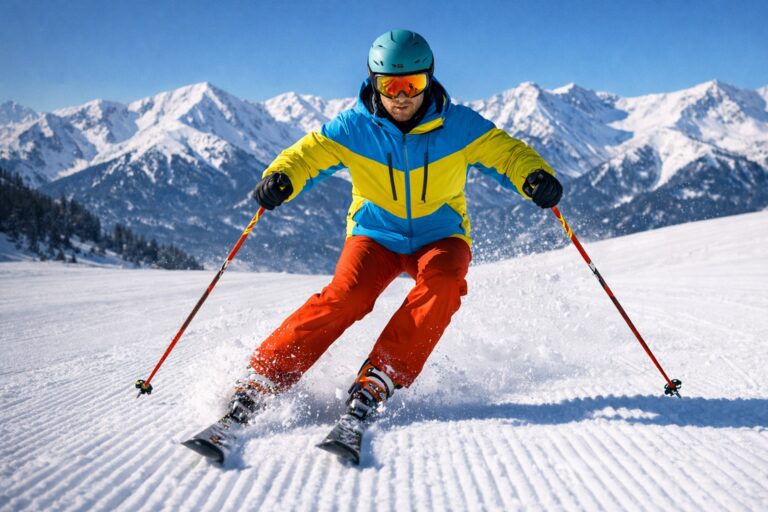
To help you through this critical stage, we'll take a look at one of the world's most successful beginner video tutorials - the tutorial by Stomp It Tutorials, which has over 2.4 million views. The video is structured as an ingenious plan of 7 clear steps that will methodically take you from the basic “plow” to a beautiful, smooth parallel turn. Watch the video carefully below, then we will decode each phase in detail so that you can apply it to the snow in Pirin tomorrow.
Info: How to watch the video tutorial with Bulgarian subtitles
To make sure you don't miss a single subtlety when transitioning to parallel skis, you can turn on automatic translation into Bulgarian directly on YouTube:
- Turn on subtitles: Click on the “CC” (subtitles) icon in the lower right corner of the player.
- Open settings: Click on the gear icon (Settings) right next to it.
- Specify translation: Select “Subtitles/CC” and then “Auto-translate”.
- Choose language: Find “Bulgarian” in the list and highlight it.
Before we begin: Confidence in the plow
Before you can dive into the 7 steps, you need to have a solid foundation. To move on to parallel skis, you must first be able to make confident, connected turns on a snow plow (snowman), without panicking at speed, and be able to stop completely at any moment. If this condition is met, you are ready for the next level.
The 7 steps from plow to parallel skis
Step 1: Choosing the Correct Terrain
The biggest mistake beginners make is trying new techniques on steep terrain. To practice ski collection, you need a very gentle, wide and well-groomed slope (“nursery slope”). In ski In Bansko, the ideal places for this are the green slopes, the lower part of “Shiligarnik” or even the “Ski Path” on weekdays. The sloping terrain removes the fear of acceleration and allows you to focus on your technique.
Step 2: Control by Turn size and shape
To slow down, you don't have to push the plow until your hips hurt. The secret is to change your trajectory. Start making your turns much wider and tighter, making perfect C-shaped turns in the snow. The further up the hill you end the turn, the more gravity will naturally kill your speed.
Step 3: Absorb the pressure
As you gain speed exiting the turn, centrifugal force will start to push you into the snow. It's important not to freeze like a statue. Use your knees and ankles as shock absorbers to absorb this pressure at the end of the turn, keeping your body position stable and centered.
Step 4: Early weight transfer to the outer shell
This is the turning point! Everything in modern skis is based on the outside ski. While you are still in the plow, try to consciously transfer 80% of your weight to the outside ski for the turn much earlier - at the beginning of the arc. You will feel how the ski begins to turn almost on its own, freeing your inside leg.
Step 5: Turn inside ski
Now that you've released the weight from your inner scapula, you're ready to bring it back in. Here are a few progressive exercises that experts recommend:
- Bowtie drill: Transfer your weight entirely to the outside ski and lightly lift (tap) the tail of the inside ski on the snow during the turn.
- Narrow snow plough: Start deliberately making the plow much narrower than usual.
- Alignment and rotation: At the end of the turn, “straighten” the inside ski so that it lies on the same edge as the outside ski, and slide it parallel to it. Initially, this will only happen at the very end of the turn – and that’s completely normal!
Step 6: Fully parallel skis throughout the turn (Parallel turns)
Once you get used to collecting your skis at the end of the arc, start doing it earlier and earlier. The goal is to initiate the turn with your skis parallel. To do this, you need to decisively move your center of gravity forward and diagonally “through” your skis at the moment of changing direction. The feeling is as if you are throwing yourself lightly into the new turn, believing that your skis will catch you.
Step 7: Pole planting
Once you start making smooth parallel turns, it's time to bring the poles in. The pole plant is done right between the two turns - it serves as a physical trigger for your brain that it's time to transfer your weight to the other ski, and gives you the perfect rhythm on the descent.
Warning: Most common mistakes made during the transition
- Backseat position: When you first put your skis together, your speed picks up. The instinct for self-preservation makes you lean back. This automatically blocks your ability to turn. Always keep pressure on the tongues of your boots!
- Rushing: Don't try to skip straight to Step 6. If you don't master your balance on the outside skate (Step 4), you'll never be able to smoothly retract the inside skate.
- Lifting the entire frame: Retracting the inner skate should be done by sliding and rolling the ankle, not by physically lifting the entire leg high in the air.
Improving technology in Bansko
The transition to parallel skiing takes time and muscle memory. The slopes in Bansko offer ideal conditions for this progression. We recommend that you start your day on the easier blue slopes while your legs are fresh. When you feel that you are starting to get tired and instinctively return to the “plow”, it is better to take a break.
Video guides are a brilliant tool that gives you the theoretical “map”, but nothing can replace the experienced eye of a professional. Certified instructors in Bansko can literally correct your posture in a few hours, show you the right exercises for your specific balance and save you days of frustration.