

For the local, business owner, or traditional tourist, this concept may initially sound confusing. What exactly is this? Is it a hotel? Is it a regular office? Where do these people even sleep and why are they here? In this comprehensive guide, we will explain the concept of coworking in Bansko in completely understandable language, without complex corporate and business terms.
What is Coworking (in simple terms)?
To understand the idea most easily, imagine a modern gym. When you want to work out, you don't buy a professional treadmill and heavy barbells to take home because it's extremely expensive and takes up a lot of space. Instead, you pay a monthly gym membership – there's all the equipment you need, it's perfectly heated, there are changing rooms, showers, and other motivated people are working out around you.
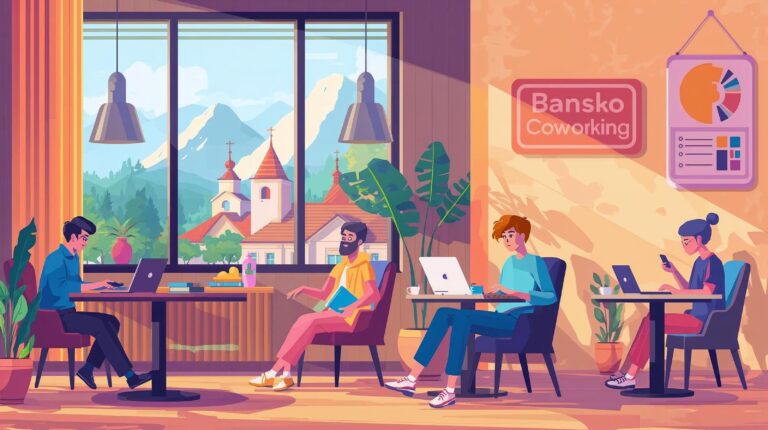
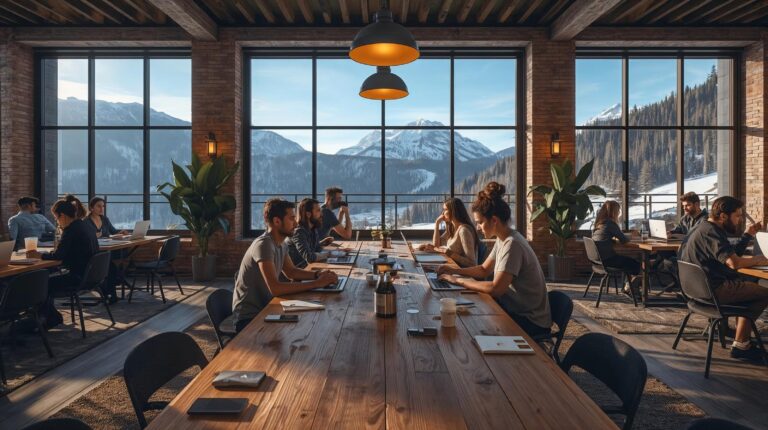
It’s a large, shared office space. There’s no one specific company inside with one boss overseeing everyone. Instead, the space is used by many different independent people – programmers, accountants, graphic designers, writers, marketers or people with their own completely online businesses. Everyone pays for a subscription “card” (for a day, week or month), goes there with their personal laptop, sits at a desk and does their own work, for which they are paid by clients or employers from all over the world.
What does a shared office space include?
When someone pays for a coworking subscription in Bansko, they are essentially renting a “ready-made workplace” without having to deal with any household issues. The price usually includes the following key amenities:
- Desk and ergonomic chair: You can choose where to sit every day (so-called. hot desk), or pay extra for your own fixed desk (dedicated desk), where no one else is allowed to sit and where you can leave your monitor.
- Very fast and reliable internet: This is the “oxygen” for digital nomads. Without a stable connection, their work is impossible.
- All household supplies: Electricity, stable heating in winter, air conditioning in summer, garbage fee and daily professional cleaning.
- Meeting rooms: Closed rooms with a large TV, projector, or whiteboard. Used if you need to video conference with a team in the US, Germany, or another country.
- Comfort extras: Free good coffee and a selection of teas, use of a fully equipped shared kitchen, printer, scanner, as well as small soundproof booths (Phone booths) for important phone calls without disturbing others working in the open space.
Coworking vs. Coliving: Where do these people sleep?
This is where the biggest confusion often occurs among locals. Many think that these are some kind of modern hostels. No, people definitely don't sleep in coworking spaces.
Coworking is only and only office. Working hours are usually from morning to evening (or 24/7 access is offered with a special chip card or phone app). In the evening, people close their laptops, pack their backpacks and leave.
The Coliving (co-living) is a building – for example, a converted former aparthotel – in which people have their own separate bedrooms and bathrooms, but share a huge communal kitchen, cinema and living room with other people like them. The goal is not to be lonely when traveling alone around the world. The scenario of their daily life is as follows: In the morning, the person wakes up in their apartment (or coliving), drinks coffee, gets dressed and “goes to work” in the co-working space somewhere on the streets of Bansko.
Why has Bansko become the capital of digital nomads?
Currently, Bansko is officially recognized as one of the largest hubs for digital nomads in all of Europe. Several extremely popular coworking networks operate here year-round, including the pioneers Coworking Bansko (with locations in the Old Town and next to the Gondola), the modern Nestwork (on Tsar Simeon Street), the cozy Altspace (on Edelweiss Street) and other emerging spaces.
But why don't these highly paid professionals just work from their apartments in Bansko? Why pay extra money to pay for office space?
- For the sake of community (Networking): When you work from home completely alone, it quickly becomes boring, monotonous and lonely. In coworking you meet interesting professionals from all over the world. There you can easily find company for skiing in the winter or for mountain hikes to the peaks of Pirin in the summer.
- Because of the events: These shared spaces are not just desks. They host events almost every day – specialized lectures, backyard barbecues, experience-sharing seminars, board game nights, or traditional Friday beers.
- For the sake of productivity: It has been proven that it is much easier to concentrate in a quiet, bright room full of other focused working people than lying on the couch at home, where the TV or refrigerator constantly distracts you.
- The perfect balance in Bansko: The city offers a unique combination of low cost of living, stunning scenery, fast internet, delicious food, and a safe environment.
Pros and cons of coworking spaces
If you are a local entrepreneur, freelancer, or just wondering if this work model is right for you, here is an objective and quick comparison of the advantages and disadvantages:
| Advantages (Pros) | Disadvantages (Cons) |
|---|---|
| Everything is ready: You don't pay separate bills for electricity, high-speed internet, and heating; you don't waste time and money buying desks and chairs. | Lack of complete silence: Sometimes in large open spaces there is movement, conversations around the coffee machine, and background noise from other people. |
| Flexibility: You only pay for the days or months you are actually there. There are no onerous long-term lease agreements. | Additional cost: The service costs money (often between 200 and 400 BGN per month), which is still more than working completely free from home. |
| Rich social life: You find new friends, potential business partners, and like-minded people who share your interests. | Lack of privacy: If you work with extremely sensitive and confidential data, an open office can be a security issue. |
| Clear boundary: You successfully separate your rest time (when you are at home) from your work time (when you are in the office). |
How does coworking culture help the economy in Bansko?
The presence of hundreds, and sometimes thousands, of remote professionals is changing Bansko for the better. Unlike traditional tourists who come for 3-4 days only in winter, digital nomads often stay for months. They rent long-term apartments, shop at local supermarkets, eat at restaurants and taverns outside the active season, use the services of local hairdressers, car repair shops and doctors. This constant flow of people creates a sustainable, year-round economy for the city, reducing its dependence on snow and the ski season alone.
In summary:
Coworking is not a secret society, a scam, or a complicated corporate scheme. It is simply a modern, extremely flexible and social office format. It allows intelligent people of the 21st century to travel freely around the world (or choose to live in a beautiful city close to nature like Bansko) and have perfect, professional working conditions wherever they are.