



Related useful information: This article is part of our series on facility technology. For up-to-date ticket prices and tips, check out our Complete guide to the Bansko cable car.
Swiss precision: Who manufactures the lift cabins in Bansko?
Although the entire massive lift infrastructure (motors, poles and stations) was built by the Austrian technology giant Doppelmayr, the passenger cabins themselves are the work of the highly specialized Swiss company CWA Constructions (a subsidiary of Doppelmayr).
Their iconic model “Omega” has become the absolute gold standard for gondola lifts worldwide. The cabins feature a clean aerodynamic design that significantly reduces resistance in strong winds – a critical factor on high mountains.
The glazing is made of a special polycarbonate. This is an innovative material that is both extremely light, flexible and up to 200 times stronger than ordinary glass. It withstands extreme temperature ranges (from -40°C to +40°C) and is resistant to mechanical shocks.
Technical specifications: Number, capacity and weight
For the transportation system to work, cable car Bansko maximally efficiently, approximately circulate along the route 165 cabins. They move in a continuous closed loop between the three stations:
- Starting station (Bansko town – 625 m above sea level)
- Intermediate station (Chalin Valog – 1467 m above sea level)
- Terminal station (Banderishka Polyana – 1620 m above sea level)
Capacity and dimensions
Each standard cabin is designed to comfortably accommodate up to 8 adult passengers. To optimize interior space, skis and snowboards are placed in special racks (“pockets”) on the outside of the doors. This prevents scratches on the windows and provides more space for the occupants.
| Parameter | Value |
|---|---|
| Curb weight (empty cab) | 450 – 500 kg |
| Maximum weight (full) | over 1100 kg |
| Movement speed | 6.0 m/s (approx. 21.6 km/h) |
| Travel time | approx. 25-30 minutes |
VIP Cabins: Faces of Legends in the Sky Over Bansko
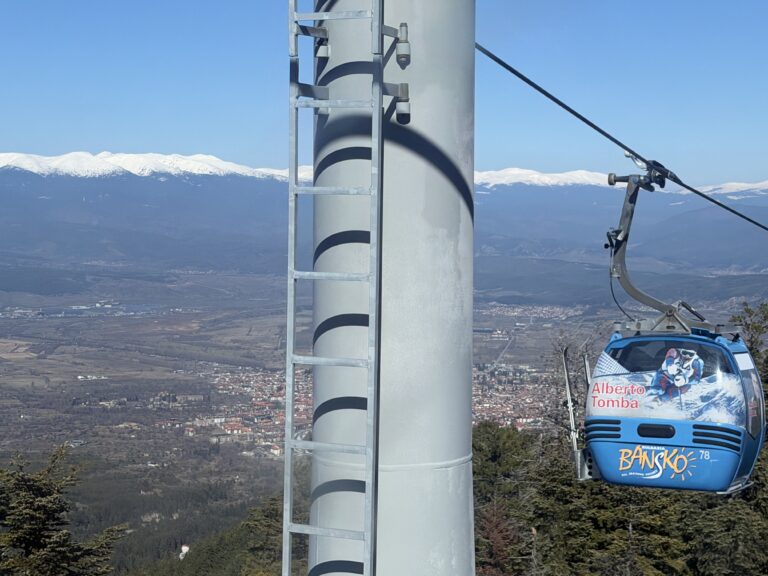
You've probably noticed that amidst the sea of blue gondolas, colorful, branded cabins with the faces of world champions periodically pass by. This is a unique tradition of ski Bansko, related to hosting the Alpine Skiing World Cup.
“Every legend who left a mark on the history of skiing and visited Bansko receives their own personalized cabin as a gesture of respect.”
Among the "owners" of VIP cabins are names such as:
- Marc Girardelli (5-time World Cup winner)
- Alberto Tomba (The Bomb)
- Lindsey Vonn and Mikaela Shiffrin
- Marcel Hirscher
- The Bulgarian ski legend Petar Popangelov
These booths are not just for decoration – they are fully functional and it's a matter of luck to get into the one your idol is in!
Where the cabins "sleep": The secrets of the garage depot
Many tourists wonder why the lift seems “empty” early in the morning or late at night. The answer is simple: the cabins do not stay on the rope at night. They are “parked” in specially built covered depots located in the stations.
Why is this important?
- Icing protection: During heavy snowfall and wind, if the cabins are on the rope, their grips may freeze, which would make launching the lift in the morning impossible or dangerous.
- Load reduction: The weight of 165 cabins (over 80 tons in total) is removed from the supporting rope, which prevents its stretching and depreciation.
- Security: In hurricane winds, the garage booths are protected from dangerous swaying and impacts with the poles.
The process is fully automated. Using a system of rails and rubber wheels, each cabin is unhooked from the main rope and stacked tightly next to the others in the garage, like a train in a depot.
Top-level security: Can the door open itself?
One of the most common fears of people with a phobia of heights is related to doors. Engineers at Doppelmayr and CWA however, they have provided mechanical protection that makes unauthorized opening physically impossible.
Omega model doors use lever mechanism, which is locked mechanically as soon as the cabin leaves the station. The system does not require electricity. Unlocking occurs only by external pressure from a special metal rail, which is installed only inside the station buildings. Even if eight people lean on the door at the same time, it will not budge.
⚠️ Safety Rules (Riding Etiquette):
- WITHOUT swinging: Sudden movement can trigger the sensors on the posts and stop the lift in an emergency.
- Smoking prohibited: Applies to cigarettes, vapes and IQOS. The space is small and enclosed.
- Ventilation: Use the small windows (vents) if it gets too warm inside.
- Protect nature: Don't throw anything out the windows – Pirin National Park is below you.
Maintenance and regeneration in 2026
Although the facility has been operating for years, cable car Bansko undergoes serious annual maintenance. Every spring and fall, a team of engineers disassembles and inspects the cabin grips with ultrasound for microcracks. The polycarbonate windows are polished or replaced, and the seats are renovated to meet the high requirements for comfort of tourists.
Are you planning a day in the mountains?
Don't waste time waiting in lines! Check our expert tips for the best boarding times and ticket prices.