



What happens when a strong mountain wind blows? Is it dangerous if the lift suddenly stops in the middle of the route? Is there a risk of lightning in the summer? In this detailed material, we will take a detailed look at the high-tech safety systems that guarantee your absolute peace of mind on the way to the summit.
The technological heart: Doppelmayr and global standards
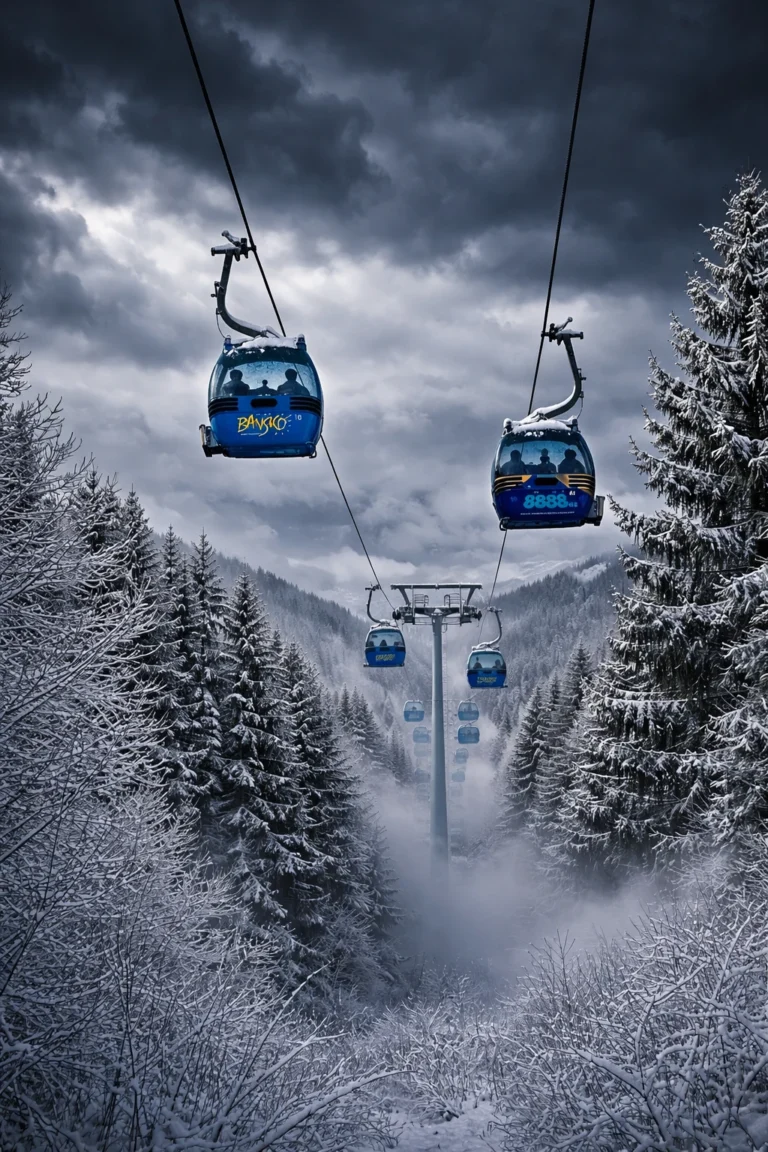
The cable car in Bansko is the work of the world leader in the production of cable cars - the Austrian company Doppelmayr. The system is designed to withstand extreme loads far exceeding standard operation. Every element – from the gripping jaws of the cabins to the steel rope – undergoes annual certification and flaw detection (X-ray inspection for microcracks).
The Invisible Guardians: The Anemometers on the Poles
Contrary to expectations, the biggest enemy of cable cars is not cold or heavy snow, but strong crosswinds. If the speed of the air masses is too high, there is a physical risk that the cars will start to swing sideways, which can lead to the rope coming off the pulleys (derailment).
To prevent this, high-tech wind sensors called wind sensors have been installed on key poles along the route. anemometers. These precision instruments continuously measure wind speed and direction, transmitting data in real time to the central computer in the engine room. The software is programmed with critical values:
- 🚩 In wind speeds above 15 m/s: The system issues a warning and automatically reduces speed.
- 🚩 For gusts above 20 m/s: The elevator stops preemptively to avoid the risk of swinging.
Why does the elevator sometimes stop or move slowly?
Tourists often get worried when the gondola suddenly slows down or stops completely in mid-air. This is not a malfunction., but proof that the safety systems are working flawlessly. When the sensors detect a sharp gust, the computer reduces the speed of the rope to reduce the amplitude of the swing. Once the dangerous gust passes, the movement is restored smoothly.
| Meteorological phenomenon | System operation | Risk level for passengers |
|---|---|---|
| Moderate wind (< 12 m/s) | Normal speed (6 m/s) | Zero |
| Strong wind (15-18 m/s) | Reduced speed | Minimal (discomfort) |
| Thunderstorm | Immediate retraction of the cabins | Controlled |
Lightning and the Faraday Cage: Summer Safety
The mountain is unpredictable and lightning is a common occurrence during the summer months. Many people wonder if they are protected in the metal box of the gondola. The answer is unequivocal: Yes. All 60 massive metal poles of the Bansko gondola lift are deeply grounded and act as huge lightning rods. Even if lightning strikes the rope directly, the electricity is instantly conducted into the ground. The gondola itself operates on the principle of The Faraday cage – the electric charge passes along the outer surface without affecting the people inside.
Backup systems: What drives the lift in the event of an accident?
The safety of the gondola lift in Bansko is ensured by triple redundancy of the drive. If the main power supply from the network is interrupted, the following systems come into operation:
- Diesel units: Powerful generators are automatically turned on to provide power to pull all the cabins to the stations.
- Hydraulic emergency motors: Even in the event of a mechanical problem in the main engine, there is a completely independent hydraulic system that can move the rope at slow speed.
Evacuation Plan: Worst Case Scenario
Despite all technical guarantees, the management of the ski area and Mountain Rescue Service (MSS) are prepared for a complete technical blockade. This scenario involves a large-scale alpine rescue operation:
Rescuers move along the steel rope itself with special roller devices. Upon reaching each cabin, they open the doors manually and lower the passengers safely to the ground, using specialized alpine harnesses (rescue diapers) and ropes. In Bansko, such an evacuation has not been necessary, but the teams conduct mandatory training before each season.
Plan your trip safely!
Awareness is the first step to peace of mind in the mountains. Check the weather conditions in real time before boarding the lift.
Frequently Asked Questions (FAQ)
1. Can the rope break?
The steel rope has a safety factor that exceeds the weight of the full cabins dozens of times. It is checked daily for structural integrity.
2. What should I do if the lift stops?
Stay calm and do not try to open the doors. Wait for instructions from the system or simply wait for the gust of wind to pass. You are in the safest place.
3. Is there a risk of suffocation in the cabin?
No, each gondola has ventilation holes at the top that provide a constant flow of fresh mountain air.
The article was prepared based on the technical safety specifications of ski Bansko and international regulations for cable cars.