

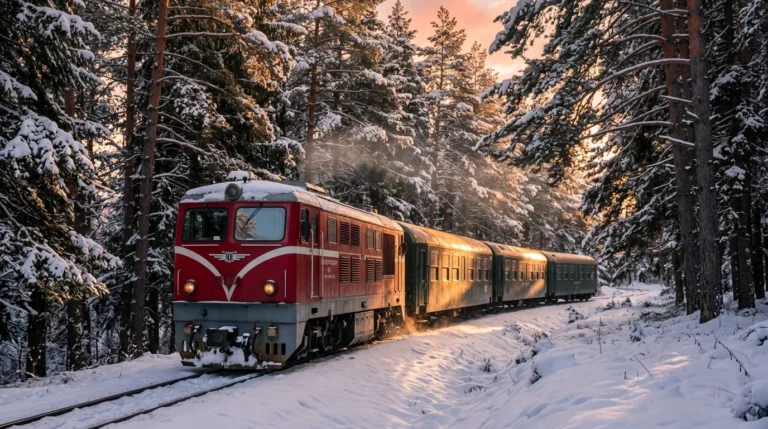
With its 35 hand-dug tunnels, three intricate spiral climbs, dozens of bridges over deep gorges and the highest station on the Balkan Peninsula, this line is an absolute triumph of engineering and human will. In this article, we will decode the technical and the engineering wonders of the narrow gauge, which make it a unique phenomenon of global significance.
A mountain range on the edge of the possible
The line has a total length of about 125 kilometers. To reach from the Upper Thracian Plain (Septemvri station) to the mountain ridges and the final stop in Bansko and Dobrinishte, the train must overcome an impressive elevation difference of over 1000 meters. This required extremely complex engineering solutions even during the design itself in the first half of the 20th century.
The maximum slope on the route reaches extreme 30‰ (30 parts per thousand). In railway parlance, this means that for every meter of length, the line rises by 30 millimeters (or 3 meters for every 100 meters of distance). For a standard adhesion railway (moving only by the traction of the wheels on the rails, without an auxiliary gear wheel) this is a huge, almost impossible challenge. To avoid slipping and the heavy diesel locomotives To be able to climb the mountain safely, engineers designed a complex system of serpentines, retaining walls, and tunnels.
35 Tunnels: The Dark Entrances to the Heart of the Mountain
Along the entire line, engineers and builders have dug a total of 35 tunnels with an impressive total length of about 2.86 kilometers. They are most concentrated in the most difficult and steep section – the one around Avramova Saddle.
The absolute leader in length is tunnel no. 32, located just below the Avramova Saddle. With its nearly 314 meters, it literally pierces the border between the Rhodope and Rila Mountains. This tunnel is a key element in overcoming the highest and most inaccessible part of the route. Its construction required extreme precision in order to meet the two galleries dug from opposite sides with millimeter accuracy – and all this was done almost entirely by hand!
The Spiral "Augers": When the Train Draws Sixes
To truly understand the engineering wonders of the narrow gauge, you should look at the spiral climbs in the area of Avramovo station. Since the slope of the terrain is too steep, the train simply cannot climb in a straight line. The engineers' solution? The train must circle around itself to gain altitude smoothly.
These complex geometric shapes are called by railroad workers „"screws"“. Seen from above, they resemble the figure six or an extended spiral. There are three such structures along the route, which are divided into two types:
- Covered spirals (covered six): The train enters a tunnel, makes a full circle underground, and emerges a little further ahead, but tens of meters higher than its entry point. The most famous example of this is the complex around tunnels No. 33 and 34.
- Open spirals: Serpentines that are visible on open terrain. Around tunnel #35 the line curves so that if you look out the window of the the wagon, you can see the lower level of the tracks you walked on just minutes ago, located directly below you.
💡 Interesting fact: Why exactly 760 mm?
The choice of a narrow gauge of exactly 760 mm is not accidental. It allows the train to take much sharper turns (with an extremely small radius). If the line were of standard national gauge (1435 mm), the construction of the spirals and curves in the narrow gorges would require the excavation of gigantic rock masses, which would be financially and technically absolutely impossible for the time you are.
Bridges over the Chepino Gorge
Early in its journey, between the Septemvri and Velingrad stops, the line enters the dramatic Chepinsko defile. Here the tracks literally fight for space with the rocks and the raging waters of the Chepinska River. A number of stone and steel bridges have been built, and in many places the route is narrowly dug into the sheer cliffs themselves.
In the higher alpine parts towards Yakoruda and Bansko, the line is held up to the slope by massive retaining walls and short viaducts. This continuous dance between the mountain and the tracks turns the journey into a visually dramatic and breathtaking experience for every tourist.
Avramovo Station: The Roof of the Balkans
The culmination of engineering excellence is reaching Avramovo station. With its 1267 meters above sea level, this is the highest railway station on the entire Balkan Peninsula. Until 1983, it bore the modest name Abram's huts, but today it is a true symbol of the line.
Avramovo Railway Station serves not only as a technical landmark marking the end of the toughest climb, but also as a perfect starting point for numerous hiking trails towards Veliytsa peak and the mystical village of Ortsevo.
⚠️ Important for photographers and travelers
The narrow gauge often passes literally centimeters from the rock massifs and stone tunnel entrances. If you are shooting from the open windows of the carriages or from the transition platforms, be extremely careful and never lean out too far. The abrupt change from open terrain to a narrow tunnel poses serious risks!
A living museum of manual labor
The greatest miracle of the Rhodope narrow gauge railway is the fact that it was built with minimal mechanization. Most of the tunnels were drilled with blasting, picks and shovels, and the excavated earth was transported with hand trucks. Every stone of the retaining walls was laid by hand by thousands of laborers, local volunteers and masters.
Today, this combination of an extreme incline of up to 30‰, 35 tunnels and spiral augers turns the train not just into a tourist attraction, but into a living museum of railway construction. A museum that you can truly experience while sitting comfortably in the carriage, listening to the rhythmic clatter of the wheels towards the top of the mountain.
🚂 Discover more about the Rhodope Narrow Gauge Railway
Interested in timetables, ticket prices, secret walking routes or stories about locals? Check out our main page with all the materials!