

But for the people who live along this line, it is something entirely different. For them, it is a literal life on rails – a daily, living thread. It is their only secure connection to the world.
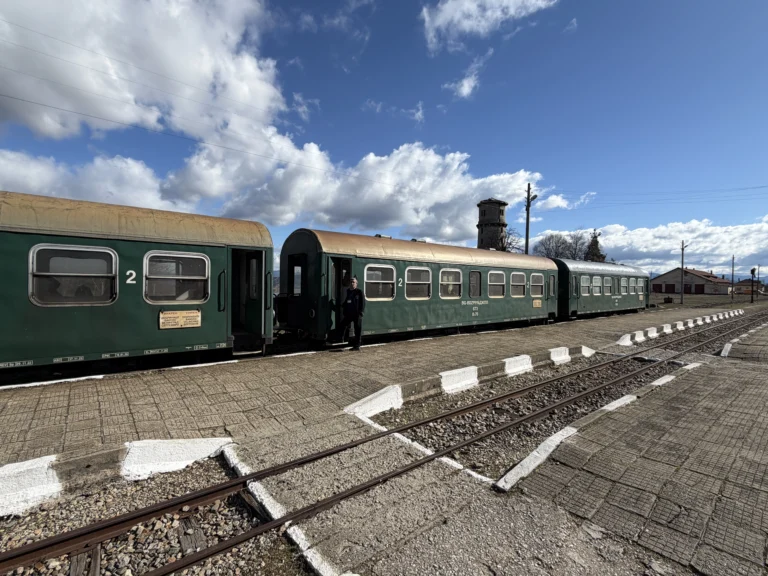
The journey along the route from the Upper Thracian Plain to the final stations Bansko and Dobrinishte is not just a route from point A to point B. It is a whole universe of human destinies, untold hopes and a silent struggle for survival high in the mountains. If you climb into the warm retro wagons In the early morning hours, even before the train has entered the deep tunnels of the Chepino Gorge, you will hear the true pulse of the region – conversations about the upcoming market, about school, about concerns about health and the harvest.
The small railway with a big history
Historically, the narrow-gauge railway was designed and built with one main purpose – to connect the harsh, inaccessible mountainous regions with the rest of Bulgaria. During the years of its construction (which began in the 1920s), the local population realized that this was their only chance to escape centuries of isolation.
People from the villages along the route volunteered. They dug the rocks by hand, carried stones, and built massive embankments just to get the train to them. Thus, the railway became part of local memory and folklore even before the first steam locomotive officially whistled.
Each small station along the route, from Sveta Petka to Avramovo, Yakoruda and Razlog, holds its own proud history – about the first students who set off for the city’s high school, about the first doctor who arrived on the tracks in a snowstorm. The railway doesn’t just cross the mountain – it crosses and changes the destinies of entire generations, for whom the city previously meant days of arduous travel by cart.
The everyday circulatory system of communities
Today, for many of the villages along the narrow gauge railway route, the train remains the only reliable, year-round public transport. Bus lines are often unprofitable, their schedules are changed or completely canceled in severe winter conditions. But the massive heart of the locomotive It continues to pound – with the familiar precise time of the morning train to the city and the evening train that takes people back home.
The school bus on rails
Imagine a group of children from a remote mountain village. Every morning they board the train. They know each other by name with the conductor, and the driver knows which stop to wait for them at if they are late in the snowdrifts. The carriage becomes a kind of mobile classroom – here homework is quickly completed, stories are exchanged, secrets are shared. For these children, the Rhodope narrow-gauge railway is not a tourist experience, but their safe school bus.
Market day on the train to Bansko and Razlog
On certain days of the week, the train changes its appearance and becomes a real „market train“. The carriages are filled with local producers carrying boxes, buckets, sacks and jars. An entire micro-economy moves along the tracks. People from small hamlets travel to the markets in Velingrad, Razlog or Bansko to sell homemade cheese, honey, potatoes or fresh eggs. At the end of the day, these same people return with bags full of provisions for the village shop and with news „from the city“.
💡 The path to health and survival
For the elderly, left in the villages without a personal car and without doctors' offices, this life on rails is literally a lifeline. It's their only way to get to a hospital, pharmacy or a specialist's office in larger cities. The carriages have witnessed quiet but important stories - about the grandmother who travels miles every month to buy life-saving medicines.
Faces of the Narrow Gauge: A Traveling Community
We can't talk about the line without paying tribute to the people who serve it. Drivers, conductors, dispatchers and stationmasters – for them this has long been not just a contract job, but a calling. When you take the train through the same 35 tunnels and high viaducts for years, you learn not only every curve of the railway, but also every wrinkle on the faces of regular passengers.
The staff knows who lives where, which student is traveling alone for the first time today, when the locals have a doctor's appointment. The train functions as a close-knit traveling community, in which carrying heavy luggage, giving up a seat, or a warm "How are you today?" are an absolutely natural part of the landscape.
Between the threat of closure and hope
Unfortunately, in recent decades, there have been many discussions about closing the narrow-gauge railway or replacing it entirely with bus transport. Dry financial statements, the need for expensive repairs and the lack of sufficient subsidies often paint a bleak picture on paper. But these bills never include the human cost.
⚠️ The threat of depopulation of the region
What does it mean to cut off the last reliable transport link for these mountain villages? It means a quick and irreversible death for them. The narrow-gauge railway is the main factor that allows people to work, get medical treatment and study without leaving their homes. Without it, migration to the big cities would be final.
This is where the power of civil society comes in. In recent years, we have witnessed powerful public initiatives led by young enthusiasts and local residents who refuse to compromise. Volunteer actions are organized to clean the stations, holiday trips are created, successful media campaigns are conducted. Their message is clear: the line is not a financial burden, but a priceless cultural and social heritage.
An invitation to a real journey
The next time you plan scheduled travel from Bansko or Dobrinishte, try to look beyond the beautiful landscape. Sit next to the old man with the wicker basket. Smile at the student with the big backpack. Listen to the conversations.
This journey may not be fast or luxurious by modern standards, but it is filled with soul. And as long as there are people buying tickets and boarding the carriages – be they locals or tourists – the narrow gauge railway will continue to be the living thread that keeps the heart of the mountain beating.
🚂 Discover more about the Rhodope Narrow Gauge Railway
Interested in secret walking routes, timetables, or engineering facts about the train? Check out our main page with all the materials!