



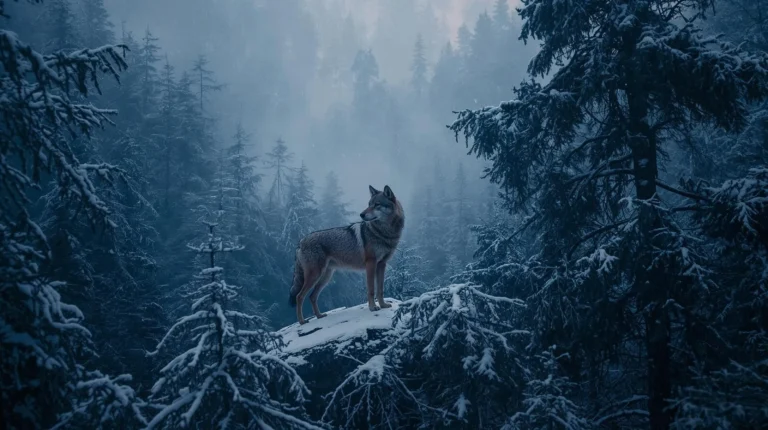
- Type: Wolf (Canis lupus)
- Status in the region: Permanent resident of Pirin National Park.
- Attitude towards man: Extremely cautious, avoids any direct contact.
- Activity: Mostly nocturnal and twilight.
Why is the wolf key to the Pirin ecosystem?
The presence of the wolf in Pirin is a clear sign of a healthy, vibrant and well-functioning ecosystem. As an apex predator, it not only survives, but also fulfills the critically important role of a natural „sanitary guard“ of the forest. Without it, the balance in the mountain would be seriously disrupted.
The diet of the Pirin wolf consists mainly of large game – wild boars, roe deer and red deer, as well as smaller mammals when the main food is scarce. Its hunting tactics are extremely selective. Wolves attack mainly weaker, older, sick or inexperienced individuals. In this way, they control the populations of herbivores, prevent excessive grazing of forest vegetation and maintain the excellent genetic health of the game in the Bansko region.
Habitats: Where do wolves hide around Bansko?
For the thousands of skiers, snowboarders and summer mountaineers who visit the Bansko ski area, the wolf remains more of a myth than a reality. These intelligent animals consciously avoid urban areas, busy trails and the noise of snowmobiles or lifts.
Their territories encompass dense, impenetrable centuries-old coniferous forests, deep river valleys (such as those of the Demyanitsa and Banderitsa rivers in their higher and wilder parts) and inaccessible rocky terrains. In winter, when the snows in Pirin become extremely deep and movement is difficult, wolves often descend to the lower parts of the mountain, following the natural migration of their prey. However, they maintain their distance from the outskirts of Bansko and the neighboring villages, except in cases of extreme hunger and exceptionally harsh conditions.
Is there any danger for tourists?
The chance for direct visual contact with a wolf on popular tourist routes – for example around Vihren hut, Demyanitsa hut or Banderishka Polyana. – is practically zero. The animal has a perfect sense of smell and hearing, thanks to which it senses human presence from miles away and always prefers to retreat unnoticed.
If by some incredible chance you spot a wolf in the distance, stay calm. Don't run, as this can trigger a predatory instinct. Just stand still, speak loudly (but don't scream in panic), and slowly back away without losing eye contact with the animal. The wolf will be much more scared of you and will run away on its own.
How do we know that a wolf was nearby?
Even if you don't see the predator itself, the mountain often keeps traces of its presence. The most common evidence that these majestic animals share Pirin with us are the fresh tracks in the snow in winter. The wolf's stride is very similar to that of a large dog, but it is more elongated, and the middle two toes are strongly extended forward. Another, far more emotional sign is the chilling, but indescribably beautiful distant howl that tourists spending the night in tents or in high-mountain huts sometimes hear on clear and cold nights.
Conservation and future of the species in Bulgaria
Although the wolf is key to nature, in Bulgaria it is still hunted under certain conditions, unlike in many Western European countries where it is strictly protected. The protection of its habitats within the Pirin National Park is of vital importance for preserving the wild and authentic spirit of the mountain above Bansko.
Understanding the habits of these predators and cultivating respect for their living space is the duty of every tourist. The next time you walk among the centuries-old walls of Pirin, remember that you are visiting a home that has its strict, ancient rules and its invisible guardians.