



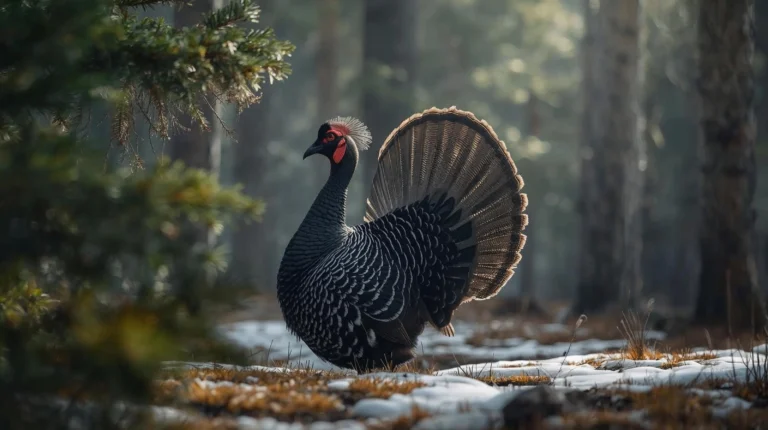
Pirin Mountain hides dozens of secrets in its bosom, but few of them are as impressive as an encounter with a true forest titan. Dandelion (Tetrao urogallus) It is not by chance that it is called the "lord of the coniferous forests". It is a symbol of wild, untouched nature and one of the rarest and most respected inhabitants of the ancient forests above Bansko. For any mountain hiking enthusiast, nature lover, or photographer, seeing this bird is an event that leaves a memory for a lifetime.
Who is the majestic capercaillie (Tetrao urogallus)?
The capercaillie is the largest member of the family Tetraonidae found in Europe. It is characterized by pronounced sexual dimorphism - males and females differ dramatically in both size and color.
The male is truly impressive. Its weight can reach 5 kilograms, and its wingspan is over a meter. Its plumage is dark, metallically shiny in blue and green on the chest. It is distinguished by a characteristic „beard“ of feathers under the beak and bright red skin areas (eyebrows) above the eyes, which swell and become even more expressive during the love period.
Females (also called damsels), on the other hand, are considerably smaller (about 2 kilograms) and have excellent camouflage plumage. Colored in complex shades of brown, rust and gray, they blend in perfectly with the forest floor, which is vital for their survival while they lay their eggs on the ground.
Where does the capercaillie live around Bansko and in Pirin?
If you walk along the popular routes around the Banderitsa, Vihren or Demyanitsa huts, you pass through the natural home of this species. Its kingdom is old, virgin coniferous and mixed forests of Pirin National Park. The capercaillie is an extremely conservative species and is strongly attached to its habitat.
Why are old-growth forests critically important to the species?
The capercaillie has very specific requirements for its habitat. It needs old trees (such as white and black pine, spruce and Scots pine) with strong and thick horizontal branches for roosting. The forest should also offer an abundance of bilberry bushes – their berries and leaves are a staple of its summer and autumn menu, and the bare branches offer protection in winter.
The Phenomenal Spectacle: The Wedding Ceremony
What makes this species a true emblem of the wild is its nuptial ritual – the current. When the thick snows in Pirin begin to melt, usually in late April and early May, one of the greatest events in the bird world begins.
In the wee hours of the night, long before dawn, the males gather in strictly defined, traditional places in the forest, called currents. There they spread their beautiful tails like huge fans, spread their wings to the ground, proudly raise their heads to the sky and begin their love "song".
The four phases of song
- Fucking: It begins with single, rhythmic sounds, "tk... tk... tk...", resembling the hitting of dry sticks.
- Trill: The pounding gradually speeds up, turning into a fast and tense trill.
- The main blow: The loudest sound in the song, which resembles a loud popping or opening of a bottle with a cork (the so-called "pop").
- Sanding: A creaking sound, resembling hair sharpening or scraping, that lasts about 3-4 seconds.
Interesting fact: Why is the bird called a “capercaillie”?
It is during the final phase of the song (the grinding) that the male falls into a state of absolute ecstasy. A specific fold of swollen tissue in the ear canal presses on the eardrum with the beak wide open and the bird literally deafens for a few seconds. It stops reacting to external noises – hence the Bulgarian name of the species.
Nutrition and lifestyle through the seasons
The life of the capercaillie is extremely harsh during the long winters in Pirin. While in spring, summer and autumn its menu is varied and includes fruits (mainly blueberries, raspberries), seeds, insects (which are critically important for the survival of the young chicks) and fresh leaves, winter requires a strict diet. In the months when the mountain above Bansko is frozen by snow, the capercaillie feeds almost exclusively on pine and spruce needles. This low-energy food requires the bird to conserve its energy as much as possible, which is why it is poorly mobile in winter.
Protection and rules for tourists in Pirin National Park
Today, the capercaillie (Tetrao urogallus) is a strictly protected species in Bulgaria and is included in the Red Book of the Republic of Bulgaria. The main threat to its existence is the destruction of ancient forests, habitat fragmentation and human disturbance. Protecting its home is not just a concern for one bird, but for the entire highland ecosystem.
Important: How to keep the capercaillie?
- Silence in the forest: Avoid making noise, especially during the breeding season (April - June).
- Do not leave the marked trails: Off-trail movement, especially by freeriders in winter and spring, causes fatal stress to birds, who waste precious energy trying to escape.
- Dogs on a lead: If you are walking with a pet within the park, it must be on a leash so as not to scare away the females nesting on the ground.
- Ethically photoshopped only: Photographing mating birds should only be done from specialized shelters and with professional guides. Any interruption of mating due to human presence can ruin the breeding season for a given population.
The capercaillie is the living link of our mountains to the ancient ice ages. Knowing that these ancient birds still roam the forests above Bansko is a privilege. Let us protect them so that their song continues to ring out the spring mornings of Pirin.