



As experienced mountaineers and local guides in Bansko, we often receive questions: “Are there dangerous snakes on the trails?” & “What should I do if I see a snake?”. The truth is that incidents are extremely rare, and snakes avoid humans. However, knowing their habits and habitats is key to your mountain safety.
What are the poisonous snakes in Pirin and how to recognize them?
There are several species of snakes in Bulgaria, but only two of them are medically significant and pose a real risk to humans. Both species inhabit the Bansko and Pirin Mountains regions.
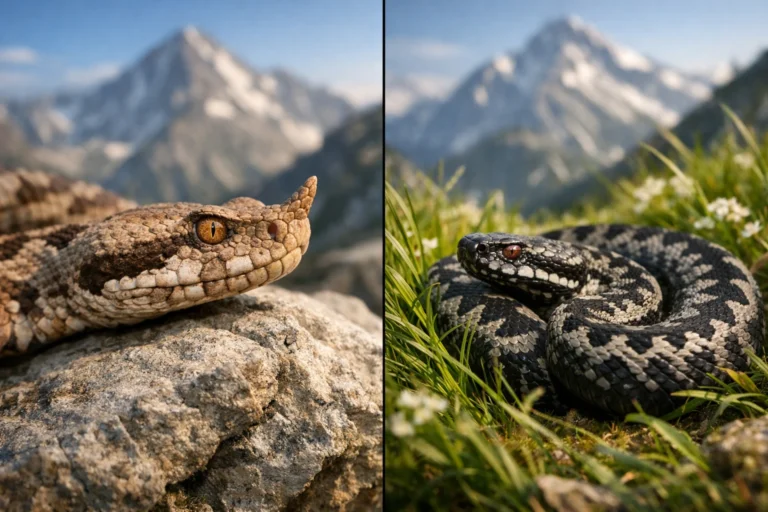
1. Vipera ammodytes – The Mistress of the Pitfalls
If you are hiking on the lower trails around Bansko in the summer, you are most likely to encounter a viper. It is heat-loving and avoids harsh alpine conditions.
- Habitat: Dry, rocky slopes, scrub, scree and open meadows at altitudes up to 1400-1500 meters. It can often be seen around the ski road above Bansko, along the trail to the Caves area or the eastern slopes of the mountain.
- Distinctive features: The surest sign is the scaly horn on the tip of the snout. It has a short, stocky body (usually 50-70 cm) and a distinct dark zigzag or diamond-shaped stripe along its back. The color varies from ashy-gray to yellowish-brown or copper.
- Behavior: The ash borer is relatively clumsy. It likes to bask in the sun on warm stones. It is very timid – sensing the vibrations from footsteps, it usually rushes to hide in cracks.
2. Common Viper (Vipera berus) – The Cold-loving Climber
When you leave the forest belt and climb to Vihren hut, Banderishki lakes or a shelter Tevno Ezero (over 1500 meters above sea level), you enter the kingdom of the viper.
- Habitat: It prefers a humid and cool mountain climate. It is found around juniper thickets, moist high mountain meadows, near mountain streams and rocky moraines.
- Distinctive features: Unlike the viper, The viper has no horns.. There is a dark zigzag line on the back. It is important to know that in the high parts of Pirin they are very often found completely black vipers (melanistic). The dark color helps them absorb the scarce solar heat at high altitude more quickly.
- Behavior: It is more active during the day compared to its counterparts in the lowlands because it relies on the sun to warm its body.
How to protect yourself from being bitten during a hike?
Prevention is the best solution. Snakes only bite in self-defense – if stepped on, squeezed, or if a person tries to grab them. Follow these golden rules when hiking:
Mountain safety tips:
- Suitable equipment: Always wear high, closed hiking boots and long pants. Never walk on mountain trails in sandals!
- Use hiking poles: They are your best friend not only for balance. Their hitting the ground creates vibrations that alert snakes to your approach.
- Watch where you step: Be especially careful when stepping over fallen trees, jumping over large rocks, or moving through tall grass.
- Caution when resting: Before you sit on a meadow or a rock, look carefully at the place.
- Respect for nature: If you see a snake, simply stop. Give it space and time to get away. Don't try to take close-up photos of it, tease it, or move it.
First aid for a snake bite: What to do?
Although the venom of Bulgarian snakes is rarely fatal to a healthy adult, the bite is medical emergency. It causes severe pain, rapidly increasing swelling, nausea, palpitations, and a drop in blood pressure.
CRITICAL: What to NEVER do!
- DO NOT suck out the poison by mouth! This is a myth from the movies. The poison can enter your bloodstream through microscopic wounds in your mouth.
- DO NOT make a tourniquet! Clamping the limb concentrates the venom in one place and can lead to necrosis (tissue death) and subsequent amputation.
- DO NOT cut the wound with a knife. and don't burn it.
- DO NOT give the victim alcohol. Alcohol dilates blood vessels and accelerates the spread of poison.
Correct steps for response:
- Stay calm: Panic increases the pulse rate, which spreads the poison through the body more quickly. Calm the victim.
- Immobilize the limb: Have the victim sit or lie down. Immobilize the bitten limb (usually a leg or arm), preferably at heart level or slightly lower.
- Remove jewelry and tight clothing: Immediately remove rings, watches, bracelets, and tight clothing around the area because swelling develops very quickly.
- Seek help immediately: Call immediately. 112. Contact the Mountain Rescue Service (MSS).
- Wash the wound: If you have clean water, you can gently rinse the bite area without rubbing.
- Transportation: The victim should not walk alone, if possible. If you are deep in the mountain, wait for rescuers according to their instructions.
Conclusion
The meeting with poisonous snakes in Pirin should not deprive you of the beauty of the mountains around Bansko. Awareness, appropriate equipment and respect for wildlife are enough to guarantee you a safe and enjoyable hike. The local hospitals in Bansko and Razlog are prepared for such situations and have the necessary anti-snake serum.