


What is a strict reserve?
Before we take a virtual walk through them, it is important to understand exactly what the status of "strict reserve" means. These are territories in which human activity is reduced to an absolute minimum. The goal is for natural processes to proceed in their natural and primary way, without any external intervention.
Here are the two priceless treasures that guard the wild heart of Pirin National Park:
1. Bayuvi Dupki – Djindzhiritsa Reserve: The Kingdom of the Centuries-Old Moors
This is not only one of the oldest reserves in Bulgaria, but also a site of global importance. It was declared back in 1934 to save the unique relict forests of black and white pine from logging. In 1977, it was included in the prestigious UNESCO program "Man and the Biosphere" as a biosphere reserve.
Flora and fauna in the heart of the mountain
The main goal of "Bayuvi Dupki - Dzhindzhiritsa" is the preservation of natural forest massifs. Here you can touch real centenarians - some of the pine trees are over 500 years old and remember times long before we set foot on these paths. In addition to the white and black pine trees, here you can find centuries-old pines, spruces and firs.
The steep marble slopes of the reserve are the favorite and safest refuge of the Balkan chamois - one of the undisputed symbols of Pirin. The extremely harsh and inaccessible karst terrain, dotted with deep ravines, rock ledges and caves, also provides shelter to brown bears, wolves, golden eagles, capercaillies and golden eagles.
Access and popular routes
Although access is strictly restricted, some of the most popular tourist routes pass along the borders or through certain areas of the reserve. The famous and extreme rock edge Koncheto Ridge passes right along its border, and the international route E4 (in its section from Yavorov hut to the main ridge) passes directly through its centuries-old forests.
2. Yulen Reserve: Glacial lakes and bear trails
Unlike its older sibling, the Yulen Reserve was declared much later – in 1994. The reason for its creation is the need to preserve unique high-mountain ecosystems, alpine meadows, juniper formations and water bodies without any human intervention.
The water wealth of Pirin
Located in the heart of the mountain, above the town of Bansko and the town of Dobrinishte, Yulen offers a completely different, but equally breathtaking landscape. This reserve is a true home of waters. Within its borders fall some of the most beautiful lake groups in Pirin – the Vasilashki, Tipitski, Disilishki and Polezhanski lakes. These crystal clear glacial eyes feed the rivers that descend to the valleys and give life to the entire region.
Biodiversity and Alpine atmosphere
Valuable plant species are preserved here, including many endemics (plants that are found only in this part of the world). In addition to herds of wild goats, traces of a brown bear can often be found in the lower and forested parts of the Yulen reserve. The reserve preserves the classic alpine appearance of Pirin - with impressive stone rivers (moraines), deep cirques and a feeling of absolute freedom.
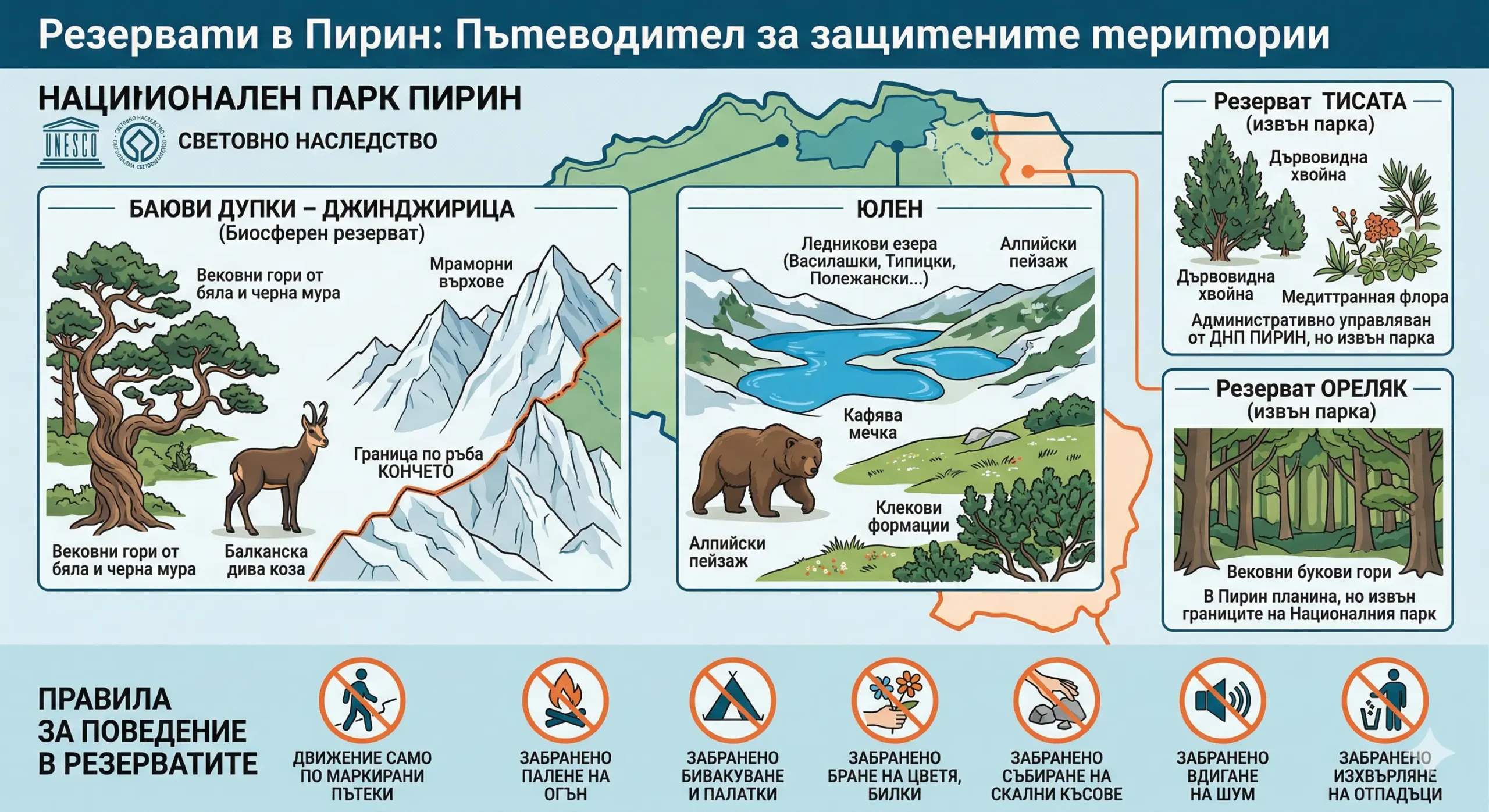
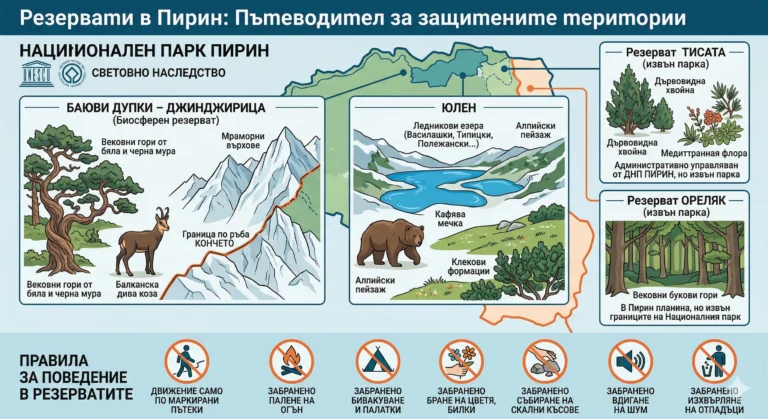
Visual infographics for the two strict reserves in Pirin National Park – „Bayuvi Dupki – Dzhindzhiritsa“ (1934, centuries-old groves, chamois) and „Yulen“ (1994, glacial lakes, bears), with illustrations of flora, fauna and basic prohibitions for visitors.
How many reserves are there? The difference between Tisza and Oryol
Very often, tourists and nature lovers get confused, reading in various sources that there are three or even four reserves. To be absolutely factually precise, it is important to distinguish between the geographical territory of the mountain, the borders of the National Park and the administrative management.
As we have already specified, within the borders of Pirin National Park there are exactly two reserves (Bayuvi Dupki and Yulen Reserve). But here's where the catch lies with the rest:
Tisata Reserve: The Guardian of the Juniper
The Tisata Reserve is located at the foot of Pirin and the Malashevska Mountains, around the picturesque Kresna Gorge. Physically and geographically it does not fall within the borders of Pirin National Park. However, the reason it is often included in the Pirin reserves is that it is managed, managed and administratively protected by the Pirin National Park Directorate, whose headquarters are in Bansko.
The main mission of "Tisata" is to preserve the largest juniper tree deposit in Bulgaria, as well as unique Mediterranean biodiversity, including a number of rare birds and reptiles.
"Orelyak" Reserve: The Beech Forests of Middle Pirin
To this natural puzzle we add the reserve "Orelyak". Geographically it is located entirely in the Pirin Mountains (in its part Sreden Pirin), covering the area around the eponymous peak Orelyak. However, the national park covers mainly the alpine Northern Pirin. For this reason, "Orelyak" is a reserve in Pirin Mountain, but is located outside the National Park boundaries. Its goal is to preserve the centuries-old, primary beech forests in this part of the mountain.
Rules of conduct in reserves
Whether you are in Bayuvi Dupki – Dzhindzhiritsa, Yulen or Tisata, visiting a reserve requires a high level of culture and responsibility. When we pass through these territories, we are only temporary guests.
* Deviating from officially marked hiking trails (this protects both you and the fragile flora).
* Lighting a fire and camping with tents outside of the explicitly designated areas.
* Making noise, playing music, or shouting, which stresses wild animals.
* Disposing of any waste (even biodegradable).
* Picking flowers, herbs, mushrooms and collecting rock fragments.
Knowledge of the reserves in Pirin helps us understand the true value of the mountain. It is not just a decoration for our winter or summer vacations, but a complex, living organism that needs our respect to continue to exist in its wildest and most beautiful form.