



History: One of the oldest protected areas in Bulgaria
The history of the reserve begins long before ecology became a modern topic. Back in 1934, realizing the exceptional value of the centuries-old forests of white and black pine, the state declared the “Bayuvi Dupki” area a strict reserve. The goal was clear – to stop poaching and the destruction of these relict tree species.
In 1976, the territory was significantly expanded, with the addition of the “Djindzhiritsa” area, and the total area reached over 2,873 hectares. True global recognition came in 1977, when the Bayuvi Dupki – Djindzhiritsa reserve was included in the prestigious UNESCO program „Man and the Biosphere“ (MAB – Man and the Biosphere Programme), becoming a biosphere reserve of global importance.
Geography and harsh karst relief
The reserve covers an extremely dramatic and rugged part of the Northern Pirin Mountains. It is located at an altitude ranging from 1200 meters in the lower forest belts to an impressive 2884 meters at the highest peaks.
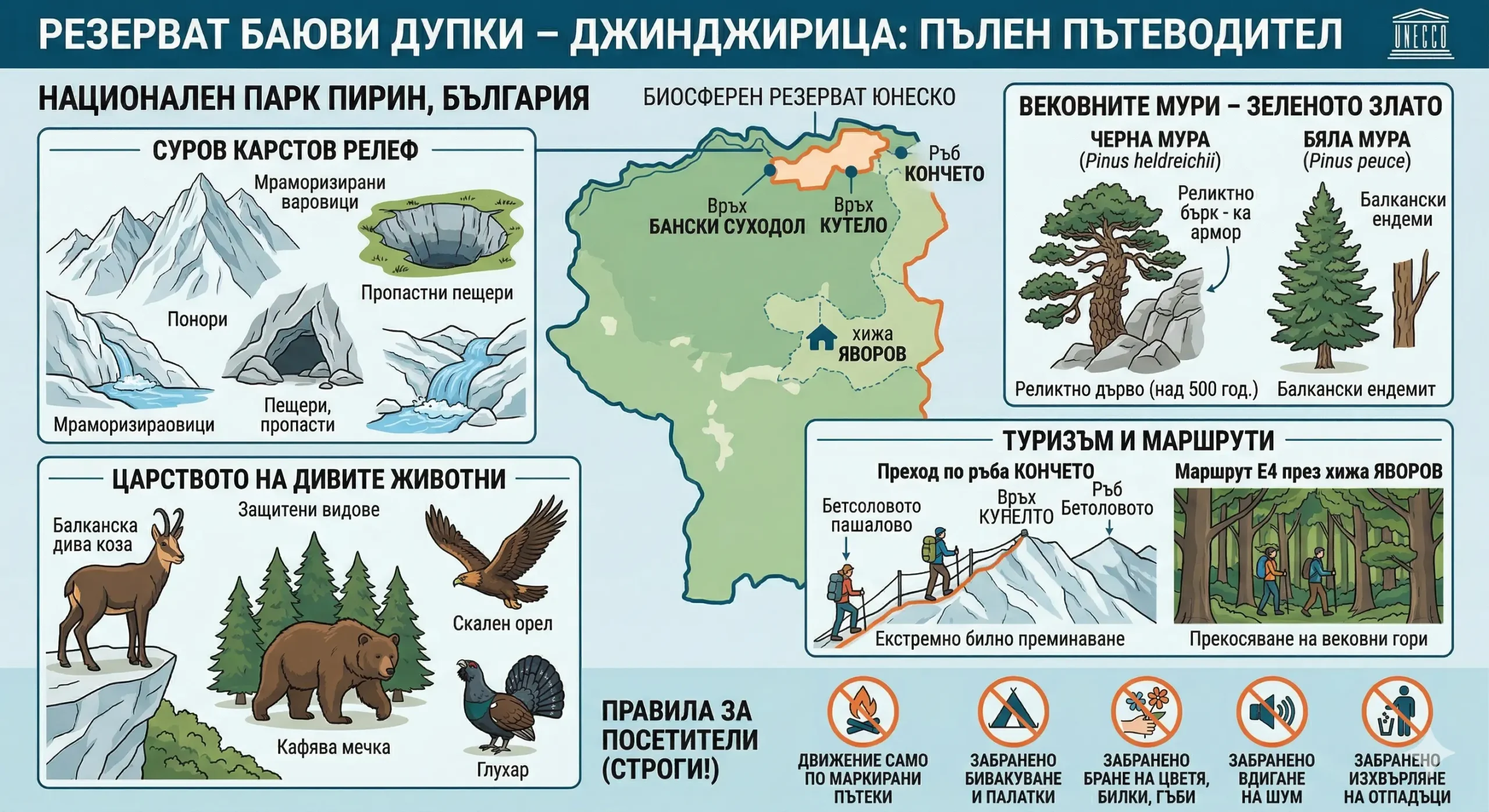
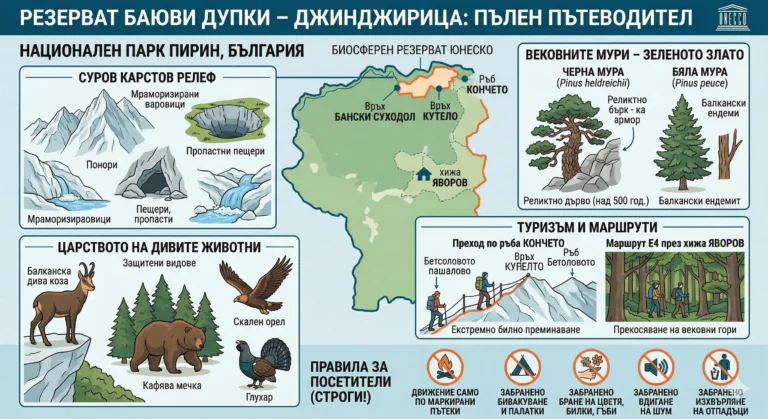
Detailed infographic for the strict reserve "Bayuvi Dupki - Dzhindzhiritsa" (2873 ha, 1934, UNESCO MAB), with a map of Northern Pirin, flora (white/black fir, pine), fauna (chamois, bear, eagle) and tourism bans.
Did you know? The relief here is entirely karst, built of Proterozoic marbles. This means that the water literally “disappears” into the rocks, forming deep chasms, sinkholes and caves. Here are some of the deepest abyssal caves in Bulgaria, which are the subject of research by professional speleologists and are absolutely inaccessible to ordinary tourists.
The borders of the reserve include parts of the circuses Bayuvi Dupki, Razlogski Suhodol, Kamenititsa, as well as the formidable peaks of Pirin, Duninoto Kuche, Banski Suhodol and part of the marble edge of Kutelo.
The Green Gold of Pirin: The Ancient Walls
What makes the reserve truly exist are its forests. Here are preserved some of the most extensive, old and intact massifs of white and black pine on the Balkan Peninsula.
White pine (Pinus peuce)
The white fir is a Balkan endemic – a tree that occurs naturally only on our peninsula and nowhere else in the world. It is distinguished by its smooth, gray-green bark when young and a beautiful pyramidal crown. There are specimens in the reserve whose age exceeds 500 years.
Black pine (Pinus heldreichii)
The black fir, also known as the black Bosnian fir, is a true survivalist. It grows on the harshest, rocky and waterless marble terraces, where no other tree could take root. Its bark is cracked into characteristic pentagonal “plates”, resembling armor. The most famous tree of this species in Pirin is the Baykush fir (which is outside the boundaries of this reserve), but in Djindjiritsa itself there are trees of almost the same impressive size and age.
Fauna: Who inhabits the marble slopes?
The lack of human activity turns the Bayuvi Dupki - Dzhindzhiritsa reserve into a true refuge for the wild animals of Europe.
- Balkan chamois (Rupicapra rupicapra balcanica): The absolute master of the rocks. These graceful animals move with incredible ease along the almost sheer marble walls below Banski Suhodol Peak and the edge of the Koncheto Ridge. They can often be observed by tourists passing along the ridge.
- Large predators: In the dense centuries-old forests at lower altitudes, brown bears hide bears and wolves. They avoid marked trails, so encounters with them are extremely rare, but their tracks are common.
- Birds: The reserve is an ornithological treasure trove. The golden eagle, the peregrine falcon, the three-toed woodpecker, and the extremely rare capercaillie nest here, whose nuptial rituals (tokuvanje) take place in the deepest and most hidden parts of the forest in spring.
Tourism: How to get to the reserve?
Since the status is a “strict reserve”, human access is extremely limited. Walking “indiscriminately” through the forest is completely prohibited. However, there are two main, legal ways to enjoy this territory, following the official tourist routes.
1. Along the international route E4 (via Yavorov hut)
This is the classic way to enter the heart of the reserve. The trail starts from the Betolovoto area (above Razlog), passes through the Yavorov hut (the best starting point) and begins a steep climb to the Suhodolski pass. Moving along this red-marked route, you cross the centuries-old pine forests of Djindjiritsa. The feeling is magical - the silence of the old forest, the aroma of resin and the giant tree trunks create a unique atmosphere.
2. On the Edge of the Horse
For more extreme mountaineers, crossing the main Pirin ridge is the ultimate experience. The route from Kutelo Peak, through the famous Koncheto cliff edge and to Banski Suhodol Peak, runs literally along the border of the reserve. Looking northeast (towards the Banski Suhodol circus), you look straight into the inaccessible depths of Bayuvi Dupki – a territory reserved only for eagles and wild goats.
Within the boundaries of the Bayuvi Dupki – Dzhindzhiritsa reserve, the strictest possible restrictions in Bulgarian legislation apply:
1. NO deviation from the officially marked tourist trails!
2. It is prohibited to pick mushrooms, berries, herbs and even wild flowers.
3. Lighting a fire and bivouacing (pitching tents) is absolutely illegal outside the territory of Yavorov hut and Koncheto shelter.
4. Making noise (shouting, music) is prohibited as it stresses wild animals, especially during their breeding season.
Violators are subject to serious financial sanctions from the park guards.
Why is it so important to preserve it?
Bayuvi Dupki – Dzhindzhiritsa Reserve is much more than a beautiful landscape. It is a global “gene bank” and a kind of open-air laboratory. Since human intervention is excluded here, scientists can observe how ecosystems cope with climate change, how forests recover naturally, and how species evolve.
As tourists, we have the privilege of peeking into this primal world. Our only task is to pass through it quietly, respectfully, and without leaving any trace behind. Only in this way will we be sure that the centuries-old walls will continue to protect the marble peaks of Pirin for generations to come.