


History and mission of the Yulen Reserve
Unlike its older sibling (declared in 1934), the Yulen Reserve was created much later – on August 26, 1994. Its area covers an impressive 3,156 hectares (over 31 sq km), located at an altitude of between 1,600 and 2,851 meters above sea level.
The main goal of its creation is conservation: to preserve from human intervention the unique high-mountain ecosystems, relict plant species, vast juniper formations and incredible glacial lakes. The territory of the reserve falls entirely within the granite part of the mountain, which determines its specific, alpine relief, dotted with deep cirques, rock sills and moraines (stone rivers).
Water wealth: The Lakes of Yulen
What attracts the attention of tourists and photographers from all over the world are the numerous glacial lakes scattered throughout the reserve. These crystal clear water bodies are a remnant of the last ice age and today feed some of the largest rivers in the region, including the Demyanitsa River.
Several exceptionally beautiful lake groups fall within the boundaries of the reserve:
- Vasilash Lakes: A group of over 10 lakes, located in a terraced manner in the picturesque Vasilaski Circus. The Upper and Lower Vasilaski Lakes are among the largest and most beautiful in the entire Pirin.
- Tipitskie Lakes: Hidden deep beneath the Tipitz peaks, they are difficult to access and offer views of absolute wild isolation.
- Strashki (Strazchik) lakes: Small but extremely charming water mirrors, nestled under the rugged Strazhite peak.
- Polezhanski and Disilishki lakes: Located in the eastern part of the reserve, they reflect the proud profile of Polezhan Peak.
Flora: The Kingdom of the Squat and the Alpine Rose
The plant world in the Yulen Reserve is adapted to the extreme conditions of the high mountain – strong winds, thick snow for most of the year, and a short, cool summer.
The most characteristic species here is mugo pine (Pinus mugo). The reserve is home to some of the most extensive, old and impenetrable juniper forests in the Balkans. These low, flexible, shrubby pines play a critical role in snow retention, avalanche prevention and water runoff regulation.
During the short summer months, the alpine meadows of Yulen turn into a colorful carpet. Here you can see rare and protected species such as the mountain peony (Vitosha tulip), golden marigold, narcissus-like anemone and the exquisite alpine rose.
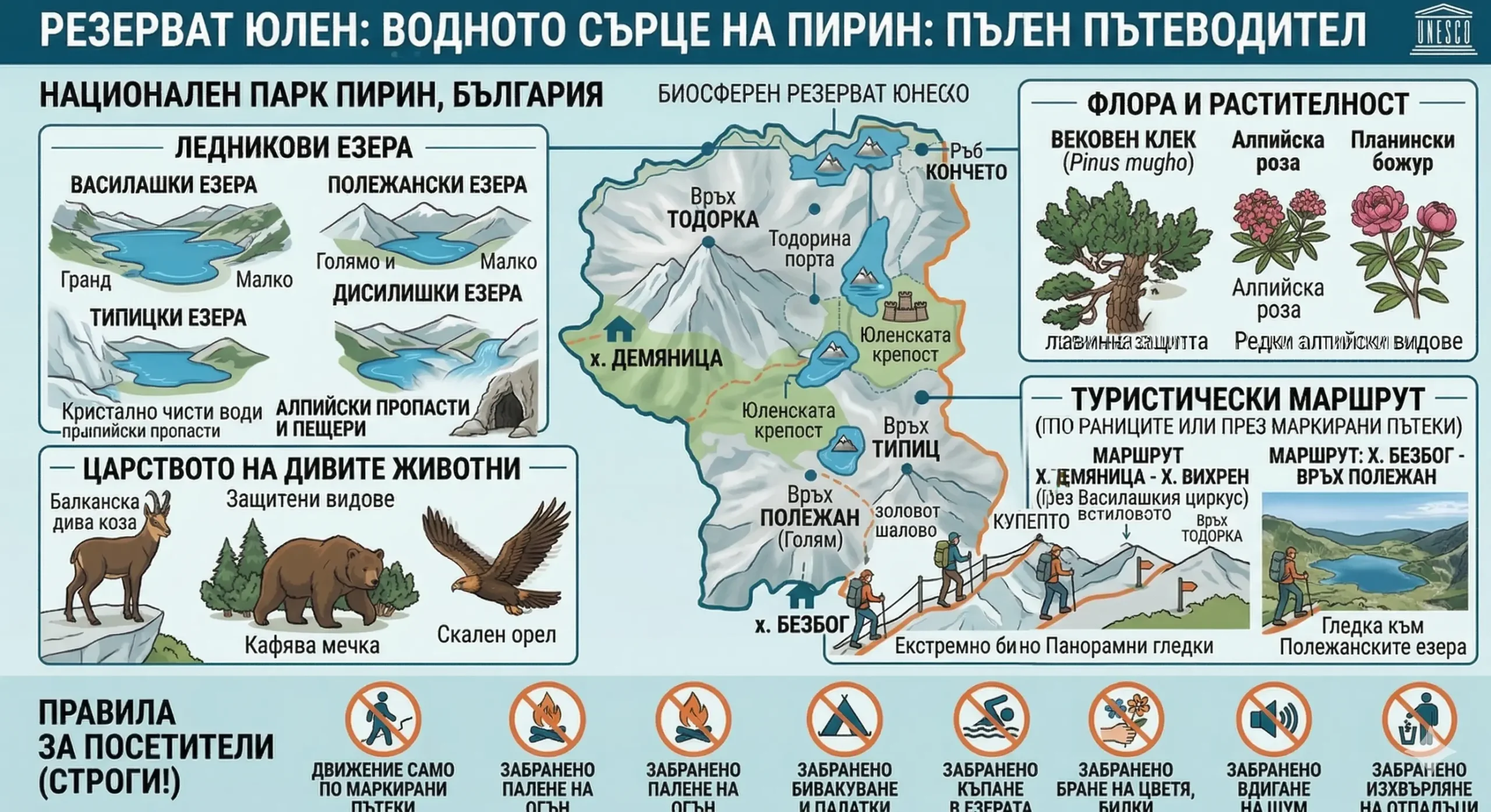
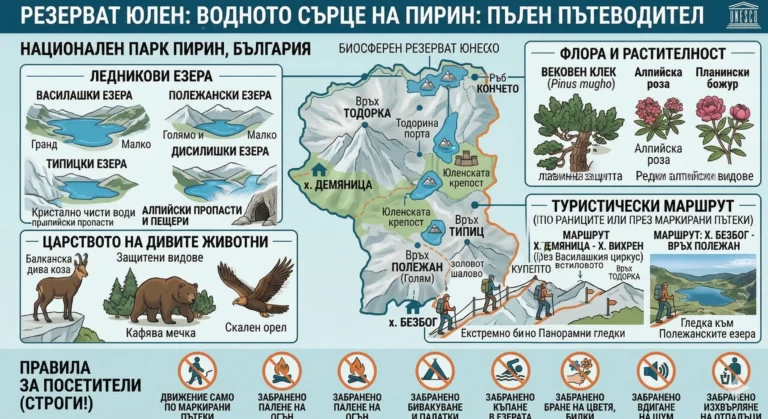
Infographics for the Yulen Reserve (3156 ha, 1994) – a high-mountainous area with lakes (Vasilashki, Tipitski, Polezhanski), juniper massifs, alpine flora and fauna, plus bans on fire, tents, and deviation from trails.
Fauna: Who's hiding in circuses?
The dense undergrowth and the distance from settlements make “Yulen” a safe home for typical alpine animals. The population of Balkan chamois is stable here, and in the lower forested parts of the Demyanitsa River valley there are traces of brown bear, wolf and fox.
Ornithologists also have something to see - the reserve is a hunting territory for the golden eagle, and ravens and various types of falcons nest in the rock crevices.
Tourist routes: How to see the Yulen Reserve?
Since it is a strictly protected area, “free” wandering around it is absolutely prohibited. However, you can enjoy the beauty of the reserve by following the official marked hiking trails that cross it or pass along its borders.
1. The route through Demyanitsa hut
Demyanitsa Hut (located above Bansko) is one of the best starting points. The route from the hut to the Vihren hut (via the Vasilash circus and Todora's gate) passes directly through the territory of the reserve. The path winds along the Vasilash lakes and offers phenomenal panoramas. It is mandatory not to deviate from the road markings!
2. From Bezbog hut to Polezhan peak
For guests of Dobrinishte, the climb from Bezbog hut to the fourth highest peak in Pirin – Polezhan (2851 m) is a classic. From the top, a breathtaking view opens up of the Polezhan Lakes and the eastern borders of the Yulen reserve.
Since the Yulen Reserve preserves extremely fragile alpine ecosystems, compliance with the rules is mandatory:
* Swimming in the lakes is prohibited! This disrupts their delicate chemical and biological balance.
* Movement is allowed ONLY on officially marked tourist trails.
* Camping (pitching tents) outside of designated areas around the huts is prohibited.
* Lighting fires, picking flowers (even as a souvenir), and throwing garbage are subject to serious fines.
* Don't make noise - you are guests in the home of wild animals.
A treasure for the future
Yulen Reserve is the living, breathing archive of the Pirin Mountains. It shows us what nature looked like long before man began to change it. As tourists in the Bansko region, our greatest responsibility is to preserve this alpine treasure, so that our children can also see the crystal waters of the Vasilashki Lakes and smell the aroma of the centuries-old squat oak.