


History and significance of the reserve
The Oreljak Reserve was declared on February 22, 1985 with one main, very clear mission: to preserve the primary, centuries-old beech forests in this part of the mountain, as well as the enormous wealth of rare plant and animal species. Its area amounts to just over 758 hectares.
This reserve is of exceptional importance because it represents a kind of buffer and transition zone between the harsh Alpine climate to the north and the milder Mediterranean influence that enters from the south along the Mesta River valley. This unique symbiosis creates conditions for the development of specific flora and fauna that can hardly be seen elsewhere.
Geography and relief: In the skirts of the prince
The reserve covers the northwestern, northern and eastern slopes of the peak of the Middle Pirin - Oreljak peak (2099 m). The relief here is highly rugged, with deep ravines, steep slopes and impressive marble rock crowns in its highest parts.
The elevation of the protected area ranges from about 900 meters in its lowest forest belts to the very peak. It is this elevation difference that is responsible for the impressive biodiversity and the presence of several different vegetation belts.
Flora: The Kingdom of Beech and Pirin Tea
If mulberries and junipers reign in the Northern Pirin, then the emblem of the "Orelyak" reserve is common beech (Fagus sylvatica). These forests occupy over 70% of the reserve's area. The trees here are true giants – their average age exceeds 150 years, with specimens over 200 years old not uncommon.
Descending further into the reserve, the beeches give way to mixed forests of black pine, water hornbeam and hornbeam. But the real treasure of Oreljak lies in the high alpine meadows above the forest belt.
Fauna: Who inhabits the Middle Pirin?
The dense and inaccessible beech forests provide perfect shelter and abundant food for many wild animals. The Oreljak Reserve has a stable population of brown bear, wolf, wild boar, roe deer and red deer.
The area is extremely rich in birds and amphibians. In the old, hollow beech trees, various species of woodpeckers, owls and woodpeckers nest. In the damp ravines, you can often spot the salamander (Salamandra salamandra) with its characteristic yellow-black coloration, as well as a number of rare species of frogs.
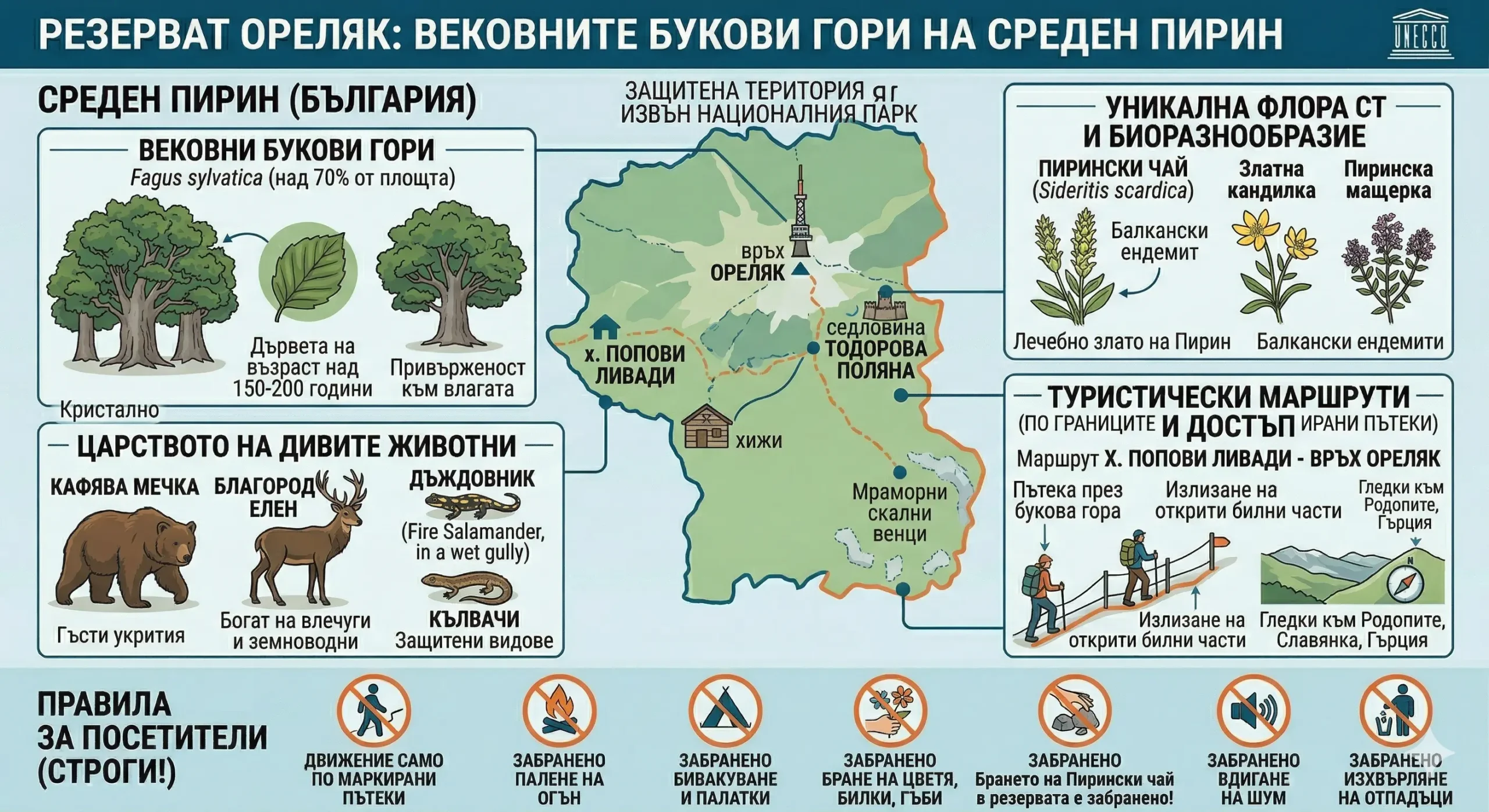
Infographics for the Orelyak Reserve (758 ha, 1985) - elite beech forests, endemics (bramble), fauna and access from the Popovi Livadi hut to Orelyak Peak (2099 m).
Tourist routes: How to see Oryol?
Access to Middle Pirin is most convenient from the area of the town of Gotse Delchev. The starting point for almost all routes in the region is the famous area and lodge Popovi vadi (Papaz chair), which is reached by an asphalt road.
Climbing Mount Oreljak
This is the most popular route that allows you to touch the borders of the reserve. The trail starts from the Popovi Livadi hut and climbs smoothly through beautiful beech forests before emerging on the open ridges. The hike to the top takes about 2-3 hours one way. The Orelyak peak itself is easily recognizable because of the tall television tower erected on it. The view from the top is phenomenal – on clear days you can see the Greek mountains, the Rhodopes, Slavyanka, Belasitsa and the alpine North of Pirin.
As with all strict reserves in Bulgaria, human activity is prohibited here. We remind tourists:
* Picking Pirin tea within the reserve is ABSOLUTELY FORBIDDEN. and is punished with stiff fines.
* Movement is only possible on marked paths.
* Bivouac, lighting fires, and picking mushrooms and berries are not allowed.
* Do not make noise so as not to disturb the bears and deer in the forest.
The hidden gem of the Southwest
The Oreljak Reserve is proof that Pirin is a mountain of contrasts. If you ever get tired of the rocky edges and the crowds of tourists along the Koncheto Ridge or Vihren, treat yourself to a weekend in Middle Pirin. The centuries-old beech forests, the silence of Popovi Livadi and the endless panoramas from Mount Orelyak will show you a softer, but no less majestic side of wild nature.