


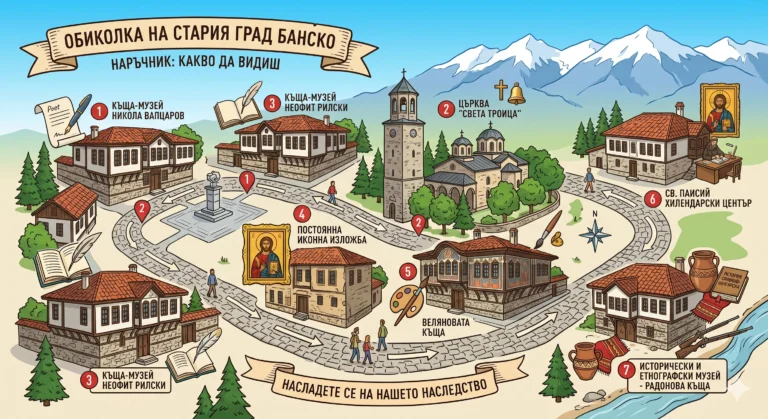
This detailed guide is designed to take you step by step through Bansko's most significant landmarks and architectural monuments. We have prepared a logical and convenient itinerary that covers all the most important things so that you don't miss any of the cultural gems of the region.
Why is the Old Town of Bansko an architectural phenomenon?
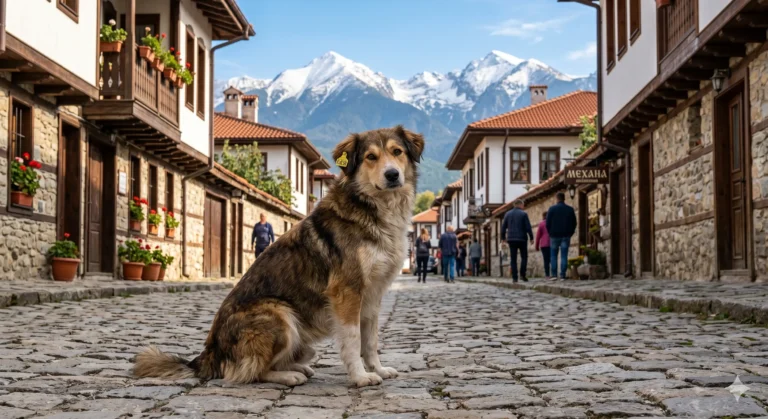
Before we begin our walk, it is important to understand what makes the architecture here so special. Unlike the houses in Koprivshtitsa or Plovdiv, the traditional 18th and 19th century Banska kashta looks more like a small fortress. Times were uncertain, and local merchants were extremely wealthy, traveling to Vienna, Budapest and Venice. To protect their families and their wealth, they built homes with stone walls up to one meter thick, small windows on the ground floors, secret rooms and loopholes.
At the same time, behind these harsh facades lie spacious verandas, richly carved ceilings and beautiful frescoes, which testify to the refined taste and cultural growth of the local people. Every step on the cobblestones is an encounter with this unique combination of harsh protection and homely warmth.
💡 Useful information before the start of the tour
- Duration: About 2.5 – 3.5 hours if you take your time exploring and taking pictures.
- Combined ticket: At the first museum you visit (we recommend Vaptsarov's), ask about general combined ticket. It is much more affordable and provides access to all municipal attractions in Bansko.
- Working hours: Most locations are open from 09:00 to 12:00 and from 13:00 to 17:00. They are often closed on Sunday afternoons and Mondays, so check the current schedule in advance.
Complete Walking Tour: Bansko Sights Step by Step
Stop 1: Nikola Vaptsarov House Museum„
Location: Central Square (3 Nikola Vaptsarov Square)
Located in the very center of the town, this property is the perfect starting point for your tour of the Old Town of Bansko. This is the birthplace of one of the greatest and most translated Bulgarian poets – Nikola Vaptsarov. The house was converted into a museum in 1952, but today it has modern equipment and multimedia presentations.
The exhibition traces the poet's life from his childhood in Bansko, through his studies at the Naval School in Varna, to his tragic execution in Sofia. The setting is completely authentic, restored according to the memories of his mother - grandmother Elena Vaptsarova. The story of the local guides is extremely emotional and moving, which makes the visit unforgettable.
Stop 2: The symbol of Bansko – the Holy Trinity Church„
Location: 2-3 minutes walk from Vaptsarov Square (Vazrazhdane Street)
This is the undisputed symbol of Bansko and the heart of the spiritual life in the city. Before the construction of the St. Alexander Nevsky Church-Monument in the capital, this was the largest church in Bulgaria. The story of its construction (completed in 1835) is worthy of a movie - the locals, led by Lazar German, used diplomacy, cunning and huge donations to obtain permission from the Ottoman authorities for the construction of such a large-scale Christian church.
In the courtyard you will immediately be struck by the impressive 30-meter stone bell tower. The clock on it is the work of the self-taught Bansko master Todor Hadzhiradonov and works flawlessly to this day. Inside, see the unique iconostases and wood carvings, the work of masters from the Debar and Bansko art schools. The feeling under the centuries-old pine trees in the courtyard of the temple is truly magical.
Stop 3: House-Museum "Neofit Rilski" (Beni's House)
Location: Right next to the entrance to the courtyard of the Holy Trinity Church„
Right next to the church is the birthplace of Nikola Poppetrov Benin, who went down in history as Neofit Rilski – the patriarch of the new Bulgarian education and author of the first Bulgarian grammar. This house is one of the best examples of classical Bansko fortified architecture from the 18th century.
The building itself resembles a small fortress. It has a hiding place (cache) where the family could hide in case of attack. The hiding place has thick stone walls, metal doors and small loopholes. At the same time, the residential part offers spacious wooden verandas and a beautiful courtyard with the geraniums and cobblestones typical of the region. Here you will feel the spirit of the Bulgarian Renaissance enlightenment and the pursuit of knowledge.
Stop 4: Permanent Icon Exhibition and the Bansko School
Location: In the building of the old Hilendar monastery, next to the Holy Trinity Church„
Did you know that Bansko has its own, very characteristic Renaissance art school? It is called the Bansko Icon Painting School, and its founder is Toma Vishanov - Molera, who studied fine arts in Vienna. The exhibition is located in the oldest preserved building in the town - the former Hilendar monastery (from 1749).
Here you will see magnificent icons that are radically different from the traditional, strict Byzantine canons. The works of the Bansko icon painters overflow with bright colors, vitality, everyday details and realism. Their characters have rosy cheeks and wear clothes decorated with floral motifs, which shows the influence of the Western European Renaissance.
Stop 5: Velyanova House – a masterpiece of art
Location: About 5 minutes walk along the cobblestones (5 Velyan Ognev Street)
Continuing into the Old Town of Bansko, we reach the Velyanov House. This is an absolute masterpiece among the local landmarks. The house was given to Master Usta Velyan Ognev (representative of the Debar School) as a token of gratitude by the local people for his unpaid work on the decoration of the Holy Trinity Church.
Master Velyan transformed this home into a real palace. He painted the rooms inside and out with incredible frescoes – unknown to the time The interior is decorated with landscapes from Venice and Istanbul, wolves, floral motifs and geometric shapes. The Blue Room (the guest room) is stunningly beautiful with its detailed carvings. The house also has a very cleverly designed hideaway connected to two of the rooms, which is open to the public.
Stop 6: Spiritual and Historical Center "St. Paisius of Hilendar"„
Location: Near Velyanovata House (21 Otets Paisii Street)
This modern center is built exactly on the site of the birthplace of Paisii Hilendarski, the author of "Slavonic-Bulgarian History." Although the building is new, it carries a huge spiritual charge and is an extremely interactive landmark.
The most impressive experience here is a visit to the exact copy of the monastic cell in the Hilendar Monastery on Mount Athos, where Paisios wrote his great work. The setting has been recreated down to the smallest detail. In the basement there is also a reconstruction of the chapel "St. Ivan Rilski", in which the monk prayed during his stay on Athos.
Stop 7: Radonova House (Historical and Ethnographic Museum)
Location: By the Glazne River (3 Aton Street)
The Radon House is the perfect end to your tour. It is located near the Glazne River and is itself a wonderful cultural monument from the early 19th century. Today it houses a rich exhibition that brings together the entire history, archaeology and lifestyle of the region.
The exhibition traces the development of the region from antiquity (Thracian and Roman artifacts) to the beginning of the 20th century and the liberation of the city from Ottoman rule. Here you will get acquainted with local crafts, see authentic traditional Bansko costumes, old weapons and tools that tell the story of the hardworking Bansko people.
⚠️ Important tips for your walk
The old town of Bansko has retained its authentic appearance, which means that the streets are covered with original, uneven cobblestones. Be sure to wear comfortable, flat shoes (sneakers or hiking boots)! High heels are not just uncomfortable here, they are dangerous. Also, during the summer months, bring a hat and water as the sun in the mountains can be strong.
Where to eat after the cultural tour?
After you have immersed yourself in the rich history of the city and have traveled the route through all the sights, it is time to enjoy the culinary wealth of the region. The cuisine of Bansko is as unique as its architecture. The best way to assimilate the impressions is to visit a traditional Bansko tavern, located in one of the old Renaissance houses.
If you are with a company, be sure to order bathhouse – a dish of several types of meat, sauerkraut and rice, which is baked for hours in a clay pot. Other local specialties that you should not miss are chokmalek, old man in a bathing suit (traditional dry sausage) and perch (beans). Combine them with a glass of strong red mulled wine and live music from the nearby Melnik region and enjoy the hospitality of the locals.