


The Roots of the Rebellion: How an Ilinden Uprising is Prepared in Bansko
At the end of the 19th and the very beginning of the 20th century, Bansko was the absolute economic engine of the Razlog Valley. Local merchants were educated, enterprising and traveled freely to major European centers such as Vienna, Budapest, Leipzig and Venice. They traded in cotton, leather, tobacco and artisanal goods.
But instead of being satisfied with their accumulated wealth, hiding behind the thick stone walls of their fortified Renaissance houses and living in peace, the people of Banska Bystrica chose the infinitely more difficult and dangerous path – that of national liberation. The love for the homeland turned out to be stronger than the desire for personal comfort.
From rich merchants to armed committees
Years before the official outbreak of the uprising, an extremely strong and well-functioning iron network of the Internal Macedonian-Adriatic Revolutionary Organization (IMRO) was built here. Part of the hard-earned gold coins did not go to luxury and the expansion of trading offices. They were secretly converted into gunpowder, lead and modern Mannlicher rifles, which were smuggled across the border.
Krastovden: Why did the uprising in Pirin break out later?
An extremely important historical fact that makes the history of Bansko unique is the timing of the uprising. While in Bitola the uprising broke out on the very holiday of Ilinden (July 20, old style, early August, new style), and in Edirne – on the Transfiguration, the Serres Revolutionary District received a completely different strategic order. The district in which Bansko falls was to rise later.
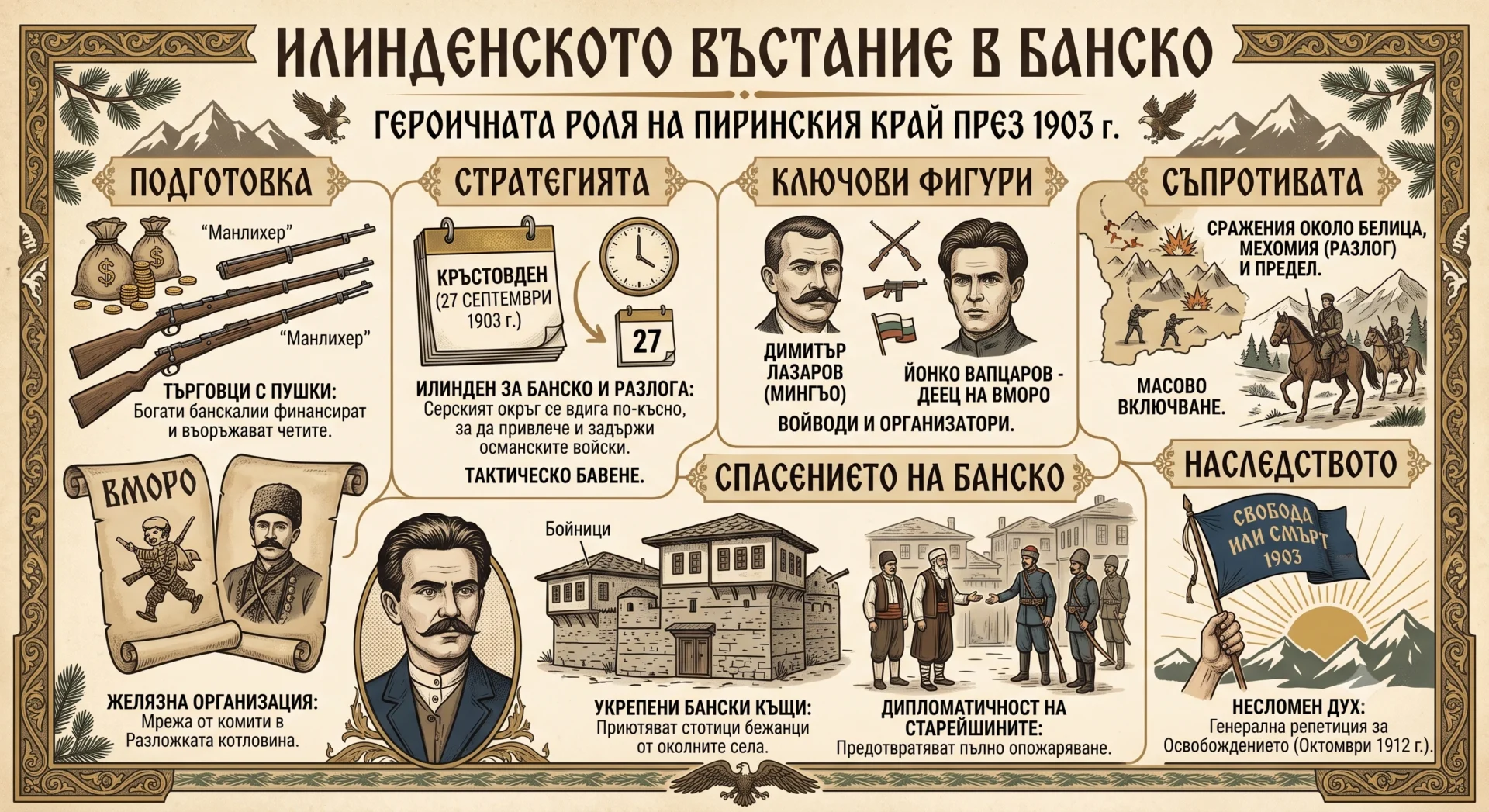
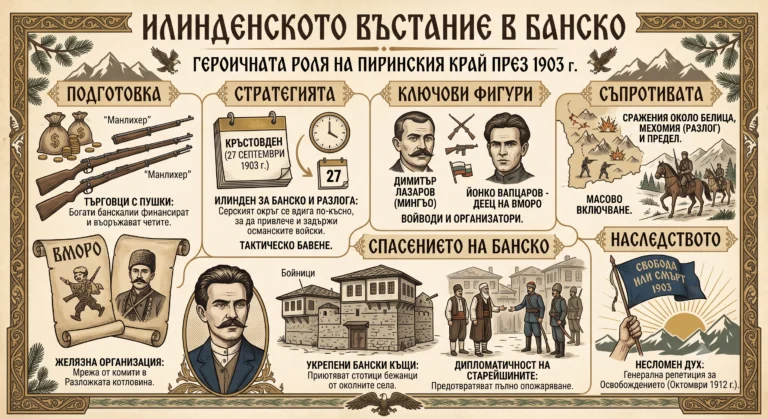
Edited infographic (edited-image.jpg) dedicated to the Ilinden Uprising in Bansko. Through retro illustrations and text, key moments of the heroic struggle in 1903 are presented, including the preparation, the strategy for the Krastovden uprising, the important figures, the resistance in the region, the saving of the city and the legacy of the liberation.
The strategy of the Sersky Revolutionary District
So for the Razlog region and for Banska Bystrica Cross Day (September 27, 1903, new style) It practically becomes their Ilinden. This move is not accidental, but the result of brilliant military tactics.
The plan of the Central Committee was clear – the rebels in Pirin had to attract and retain in the mountains as many regular Ottoman troops as possible. The aim was to relieve the pressure on the rebels in Bitola and Edirne, who were already fighting unequal battles with the empire. On the day of the uprising, the bells in the region of Bansko and Mehomiya (today Razlog) did not ring for a church holiday, but gave the long-awaited signal for battle.
Heroism in the Foothills of Pirin: Battles and Tactics
The uprising in Razlog was massive, fierce, and surprisingly well-coordinated for its scale. What exactly was happening in the area around Bansko during those fateful autumn days?
- Bansko as a logistics center: The city acted as a major base for supplies, weapons, and refuge. The brave bands of local voivodes such as Dimitar Lazarov (Mingyo), Radodon Togov, and Boris Golev operated here.
- The participation of famous families: Among the prominent Banska Bystrica residents who took up arms was Yonko Vaptsarov (the father of the great Bulgarian poet Nikola Vaptsarov), who during these years was an extremely active and courageous member of the organization.
- Clashes at the front: The bloodiest battles were fought around Belitsa, Mehomiya and the Predel Pass. The Banskaiai fought side by side with their neighbors against the many times superior regular Ottoman army, supported by a thousand bashibozuks.
How did Bansko survive the complete destruction?
While neighboring Belitsa was almost completely burned to the ground, and Mehomiya suffered heavy casualties, Bansko managed to escape complete destruction. This was due to two main factors. The first was the incredible diplomacy, cunning and wealth of the local elders, who managed to negotiate with the Ottoman commanders. The second factor was the famous Bansko fortified houses.
Their massive stone walls, secret dungeons, and battlements turned the city into a true fortress, sheltering and rescuing hundreds of refugees from the surrounding burned-out villages. These houses were designed precisely for such dark days.
The Legacy of the Ilinden Uprising Today
Although the Crusaders' Uprising in Razlog was suppressed, the free spirit of Bansko remained unbroken. That bloody but extremely glorious September of 1903 became a dress rehearsal for the final Liberation of the city in October 1912 (during the Balkan War), when detachments led by the poet Peyo Yavorov, Hristo Chernopeev and Yonko Vaptsarov triumphantly entered the city.
The next time you walk through the center of Bansko, pass by the majestic Holy Trinity Church or look at the old Renaissance houses. Stop for a moment and remember the year 1903. These ancient walls preserve the memory of some of the bravest Bulgarians, and the echo of the bells still carries the story of the greatest epic of the Macedonian Bulgarians.