


Every broker in Bansko has had this dialogue at least a hundred times:
Customer: “"Does this building have Act 16?”
Broker: “"It is currently on Act 15, but will soon take 16.”
Customer: (Silence and fear in the eyes) “Oh, so it’s illegal? I don’t want to take any chances.”
For the average person, construction terminology is a daunting jungle. For them, there are only two states: “Done” and “Problematic.” Your job as an expert is not simply to quote articles from the Spatial Planning Act (SPA), but to translate bureaucratic language into human language.
In this article, we will debunk the myths surrounding the Holy Trinity of new construction – Act 14, 15 and 16 – and we will give you the exact words (scripts) to calm the client and save the deal without lying.
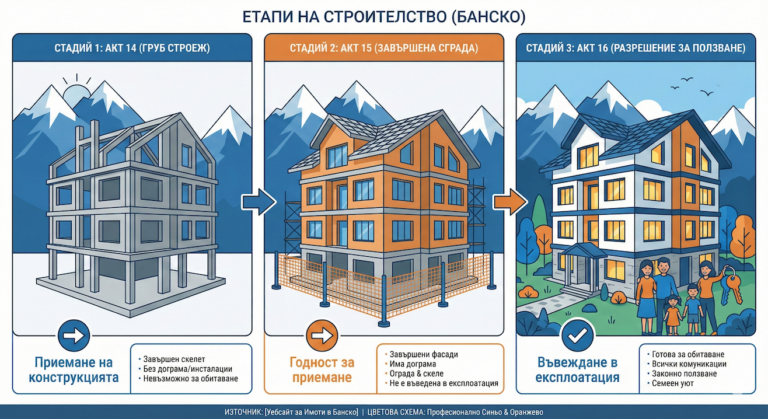
Act 14: “The skeleton is ready” (Rough construction)
The technical definition: Construction acceptance certificate (Form 14).
How to explain it to the client:
“Mr. Client, Act 14 is the 'Birthday' of the apartment. This means that the building now has walls and a roof. It is no longer just a drawing, but a real property that appears in the Cadastre with a separate identifier. From this moment on, you are buying a real object, not a 'right to build'. Banks are already granting mortgage loans at this stage, which is the surest sign that the construction is legal.‘
The risk: Is it livable? Absolutely not. There is no electricity, water, elevator, or windows. This is an investment in the future at the lowest price.
Act 15: “The building is completed” (Ready for viewing)
The technical definition: Certificate of conformity for establishing the suitability for acceptance of the construction (Form 15).
How to explain it to the client:
“Act 15 means that the builder has finished his work and handed over the site to the client (you). The building is completely ready visually – there is electricity, water, windows, insulation, the common areas are painted. The construction machines and cranes have left.”
⚠️ Frequently asked question: “Can I live in a building with Act 15?”
Your answer: “Technically – yes, many people are doing renovations and even living. But you should know that electricity and water are still paid for by the industrial prices (more expensive) because the lots are in the name of the builder. We are just waiting for the state acceptance committee to put the final stamp.”
Act 16: “The Building Passport” (Permit for Use)
The technical definition: Certificate of commissioning.
How to explain it to the client:
“"This is the finale. The state has come through, checked everything (fire safety, ecology, plumbing) and said: 'This building is safe and complies with all laws.' With Act 16 "You can now open a personal electricity and water bill (household electricity) and officially register at the address. This is the highest level of security, but the price of the property here is 20-30% higher than that 'on the green'."‘
Comparison table for your customers
Print this table or save it to your phone to show to the client during the viewing. It visualizes the differences perfectly.
| Stage | Notarial transfer? | Bank loan? | Electricity and Water | Price |
|---|---|---|---|---|
| Act 14 | YES (As a property) | YES (Normal) | NO | Lowest |
| Act 15 | YES | YES | IMA (Industrial) | Medium |
| Act 16 | YES | YES (Easiest) | IMA (Bitov) | Highest |
The Trap in Bansko: “Buildings without Act 16”
This is a specific problem for our region. After the construction boom in 2008 d., many hotels in Bansko remained "frozen" at the Act 15 stage. They are functional, have electricity and water, people have lived there for years, but legally the building has not been put into operation.
How to sell such properties? (The Ethical Approach)
- Be honest: Don't hide the fact. Say it in the first conversation. "The property doesn't have Act 16 and may never have one."“
- Use the price as an argument: “Mr. Client, this property does not have Act 16, but that is why its price is 30% lower than the neighboring complex. You get the same comfort, the same view and location, but at a much better price. The difference in the electricity bill (industrial vs. domestic) will be paid for by the lower purchase price for the next 20 years.”
- Check the batches: Make sure the building has at least open accounts with CEZ (Electrohold), even if they are industrial. If the electricity is paid “at the reception” or to the “guard”, this is a red flag for future problems.
Want to look like an expert?
Download our infographic “The Building Journey: From Excavation to Turnkey.” Send it to your clients via Viber after a viewing so they can understand the process visually and trust you.
Understanding the Act 14, 15 and 16 is the foundation of your expertise as a broker. When you explain these complex terms in simple language, you take the tension and fear out of the client. And a calm client is the one who takes out the pen and signs the deal.





 English (UK)