


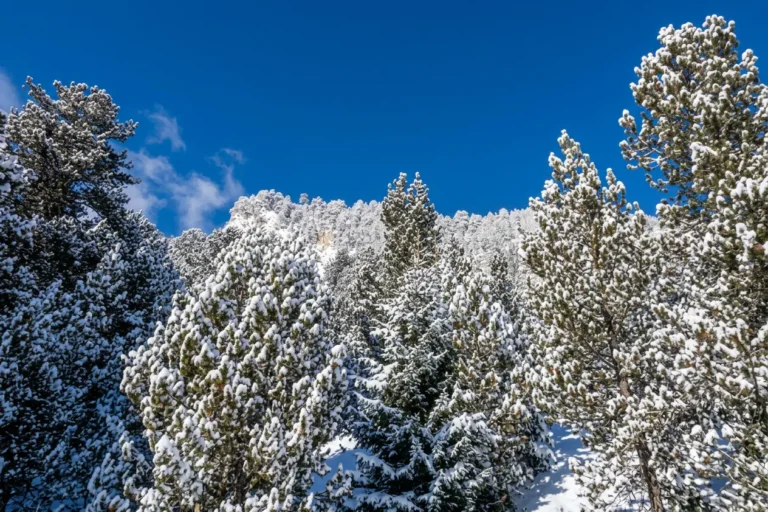
The emblem of the mountain: White and Black Fir
Pirin is world-famous for its centuries-old coniferous forests, with a large part of the National Park occupied by mulberry trees. They are not just beautiful trees – they are Balkan endemics (species found only on the Balkan Peninsula) and true masters of survival in extreme conditions.
White pine (Pinus peuce) – The aristocrat of the heights
The white pine prefers the high parts of the mountains, often reaching the very tree line (about 2000-2200 meters above sea level). In winter, its silhouette is extremely elegant. Its crown is relatively narrow and pyramidal, which helps it easily “shake off” heavy snow, protecting its branches from breaking.
Its bark is smooth and gray-greenish on young trees, and cracks into small plates on older trees. The needles are gathered in bundles of five – fine and delicate, they hold snowflakes like lace.
Black pine (Pinus heldreichii) – The Lord of the Rocks
Unlike its “white” sister, the black pine (also known as the Bosnian pine) is rugged, knotty, and loves steep, rocky terrain where few other plants can take root. Its roots literally split the marble of Pirin to find support.
You will recognize it by its ash-gray to black bark, which in old specimens resembles armor, composed of characteristic polygonal plates (the so-called “armor-like bark”). Its needles are dark green, hard, prickly and gathered in bundles of two.
The Baykush pine under a blanket of snow
We can't talk about Muri in Pirin, not to mention its greatest representative – the Baykusheva fir. This amazing specimen of the black fir species is over 1300 years old, making it the oldest coniferous tree in Bulgaria and one of the oldest in the entire world.
In the summer it is teeming with tourists, but in the winter the experience is completely different. Covered in thick snow, the Baikushevata mura exudes an ancient tranquility. Standing in front of a tree that sprouted shortly after the founding of the Bulgarian state, while snowflakes slowly fall around you, is a moment of true humility before the power of nature.
The best winter routes for "hunting" snow mountains near Bansko
If you want to immerse yourself in this snowy fairy tale (like the one in your photo), here are three easily accessible areas around Bansko:
- The road to Banderishka meadow: Even if you don't ski, a winter walk along the beaten tracks around the road (or a ride on the gondola lift) will reveal breathtaking panoramas of centuries-old pine forests.
- The area The Shiligarnika: The area is surrounded by incredibly beautiful, old specimens of white and black pine. The sunny winter days here offer perfect conditions for photography.
- Eco-trails in the lower part of the park: The routes that start just above Bansko in the direction of Demyanitsa hut or Vihren hut (wherever it is safe and cleared) offer a great opportunity for a leisurely walk among the snow-capped giants.
Why is snow vital to the forest?
While it may seem like snow is just a pretty burden on the branches, it is critically important to the Pirin ecosystem. The thick snow cover acts as an insulator, protecting tree roots and seeds in the soil from freezing during extreme nighttime temperatures. Additionally, the slow melting of snow in the spring provides the necessary moisture for the mulberries to survive the dry summer months on the rocky terrain.
Next time you're in Bansko, take an hour or two to escape the hustle and bustle of the slopes. Step into the ancient trees, breathe in the crystal-clear air, smelling of resin and cold, and enjoy the perfection of the snow-capped mountains.






 English (UK)