


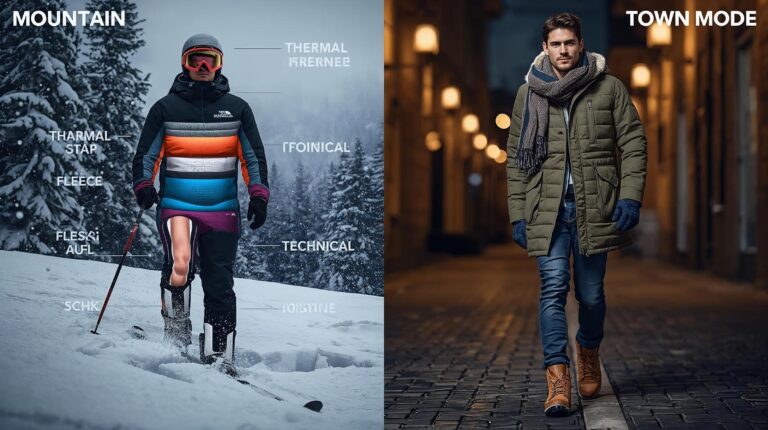
The main mistake in dressing in Bansko is to try to use the same strategy for both places. If you head to the slopes in your thick city jacket, you'll overheat in minutes. If you head out for a walk in your ski gear, you'll freeze as soon as you stop moving. This article is your step-by-step guide to how to handle both situations to stay dry, healthy, and comfortable.
PART 1: ON THE MOUNTAIN (ACTIVE MODE)
When you are skiing, snowboarding or hiking to Vihren Hut, your body is working like an engine. It produces a huge amount of heat. Your goal here is NOT just to “warm up”, but to manage moisture. Sweating is the biggest enemy. At -5°C, wet clothing can lead to hypothermia within 15 minutes on the lift.
The Foundation: The Three-Layer System
Forget about grandma's thick sweaters. In the mountains, we dress in layers that interact with each other.
1. Base layer (Moisture transport)
This is your “second skin.” This layer should fit snugly against your body.
- The matter: The only correct choice is merino wool or specialized synthetics. Merino is a miracle of nature – it’s warm even when wet and doesn’t retain odors (you can wear it for days). Synthetics dry faster and are cheaper.
- THE PROHIBITION: Never, under any circumstances, wear cotton in the mountains. The cotton T-shirt absorbs sweat like a sponge, doesn't dry out, and turns into an ice pack on your back.
2. Middle layer (Thermal insulation)
The role of this layer is to trap the warm air that your body gives off. A skier's best friend is fleece. It is lightweight, breathable and allows moisture from the base layer to pass through. If the day is very cold (below -10°C), you can use a thin jacket with artificial down (Primaloft) as an intermediate layer, but be careful not to overheat.
3. Outer layer (Protection/Shell)
This is your armor against the Todorka wind and snow. The jacket and pants should have a membrane (breathable and waterproof). Look for jackets with ventilation zips under the arms. This is your mechanical air conditioner – open them before you feel yourself sweating.
Lower body: Legs work the hardest
Many people focus on the jacket and ignore the pants. The legs generate a lot of heat when moving.
- Thermo-wedge: A must in sub-zero temperatures. Choose 3/4 length (to the top of the ski boot) to avoid creating a crease inside the boot, which can lead to calluses.
- Ski pants: It should not be too tight. It should have a “gaiter” (inner leg with elastic) that covers the shoe and stops snow from getting in.
Socks: The “One Pair” Rule”
It's a myth that two pairs of socks keep you warmer. On the contrary, they squeeze your feet, stop blood circulation, and your feet freeze faster. Wear just one pair Quality ski socks (a blend of merino and synthetics). They are reinforced on the shin for comfort and zoned for sweat wicking.
PART 2: IN THE CITY (PASSIVE / SOCIAL MODE)
You are getting off. The Gondola, you put away your skis and return to the hotel. Shower, relax and it's time for dinner. Here the strategy for dressing in Bansko changes dramatically. You no longer generate heat through movement. You walk slowly, stop to look at the souvenirs on Pirin Street, wait in front of the restaurant. The body cools down quickly.
Outerwear: Heavy Artillery
Unlike the mountains, where we look for breathability, in the city we look for complete isolation. This is where:
- Long down jackets (Parkas): The longer the better. The wind in Bansko at night is often piercing. A jacket that covers the hips keeps the waist and kidneys warm.
- Natural down: Unlike active sports, where down is not recommended, for walking it is the best insulator.
- Elegant coats: If you want a more stylish look for dinner, a thick wool coat is a classic, but be sure to combine it with a large, warm scarf.
The Legs: The Battle with the Ice
The streets in Bansko have one peculiarity - during the day the sun melts the snow, and as soon as it sets (around 5:00 p.m.), the water freezes and turns the sidewalks into a skating rink.
IMPORTANT ABOUT SHOES:
- DO NOT wear: Shoes with smooth soles, high heels (absolutely dangerous!), canvas sneakers or trainers (they will get wet from the slush in seconds).
- WEAR: Boots with a deep tread, such as “Trappers” or “Moon Boots”. The leather should be impregnated against the salt and lye that is thrown on the streets. The sole should be thick rubber to insulate the cold from the ground.
The “Sauna” Strategy in the Tavern
This is a specific moment for Bansko. You enter from -10°C outside into a tavern, where the fireplace is roaring and the temperature is +25°C. This temperature shock of a 35 degree difference requires clever dressing.
The error: Wear a thick wool sweater under your jacket. The moment you sit down at the table, you will start sweating uncontrollably, blush, and feel uncomfortable.
The solution: Dress “lightly” underneath. A nice shirt, cotton blouse, or thin cashmere sweater are ideal. Count on your thick jacket to keep you warm until you get to the restaurant, then leave it in the wardrobe and stay in light clothes. That way, you can enjoy the capama and wine without feeling like you’re in a sauna.
Pants: Jeans are back, but with a condition
In the city, jeans are perfectly acceptable and preferred for style. But denim is a “cold” fabric – it cools down very quickly. If you’re planning a long walk before dinner, the best advice is: keep the thin thermal wedge from your skis under your jeans. It's an invisible protection that makes the difference between shivering and enjoying the walk.
Accessories: The small details that matter a lot
| Accessory | On the Mountain (Sports) | In the City (Walk) |
|---|---|---|
| Gloves | Technical, waterproof, with membrane. Mittens for very cold days. | Leather with wool lining or knitted. It is important that they are warm and stylish. |
| Hat | Thin, without pompoms, to fit under a helmet. Balaclava for windy days. | Thick, knitted, with a fleece inside. Style is the key here. |
| Scarf | Synthetic “Buff.” It is safe (does not snag) and breathable. | A large, voluminous wool scarf to "hide" from the wind. |
Conclusion
The smart one dressing in Bansko does not require a huge budget, but the right strategy. Mentally divide your luggage into two: “Sports” and “Apresque.
For sports, invest in fabrics that breathe and do not retain moisture (Merino, Gore-Tex). For the city, rely on insulation (Fluffy, Wool) and ice security (Grapples). When you follow these rules, you won't have to worry about the forecast for the weather, and you will be able to focus on what is really important – the pleasure of the winter fairy tale in Pirin.
 English (UK)