


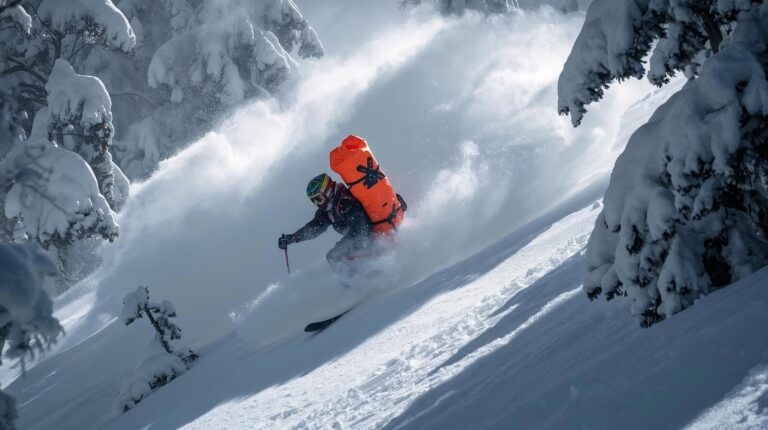
Avalanches are the biggest fear of every freerider, ski-touring enthusiast or mountaineer who decides to go outside the groomed slopes of Bansko and Pirin. When the snow mass starts, everything changes in a split second. The chances of survival depend on knowledge, speed of reaction and, of course, on the equipment. This is where modern technology comes into play. avalanche backpack (Avalanche Airbag) – the innovation that changed the rules of the game in mountain safety. But what exactly is it and is it worth the serious investment?
What exactly is an avalanche backpack?
At first glance, it's a standard backpack for riding, carrying a shovel, probe, clothes, and water. However, it has a life-saving system integrated into it: a folded balloon (or balloons) that inflates instantly when you pull a handle.
The Science Behind Survival: The “Brazil Nut” Effect”
Many people mistakenly believe that a balloon works like a life jacket in water – that it simply makes you “float.” The truth is a little more physical. The principle is called Inverse segregation (also known as the Brazil nut effect).
When an avalanche moves, it is a flow of granular particles (snowballs). As this flow moves, larger particles are naturally pushed to the surface, while smaller ones sink down into the gaps.
- Without backpack: The human body is relatively dense and small compared to large blocks of snow, so it sinks.
- With an inflated avalanche backpack: You become one huge “particle.” The physics of the avalanche literally pushes you up toward the surface.
Types of systems: Bottle vs. Fan
If you choose avalanche backpack Today, you will encounter two main technologies. Both work, but they have different advantages and disadvantages, which we have systematized in the table below:
| System Type | Technology | Advantages | Disadvantages |
|---|---|---|---|
| Cartridge (Compressed air) (Mammut, Ortovox, ABS) |
Gas bottle (carbon/steel) | Extremely reliable; Lighter (often); Lower initial cost. | Single use (requires refilling); Problems during flights. |
| Electronic / Fan (JetForce, Alpride E1/E2) |
Powerful fan + battery/supercapacitor | Multiple inflation; Free training; Easy air travel. | Higher price; Requires battery charging. |
Leading models on the market
Here's a quick guide in the sea of brands:
- Alpride (E1 and E2): Used by brands like Scott, Osprey, Deuter and BCA. It works with supercapacitors, which makes it the lightest electronic system and independent of temperature (lithium batteries degrade quickly in the cold, capacitors do not).
- JetForce: Technology of Black Diamond and Pieps. What's unique here is that the fan pulses to maintain pressure even if the balloon is slightly torn by rocks or branches.
- ABS (The Original): The Pioneers. They use a pyrotechnic system. Extremely proven reliability over the years.
- Mammut RAS (Removable Airbag System): The system can be removed and moved into different Mammut backpacks, which provides flexibility.
The statistics: It's not magic, it's a second chance
Studies show that the use of avalanche backpack reduces mortality by about 50%. The main cause of death in an avalanche is suffocation (asphyxia) due to complete burial. The backpack dramatically reduces the chance of this happening.
However, the backpack does NOT replace the “Holy Trinity”:
- Avalanche device (Beeps/Transceiver)
- Probe
- The shovel
If you are on the surface thanks to your pack, but your friend is buried, you will need a device, a probe and a shovel to rescue him. The pack protects only you; the rest of the equipment protects the group.
Support and travel
- Workout: Do at least one test pull at the beginning of each season (easy with electronic ones, requires refilling with cylinders). You need to get used to the strength and position of the handle.
- Storage: During the summer, store the backpack in a cool, dry place. For electronic batteries, check them periodically.
- Airplanes: E-backpacks easily pass as carry-on luggage (excluding those with bottles). Those with bottles require compliance with IATA regulations, prior declaration to the airline, and are often banned from flights to/from the US if the bottle is full.
CHECKLIST: Before you step on the snow
Even the most expensive avalanche backpack is useless if it is not prepared properly. Make it a habit to check this every morning:
1. Is it charged? (Battery level or tank pressure).
2. Is the handle activated? Remove it from the protective pocket.
3. The Leg Loop: THIS IS CRITICAL!
Every avalanche backpack has a strap that goes between your legs. If you don't fasten it, if you get caught in an avalanche, the sheer volume of the balloon will push the backpack over your head and it will disappear, leaving you unprotected. Never ride without a lap belt fastened!
Conclusion
An avalanche backpack is an investment in life. It's the insurance you hope you never need, but want to have on your back if the mountain decides to show its strength. It doesn't make you immortal, and it's no excuse for taking reckless risks in the gullies of Bansko, but it is the best tool to stay afloat when everything around you is going down.




 English (UK)