


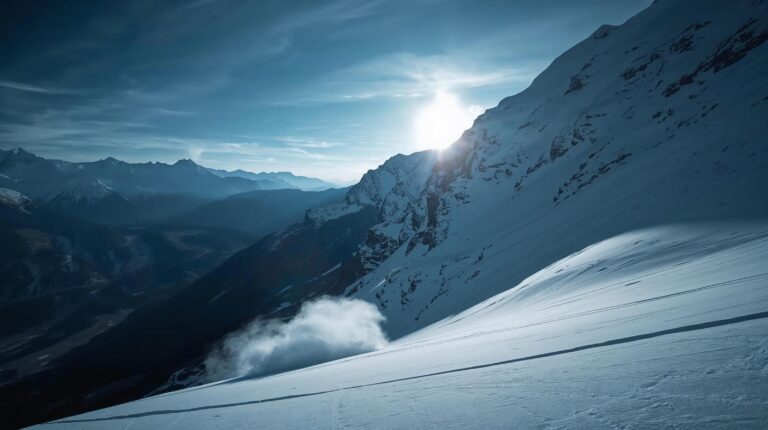
Introduction Pirin is not only one of the most beautiful but also the most avalanche-dangerous mountains in Bulgaria. Its alpine nature implies a constant and dynamic risk of avalanches throughout the winter season. The areas around Bansko – the leading ski resort in the Balkans – are particularly vulnerable, and knowing the terrain is a matter of survival.
Tragic incidents in recent years, including the December 2024 incident, are a painful reminder that the mountain demands unconditional respect. This article examines the anatomy of avalanches in Pirin, the statistics behind them, and the life-saving precautions that anyone who dares to venture outside the marked trails should know.
Geography of Danger: Where Does Risk Lurk?
Pirin is a geologically active area with a pronounced, steep relief. The deep valleys and rocky peaks create perfect conditions for the formation of "white elements".
Key risk areas The mountain is cut through by numerous chutes (natural “funnels”) and cirques that channel snow masses directly into the valleys. The most critical locations include:
-
Banderishka Valley and Demyanitsa;
-
The gullies of Vihren and Todorka peaks (often a point of attraction for freeriders);
-
The White River and the Vlahina Valley;
-
The area of Bezbog and Bayuvi Dupki;
-
Razlog and Banski Suhodol.
Important: The slopes in these areas often have a slope of more than 30 degrees – the critical limit at which gravity easily overcomes the grip of the snow. The risk is constant from December to March.
Why do avalanches occur? Climatic factors
The avalanche is not a random phenomenon, but the result of a complex combination of meteorological conditions. Experts' observations point to several main catalysts for the Bansko region:
-
Hurricane Winds: Speeds over 120 km/h carry huge masses snow, forming "snowboards" and drifts that break off extremely easily under load.
-
Temperature anomalies: Sudden warming (so-called "soft snow") destabilizes the snow cover.
-
Weak layers: New snow falling on an old, icy surface creates an extremely unstable structure with no traction.
Scientific research, including dendrochronological methods (analysis of tree rings), shows a cyclical nature of large avalanches. For example, it has been found that avalanches Palasica poses a direct threat to the lower parts of the ski area, which requires strict monitoring and control by the services.
Chronicle of an Incident: December 2024
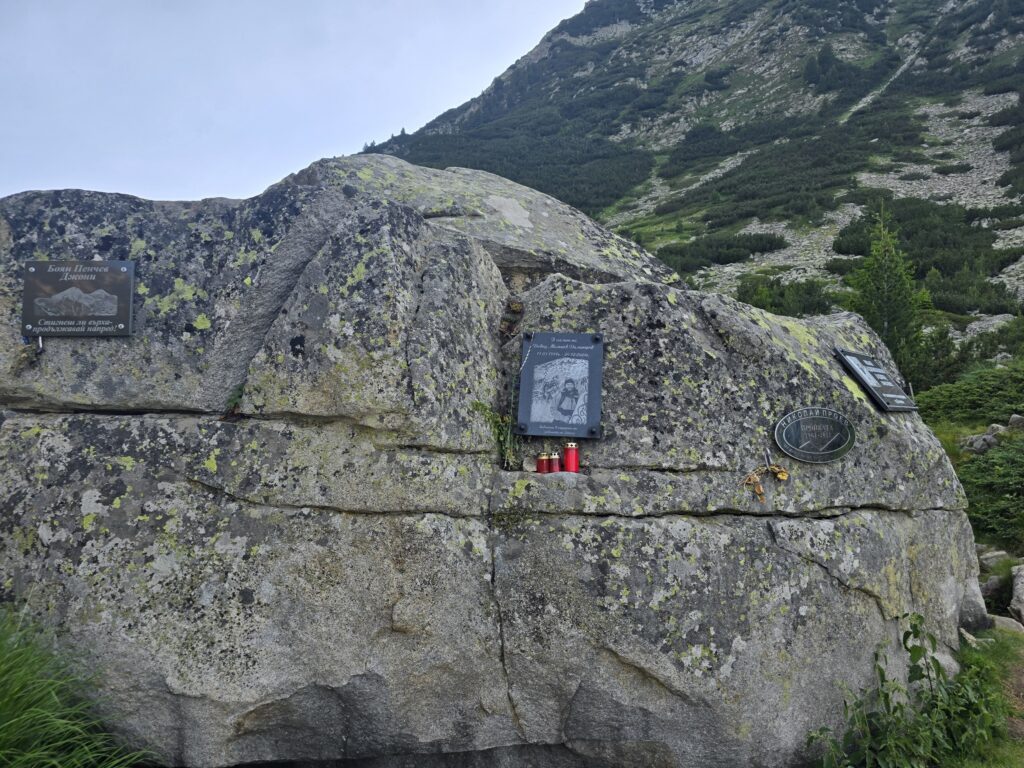
„"The Rock of Memory" - a natural memorial with plaques of fallen mountaineers, which reminds us of the respect we owe to Pirin.
On December 19, 2024, shortly before 3:00 p.m., Pirin once again reminded us of its harsh nature. Three freeriders (two snowboarders and one skier) entered one of the chutes between the ski area and Vihren hut – territory outside the marked and secured slopes.
Development of the situation: The avalanche broke off and swept the entire group away. One snowboarder managed to stay afloat and immediately began a beacon search. He found and dug out the skier, who had minor injuries. However, the second snowboarder (25 years old) was dragged over a cliff, which proved fatal.
The reaction of the PSC: The Mountain Rescue Service (MRS) responded immediately – the team set off only 6 minutes after the signal. Snowmobiles and rescue dogs were used. Although the operation ended at 16:50 with evacuation, the incident ended in a fatality.
This case, as well as the incidents from 2019 and 2015, strongly emphasize: even the presence of equipment does not guarantee survival in the event of mechanical injuries from impacts with rocks and trees.
Survival Statistics: Timing is Everything
Global and local data reveal the cruel mathematics of avalanches:
-
Reason: 90% of the avalanches are caused by the victims themselves or their companions.
-
Survival: After 35 minutes under the snow, the chance of life drops to barely 27%.
-
Injuries: Between 25% and 30% of the deaths were due to physical trauma (impacts) rather than suffocation.
-
Victims: In the Alps (which have similar terrain to Pirin) an average of about 56 people die per year.
Avalanche danger levels
In Bulgaria, the international 5-point scale is used. In Pirin, after heavy rainfall, the level often jumps to Significant (3) or High (4) degree.
-
🟢 Low: Avalanches are unlikely.
-
🟡 Moderate: Possible with heavy snow loads.
-
🟠 Significant: Critical level! Spontaneous avalanches and high risk when skiing.
-
🔴 High: Large spontaneous avalanches are likely.
-
⚫ Very high: Catastrophic scale (rare, but possible).
Prevention and Safety: How to Stay Alive?
The beauty of freeriding (riding off-piste) is attracting more and more enthusiasts to Bansko, but this pleasure requires iron discipline and preparation.
Mandatory equipment and behavior:
-
Avalanche device (Transceiver/Pips), Shovel and Probe: The three components are inseparable. One without the other is useless.
-
Airbag backpack (ABS): Significantly increases the chance of staying on the surface of the snow mass.
-
Training: Take avalanche safety courses. You should be able to recognize “drifts,” assess slope, and conduct snowpack tests before descending.
-
Discipline: Never drive alone and always check the current traffic bulletin before leaving the hotel.
Conclusion
Pirin is a majestic mountain that gives a lot, but also takes a lot. Incidents are not just dry statistics, but human destinies. Safety in the Bansko region depends on combined actions: respect for the warnings of the EMS, appropriate equipment and a realistic assessment of one's own capabilities.
The mountain will be there tomorrow. The important thing is that we are there to enjoy it.


 English (UK)