


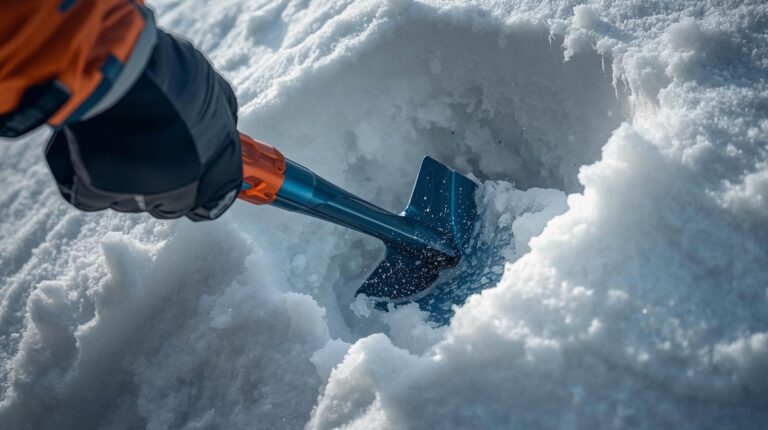
You have already located the signal with the device and fixed the victim with the probe. Now begins the most difficult physical part of the rescue operation - digging. Here your avalanche shovel comes into play. Many people underestimate this element, thinking that “a shovel is a shovel”. This is a fatal mistake. The snow in an avalanche is not fluffy; after stopping, it compacts and becomes hard as concrete (especially characteristic of heavy snow in Pirin).
⚠️ The reality of mining
To dig out a person buried 1 meter deep, you need to move an average of between 1 and 1.5 tons of snow. With bad avalanche shovel this is impossible within the critical 15 minutes.
Plastic or Metal: The Eternal Debate
This is the most important choice you will make. There are lightweight plastic (polycarbonate) models and metal (aluminum) options on the market.
| Material | Advantages | Risks |
|---|---|---|
| Plastic | Very light, cheap. | ⛔ It bends and bounces off hard snow. It is prone to breaking in low temperatures. Not recommended! |
| Aluminum (Metal) | Strong, sharp, cuts ice cubes (“bricks”). | A little heavier than plastic. |
For the conditions in Bansko, where snow often undergoes cycles of melting and freezing, the metal avalanche shovel (made of hardened aluminum) is an absolute must. It acts like a knife, cutting through the compacted blocks, while the plastic one will simply bounce off the surface.
Key features to look for
Besides the material, the modern avalanche shovel must have several specific characteristics:
1. Hoe mode
This is a “game changer” in rescue. Some models allow you to move the shovel at a 90-degree angle to the handle. This allows you to pull the snow back (like a hoe) instead of throwing it. When organizing a “V-shaped conveyor” (when several people dig in a row), the “hoe” function speeds up snow clearing by up to 30%.
2. Telescopic handle
A long handle gives you more leverage. This means less back strain and more power when shoveling. Never get a shovel with a short, fixed handle for serious freeriding.
3. Grip shape (D-grip vs T-grip)
- D-grip (D-shaped): More ergonomic, especially if you are wearing thick, one-finger gloves (paws). Allows for more force to be applied.
- T-grip (T-shaped): More compact and lightweight, but sometimes harder to grip with bulky gloves.
Did you know? The avalanche shovel is the only tool in the “Holy Trinity” that you use regularly for more than just rescue. You can use it to build a jump (kicker), dig a snow cave for a bivouac, or level a rest area.
Conclusion
Don't save money on avalanche shovel. The price difference between a plastic model and a high-end aluminum shovel with a “hoe” function is the price of a lunch in the mountains, but the difference in efficiency can cost a human life.





 English (UK)