

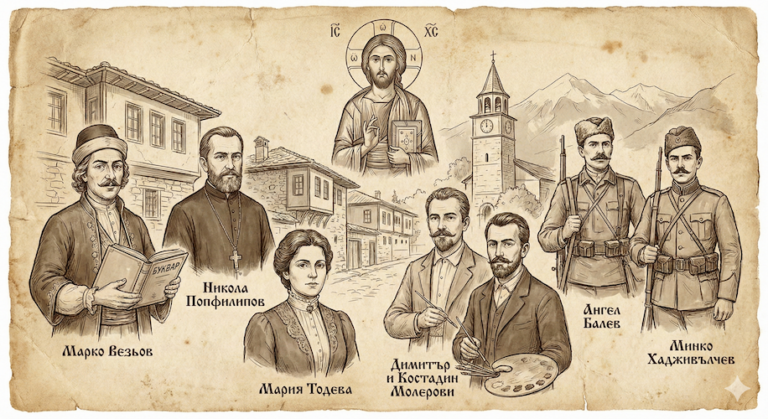
This article is a kind of “Walk of Fame” dedicated to those prominent figures of Bansko, who with pen, brush, commercial acumen or weapon in hand, built the foundations not only of their hometown, but of all of Bulgaria. Here you will discover the stories of educators, teachers, revolutionaries and brilliant icon painters, whose legacy is still alive today.
Enlighteners and Teachers: The Light of Knowledge
Marko Teodorovich Veziov (c. 1760 – 1837)
Marko Vezyov (Hadzhitodorov) is the embodiment of the bright Bansko merchant who uses his wealth for national purposes. Coming from the old Vezyov family and trading mainly with Vienna, he realizes that freedom begins with enlightenment.
In 1792, a full 32 years before Petar Beron’s “Fish Primer,” Veszov financed the publication of one of the first New Bulgarian primers. Adapting a Serbian textbook, he created a tool that broke with Church Slavonic tradition and introduced elements of the spoken language. This primer was the bridge between medieval and modern education in the Bulgarian lands.
Nikola Popfilipov (c. 1822 – 1896)
Nikola Popfilipov is a figure of national importance for Bulgarian education. Born in Bansko, he received a solid education, including under Joakim Gruev in Koprivshtitsa. Popfilipov is an “apostle” of the modern school – he introduced the mutual teaching method in Bansko (where he taught between 1854 and 1877) and in a number of other towns such as Kalofer, Svishtov and Chirpan.
He was not only a teacher, but also a writer, translator and associate of the great revivalists Nayden Gerov and Hristo Danov. At the end of his life he served as a priest in Sofia and collaborated with the newspaper "Macedonia".
Mihail (Minko) Hadzhivalchev (1854 – 1920)
Born in the turbulent years before the Liberation, Minko Hadzhivalchev is an example of the teacher-champion. His life shows how the educational work in Macedonia was often inextricably linked to the revolutionary struggle. He was a dedicated educator who educated generations of Banska Bystrica in a patriotic spirit, and at the same time an active participant in the national liberation movements. He died in Vienna, leaving behind a memory of an honest and self-sacrificing public figure.
Maria Lazarova Todeva (Buynova) (22.01.1886 – 07.12.1969)
The history of Bansko would be incomplete without mentioning Maria Todeva, also known as Buynova. She was among the pioneers of girls’ education in the region in the late 19th and early 20th centuries. At a time when education for women was still in its infancy, Maria Todeva dedicated herself to the mission of educating and educating young girls in Bansko, preparing them for an active role in a changing society. Her work is a testament to the progressive spirit of the town.
🎨 Bansko Art School (Molerov's family)
The following individuals are representatives of one of the most prominent iconographic schools in the Balkans. The Moler family, for generations, created masterpieces of iconography and fresco painting, which today adorn churches and monasteries throughout Bulgaria and beyond.
The Masters of the Brush: The Moller Family
Toma Vishanov Hadzhiikonomov – Molera (c. 1750 – ?)
The founder of the Bansko School of Art. The nickname “Molera” comes from the German word for painter (Maler), which suggests his education in Vienna. Toma Vishanov was a revolutionary in art – he broke with the rigid medieval canons and introduced Western European elements: realism, vivid colors, landscapes and chiaroscuro. His style was so progressive for the weather He was sometimes rejected by conservative church authorities, but today he is recognized as a genius.
Dimitar Molerov (c. 1780 – 1853)
Toma Vishanov's son, Dimitar, is the one who established the school and brought it the greatest fame. Although he returned a little closer to the church canon compared to his father, his works are distinguished by exceptional softness, spirituality and technical perfection. His icons are the pinnacle of Renaissance art. He worked actively in Rila Monastery and in the Church of the Holy Trinity in Bansko.
Kostadin (Kocho) Molerov (18.09.1876 - 24.10.1957)
A representative of the third generation of icon painters, son of Dimitar. Kocho Molerov created in a later stage of the Bulgarian Renaissance. He inherited the family talent and continued the tradition, while at the same time being an active participant in the public life of Bansko during the turbulent years around and after the Liberation. His work shows the continuity and sustainability of the artistic traditions in the city.
Revolutionary spirit
Angel Balev (24.06.1882 – 31.10.1965)
Bansko is a city of committees and voivodes. Angel Balev is a prominent figure in the revolutionary struggles in the Pirin region. As an activist of the Internal Macedonian-Adriatic Revolutionary Organization (IMRO), he dedicated his life to the cause of liberation of the Bulgarians who remained under Ottoman rule after 1878. His activities were related to the organization of committees, the protection of the local population and participation in the Chetnik movement. His name is a symbol of the rebellious Pirin spirit.
These personalities are just a part of the rich history of Bansko. Their work proves that the greatness of a city is not measured only by the height of the mountains around it, but by the height of the spirit of its inhabitants.

 English (UK)