

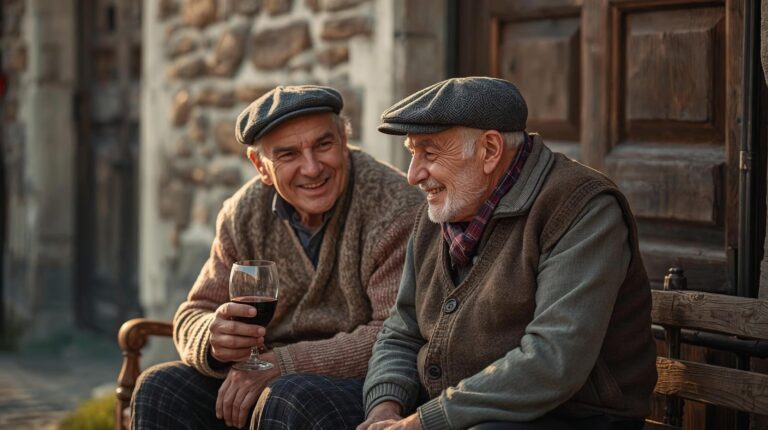
When a person first sets foot in Bansko, his gaze is fixed on the majestic peaks of Pirin, and his chest is filled with crystal mountain air. But the moment his ears catch a conversation between two old Bansko residents on the bench in front of the municipality, something unexpected happens. The tourist – be he from Sofia, Varna or Plovdiv – suddenly feels like a foreigner in his own homeland.
„"Why are you yelling, huh? Get yourself a pepper and eat it so you can grow up!"“
If this sentence sounds exotic to you, you are not alone. The Bansko dialect is not just a variety of the Bulgarian language; it is a cultural phenomenon, a historical legacy and a kind of "secret code" that the locals keep with pride. It is as hard as the Pirin stone, resonant as the chans of the Kukeri and colorful as the Bansko kapama.
In the following lines, we will try to "translate" the untranslatable and reveal to you why, despite the language barrier, you will feel like the most welcome guests in the world.
Language – the living history of the city
Bansko is a town with character. For centuries it was isolated in the mountains, relying on the cotton trade and its strong connections with the world, but always keeping its inner peace intact. The dialect here has survived almost unchanged over the years. It bears the marks of the Old Bulgarian language – especially in the preservation of certain vowels and sonorous consonants – but also the influence of the dynamic life of the former merchants.
The Bansko dialect is „"male" speech. There is no room for unnecessary softness in it. There is no "talking" here, there is „"noisy"“. The words are fired quickly, clearly, often in a high-pitched tone, which sometimes startles unprepared guests.
„"Are these people fighting?"“ – tourists often ask, overhearing a lively discussion in a tavern. The answer is almost always: „"No, they're just talking about the weather or for the harvest.“
High decibels are part of the local temperament. The Banska Bystrica man is emotional, straightforward and doesn't hide anything – neither his joy nor his anger. And his language reflects exactly that.
A short "Survival Dictionary" in Bansko
If you want to impress the waiter at the tavern or the grandmother selling homemade jam at the market, it's a good idea to know at least the basics. Here are a few key words and expressions that are absolutely essential for any self-respecting guest of the city.
1. Basic words and actions
-
Otti? – The king of bathing questions. Means „Why?“. Used all the time. „"So he's not eating?"“ (Why isn't he eating?).
-
Ke – Future tense. Forget about the particle „will“. In Bansko and the region, everything happens with „Ke“. „"Let's go"“ (We will go), „"We'll see"“ (We'll see.) This "Ke" carries categoricality - once the Banska resident says that he "will do it," then the word has been given.
-
Noise – Speak. „"Don't shout nonsense"“ is common advice to someone who talks nonsense.
-
I am – I'm shouting, I'm naming someone. „"How are you doing?"“ It doesn't mean someone is yelling at you, they're just asking "What's your name?".
2. Food and Lifestyle (The Most Important Category) The people of Banska Bystrica love to eat and their cuisine is sacred. That is why the vocabulary here is rich.
-
Potato – Potato. You won't hear the word "potato" in an old Bansko house. Potato is a religion.
-
Pepper – Pepper. No matter if it's hot or sweet.
-
Chomlek – This is not just a word, but an institution. A dish that takes hours to prepare.
-
Coma – A large piece of bread. „"Give me a piece of candy"“ (Cut me a piece of bread).
-
Do you want to? – Do you want it? Usually refers to food or drink. The answer should never be „no.“.
3. People and relationships Family ties and addresses in Bansko are a complex web that is strictly guarded.
-
Bayno – A respectful address to an older brother or an older man. A sign of respect.
-
Poop – Older sister, but also used to show respect for an older woman.
-
Uncle / Aunt / Auntie – Family relationships are named precisely and specifically.
-
Glavuš / Glavušar – Slightly offensive, but often used jokingly for someone who is stubborn or stubborn. And stubbornness is a national trait in Bansko.
-
Aresam / Bendisam – I like it. „"Did this guy do it?"“ (Did he like this boy?).
4. Words that can confuse you
-
Penger – Window.
-
Gate – Door (usually the large one, the one in the yard).
-
Clapperboard – It may be part of church ritual, but is sometimes also used for oral („"Close your eyelid"“).
-
I'm watching. – I look secretly, I peek.
-
Crouched – He grinned from ear to ear, smiling broadly.
Grammar lesson: The hardness of the statement
What makes Bansko speech difficult to understand is not just the unfamiliar words, but the intonation and abbreviations. Bansko residents like to "eat" sounds - they speak economically. Why say a long sentence when one word with the right intonation will do the trick?
The hard pronunciation of the consonants is also characteristic. „Ч“, „Ж“, „Ш“ sound heavy, authoritative. This is not a language for whispering. This is a language for the mountains – it must be heard through the storm, through the wind, across the dance floor of the horo. There is a local joke: „"The Banskaia disagrees, he just stops arguing."“ This is also felt in the language – categorical, short forms that do not tolerate objection.
A smile needs no translation.
Still, why are we telling you all this? Should you bring a dictionary when you go on a ski or spa weekend? Absolutely not.
The paradox of Bansko is that no matter how "rough" or incomprehensible the language may sound at first glance, it is a bearer of infinite warmth. The people of Bansko are known for their hospitality, which often borders on insistence.
If you enter a local house, the host may tell you something that sounds like a hassle: „"Sit here, your food is getting cold! I'll bring the wine!"“
The tone is commanding, the voice is loud, the words are strange. But the action is pure love. He puts you in the best seat, pours you the best wine, and gives you the best piece of pie.
In Bansko, communication goes beyond words. It is in:
-
The look: Direct and open. Here people look you in the eye.
-
Gesture: The hand placed on the shoulder; the full glass that is handed before you have asked for it.
-
The food: The language of the Kapama and the Bansko old man is universal. When you are served a steaming sach, there is no need for an interpreter – you understand that you are a welcome guest.
Conclusion: Come and listen
Next time you visit Bansko, don't just rush to the lift or to the restaurant table. Stop at the market. Pop into the little neighborhood bakery. Listen to the people talking. Try to catch the melody of their speech.
You might not understand the difference between „uino“ and „tetin.“ You might wonder why someone would ask you „Oti si kaheren?“ (Why are you sad?). But one thing is for sure – behind the incomprehensible words you will feel the pulse of a proud, strong and exceptionally kind people.
Because in Bansko, language may be a barrier to the mind, but the heart always finds a way. And if you still have difficulty, just smile and say: „"Pour some wine, old man!"“ This is perfectly understood by everyone.
Bonus tip: If you want to really earn the respect of the locals, learn just one phrase and use it on the spot: „"It's nice here, the air is fresh!"“. Your success is guaranteed!

 English (UK)