

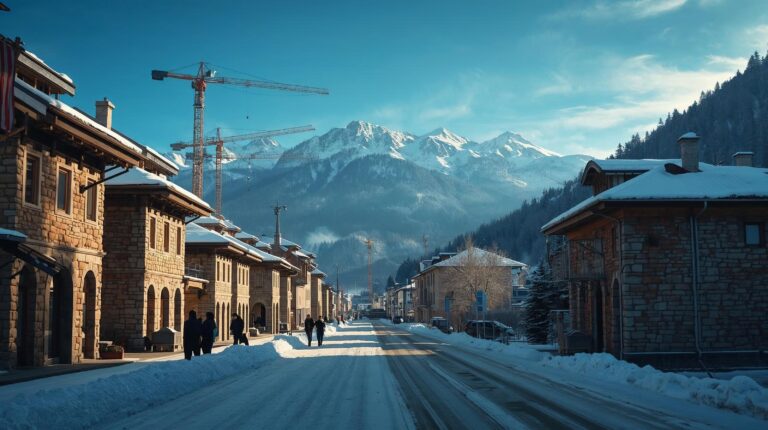
The year Bansko 2006 is emerging as a turning point in the modern history of the resort, marking the peak of the pre-accession economic boom in Bulgaria. Situated on the eve of the country's full membership in the European Union (January 1, 2007), the region of Bansko experienced an unprecedented inflow of foreign direct investment (FDI), driven mainly by the speculative real estate sector and the aggressive expansion of tourism infrastructure. This report provides a comprehensive analysis of the socio-economic landscape during this critical period, synthesizing data on the hyperactive construction that imposed a moratorium at the end of the year, and the transformation of the tourism profile towards mass international markets, in particular the UK and Ireland. The analysis reveals the fundamental dichotomy of 2006: a municipality reaping the financial benefits of rapid modernization while simultaneously struggling with the infrastructural, environmental and social pressures of uncontrolled growth.
1. Economic analysis and real estate market in Bansko 2006
1.1 Investment climate before EU accession
In 2006, the Bulgarian economy operated under conditions of high optimism generated by the upcoming membership in the European Union. This geopolitical stage acted as a catalyst for investments, reducing the perceived risk of the country and attracting both institutional and individual investors from Western Europe. Bansko established itself as the main beneficiary of this trend in the mountain tourism sector, competing in attracting capital even with the Black Sea coast. According to data from the National Statistical Institute (NSI) for Bansko 2006 In 2018, construction and real estate occupied a prominent place among the sectors of the economy receiving foreign investment, accounting for 181% of the total volume of investments in the country.1
While the national housing market is seeing an average price increase of 15-20% per year, resort areas like Bansko operate in a separate microeconomic climate, driven by external demand rather than domestic economic fundamentals. Expectations of property prices catching up with those in the established Alpine resorts of France and Austria are creating a “Gold Rush” where buying an off-plan property is seen as a guaranteed high-return investment.
1.2 Real estate market dynamics
The real estate market in Bansko in 2006 was characterized by aggressive supply and speculative pricing, dominated by foreign buyers.
1.2.1 Price evolution and market resistance
There is a sharp discrepancy between the offer prices and the actual transactions concluded, which signals the formation of a price bubble. The greatest interest is aroused by apartments in the central parts of the city and in the immediate vicinity of the starting station of the gondola lift, where demand many times exceeds supply.1
For comparison, average prices for new construction in the capital Sofia vary between 600 and 1,300 euros per sq m, depending on the area.1 This places holiday properties in Bansko at a significant premium over the residential market in the capital, which is an indicator of the speculative nature of valuations based on expected future rental income rather than intrinsic value.
1.2.2 Land price disparity
The value of regulated land properties (RLP) varies dramatically depending on location and urban planning status, reflecting micro-location as a major factor for investment interest.
| Location | Land status | Price (EUR/sq m) |
|---|---|---|
| Around the Kempinski Hotel“ | Regulated | 120 € |
| Around Hotel "Olympus"“ | Regulated | 100 € |
| Ring road | Unregulated | 55 € |
| Dobrinishte (Center) | Regulated | 125 € |
Data source: 2
An interesting observation in the analysis of Bansko 2006 is the high price of land in the neighboring town of Dobrinishte (125 euros/sq m), suggesting a spillover effect. Investors looking for early-entry opportunities are turning to satellite locations as the central areas of Bansko become overcrowded and expensive.
1.2.3 The “British Investor” Phenomenon”
The main driver of the market in 2006 was the British retail investor. Fuelled by easy access to credit in the UK (equity release schemes) and aggressive marketing campaigns promising high rental yields, British buyers dominated the greenfield property market. This demographic is less sensitive to the price per square metre than domestic buyers, often purchasing properties remotely, relying solely on brochures and capital gain forecasts after EU accession.3
Analyses from the period report that interest is primarily directed towards "second homes" or vacation homes. While the secondary market predominates on the Northern Black Sea Coast, in Bansko the focus is entirely on new construction in gated complexes.1 British publications and tourist guides for 2006 called Bansko "The fastest modernizing winter resort in Europe", which further fueled investment interest.5
1.2.4 Risks and market segments
By the end of 2006, analysts began to note the formation of a potential bubble. The separation of property prices from local purchasing power (where 1.2 average monthly salaries in Sofia are needed to purchase one square meter) created a fragile market, dependent entirely on foreign capital flows.6 Oversupply is also starting to become a problem – for the 2006/2007 season, the opening of around 100 new hotels and numerous apartment complexes is expected, which calls into question the sustainability of employment and rental yields.7
2. Construction and urban development in Bansko in 2006
The construction sector in 2006 was the engine of the economy in Bansko, generating zero unemployment in the region, but at the same time it was the source of the most serious urban planning and environmental challenges. The speed of development outpaced the administrative and infrastructural capacity of the municipality, leading to a state of “organized chaos”.
2.1 Scope and scale of construction
- Expanded built-up area: The issued building permits cover over 590,000 square meters of total area.5
- Capacity: The construction wave aims to increase the bed capacity to 15,000, effectively doubling the accommodation capacity compared to the previous season. For the upcoming winter season alone, around 100 new sites are planned to be put into operation, representing an investment of another 150 million euros.7
2.2 Key investment projects
2.2.1 Kempinski Grand Arena Hotel“
Although officially opened in late 2005, 2006 was the first full year of operation for the Kempinski Hotel Grand Arena. Located at 96 Pirin Street, this property defines the luxury segment in the resort. With its 157 Alpine-style rooms and direct access to ski facilities, the hotel serves as an anchor for real estate prices in the area.9
2.2.2 Park Hotel “Gardenia”
A significant addition to the city center was the opening of the four-star Park Hotel Gardenia in 2006. The design combines stone and dark wood, integrating with the Renaissance architecture of the old town. With a capacity of 84 double rooms and a panoramic elevator, Gardenia signals a move of luxury from the lift area to the city center.13
2.2.3 Pirin Golf & Country Club
One of the most ambitious projects launched during the period of Bansko 2006, is Pirin Golf & Country Club. In 2006, construction of the complex began on an area of 150 hectares. The project includes an 18-hole championship course designed by Ian Uznam. The investor is the company “Balkanstroy”, which plans investments of 90 million dollars. This project is key to the strategy for “two-season tourism”.17
2.3 The construction moratorium of December 2006.
- Scope: Prohibition of all construction activities during the active winter season.
- Traffic regulation: Construction trucks have been redirected outside the resort.
- Strategic goal: A coercive measure to catch up with urban planning.
2.4 Infrastructure improvements and environmental conflicts
In 2006, major roads such as Glazne, Bulgaria, Patriarch Evtimiy and Tsar Boris streets were repaved. A new 6-kilometer ring road was also built. However, the expansion of the ski area came into sharp conflict with environmental regulations and Natura 2000, provoking protests from WWF and other organizations.22, 23
3. Tourism
In 2006, Bansko finally solidified its reputation as the “Winter Capital of the Balkans.” The sector moved from a phase of local tourism to a fully internationalized industry.
3.1 Tourist flow and markets
For the 2006 season, a growth of 20% is forecast, approaching half a million visitors. It is expected that between 800,000 and 1 million tourists (Bulgarian and foreign) will visit the city during the entire 2006/2007 season.5, 7
- United Kingdom: The fastest growing market segment attracted by low-cost flights.
- Regional markets: Greece, Macedonia and Serbia remain a stable source of tourists.
- Russia: Traditional market with growth of around 17.60% on an annual basis.25
3.2 Marketing and pricing policies
The ski area concessionaire "“Yulen” AD increases the price of the daily lift ticket to 50 leva, doubling it compared to the previous year. This causes discontent among Bulgarian tourists and intensifies the debate about the accessibility of the mountain.25
4. Sports and Recreation: The Road to the World Cup
The year 2006 is a key one for Bansko's sporting ambitions. Investments are directed towards preparing the slopes for international competitions. New slopes have been opened and the biathlon shooting range has been completed.22
4.1 Hosting the FIS European Cup
On April 8-9, 2006, Bansko hosted the FIS European Snowboard Cup (Snowboardcross). The men's winners were Stefan Werlen (Switzerland) and Mateusz Ligotski (Poland). The successful holding of these events in 2006 is a decisive argument for the future hosting of the World Cup.26, 28
5. Culture: Jazz Festival Bansko 2006
Cultural tourism is the second pillar of the city's strategy. The Jazz Festival is already established as the most prestigious musical event held at Nikola Vaptsarov Square.
| Category | Artists | Country |
|---|---|---|
| World legends | Solomon Burke, Freddy Cole, Incognito, Benny Golson | USA / UK |
| European stars | Clare Teal, Axel Zwingenberger | United Kingdom / Germany |
| Bulgarian elite | Kamelia Todorova, Vasil Petrov, Yildiz Ibrahimova | Bulgaria |
In summary, the year Bansko 2006 will go down in history as a period of rapid growth, which laid the foundations of the modern resort, but also set the challenges that the town will face in the next decade.
 English (UK)