

1. Introduction: Bansko on the Eve of the Storm
At the beginning of 2020, Bansko enters the year with the confidence of an established European ski resort. The city, which has undergone a large-scale transformation in the first decade of the 21st century, is preparing for another strong winter season. Economic indicators for January and February point to growth, supported by a steady flow of tourists from the UK, Israel, Russia and the Balkan neighbors. No one in the local administration or business circles suspects that the city will become “patient zero” of the economic blockade in Bulgaria.
Analyzing 2020 requires considering three parallel storylines that intertwine: the health crisis, the ecological battle for Pirin, and the economic metamorphosis. These storylines do not develop in isolation; on the contrary, the April 2020 Pirin National Park court ruling directly affects the investment climate, while the March quarantine catalyzes processes in real estate that would otherwise take years.
2. The Epidemiological Crisis: From the World Cup to a Complete Lockdown
2.1. The triumph before the fall: Audi FIS Ski World Cup (January 2020)
The year is starting with a spectacular success for the resort. Between January 24 and 26, 2020, Bansko hosts the Women's Alpine Skiing World Cup. This event is of key importance not only for the sporting prestige, but also for the economy of the town, generating a massive stream of revenue and media coverage. The competitions, in which American superstar Mikaela Shiffrin triumphed, as well as Italians Elena Courtoni and Federica Brignone, were watched by over 124 million viewers worldwide.
The organization of the event demonstrated Bansko's capacity to manage logistics on a world-class level. Hotels were full, restaurants were operating at maximum capacity, and the marketing effect was estimated at millions of euros. This moment of peak success makes the subsequent collapse even more dramatic. Just six weeks later, the infrastructure that welcomed the world's elite would be closed and the streets empty.
2.2. “Zero City”: The March 2020 Quarantine
The first cases of COVID-19 were registered in Bulgaria on March 8, 2020. Bansko, with its international environment and intense flow of tourists from affected countries (especially the UK), was quickly identified as a risk zone.
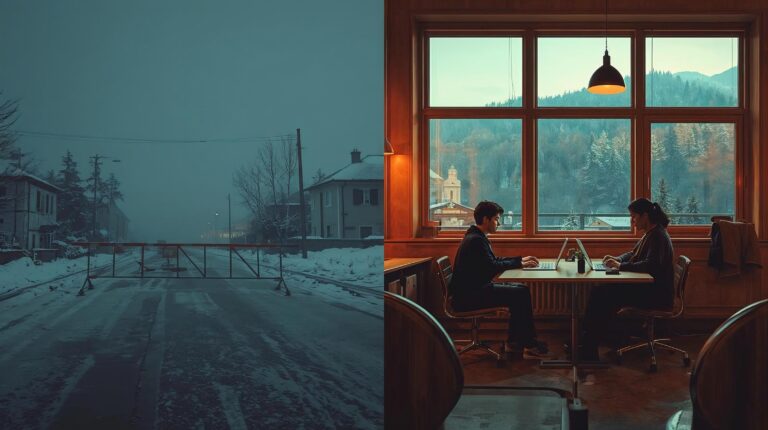
On March 17, 2020, just four days after the declaration of a state of emergency in the country, the Operational Headquarters and the government took an unprecedented decision: Bansko was placed under a full 14-day quarantine. This is the first and only city in Bulgaria to be subjected to such strict isolation in 2020.
Chronology and measures of the blockade:
- Closing the perimeter: All entrances and exits of the city are blocked by Ministry of Interior checkpoints (KPPs). Entry and exit are prohibited for everyone, except for suppliers of food, medicine, and essential goods.
- Internal mode: Residents are required to stay at home, with only going out to shop for groceries and pharmacies. The ski area was immediately closed, ending the winter season a month earlier than planned.
- Evacuation of foreigners: Thousands of foreign tourists are stranded in the resort. The Ministry of Foreign Affairs and the tourism industry are organizing a complex logistical operation to transport them through “green corridors” to Sofia Airport under police escort to prevent contact with the population outside the city.
2.3. Economic and psychological effect of quarantine
The lockdown, which lasted until March 31, 2020, had a devastating effect on the local economy. The loss of the strongest weeks of the end of the season (March usually offers excellent skiing conditions and longer days) led to immediate layoffs of seasonal staff.
A World Bank report on the Western Balkans from May 2020 highlights that regions dependent on tourism have borne the brunt of the crisis. In Bansko’s case, the shock is twofold – not only economic, but also reputational. The town was labelled a “hotbed”, necessitating serious marketing efforts in the following months to restore trust.
3. Economic Analysis: Collapse and Restructuring
The economic year 2020 in Bansko can be divided into three phases: a strong start (Q1), a collapse (Q2), and a partial adaptation through domestic tourism (Q3 and Q4).
3.1. Tourism statistics and demographic collapse
Data from the National Statistical Institute (NSI) for the third quarter of 2020 illustrate the scale of the crisis. Travel by Bulgarians abroad fell by 88%, but more importantly for Bansko, inbound international tourism has virtually disappeared. Traditional markets – the UK, Israel, Russia, Turkey and Greece – are closed due to travel restrictions and quarantine requirements.
| Indicator | 2019 (Q3) | 2020 (Q3) | Change |
|---|---|---|---|
| International tourists | Basic level | Almost zero | ~ -90% |
| Bulgarian tourists | Basic level | Growth (substitution effect) | Moderate height |
| Total revenue | Basic level | Significant decline | Decline |
The lifeline of the internal market: During the summer season (July-September 2020), the phenomenon of the “saved season” is observed by Bulgarian tourists. Due to the impossibility (or difficulty) of traveling to Greece and Italy, many Bulgarians rediscover their native mountains. Bansko, with its bed base and nature, attracts families looking for an escape from big cities and social distance.
Small family-run hotels and guesthouses are doing better than large resorts because they offer a more secluded environment that is perceived as safer by consumers. Large all-inclusive hotels suffer from high fixed costs and the inability to operate buffets and spas at full capacity.
3.2. Strategies for business survival
In order to attract the few available tourists, the Municipality of Bansko and the concessionaire "“Yulen” AD is taking aggressive pricing measures. A significant campaign was in the summer of 2020, when the price of a round-trip ticket for the cable car for children was reduced to the symbolic amount of 1 lev. This strategy aims to attract families to the mountains, counting on them to generate revenue for local restaurants and attractions.
Hotels, in turn, are investing in hygiene certification. The luxury Kempinski Hotel Grand Arena for example, it implements safety protocols that are becoming standard for the high-end segment of the resort, trying to calm customers' fears.
4. Real Estate Market: The Bottom as an Opportunity
The real estate sector in Bansko in 2020 is experiencing one of its most interesting years, characterized by the final bursting of old bubbles and the formation of a new market reality.
4.1. The “English Exit” and Price Levels
The trend of mass property sales by British owners, which began several years earlier, reached its peak in 2020. The combination of Brexit and the economic uncertainty caused by COVID-19 is forcing many foreign investors to liquidate their assets at a pittance.
Statistics show that in 2020, fully furnished apartments can be found in Bansko at prices between 250 and 400 euros per square meter. These are levels that are below the cost of new construction.
- Studios: They are sold for amounts in the range of 8,000 – 12,000 euros.
- Two-bedroom apartments: Prices vary between 15,000 and 25,000 euros depending on maintenance fee.
The main driver of low prices are the high maintenance fees in large complexes (reaching 10-12 euros/sq m per year), which become unaffordable for owners who cannot use their properties.
4.2. The new buyer profile
In the second half of 2020, Bulgarian buyers have become more active. The lockdowns in Sofia and major cities are changing attitudes towards “second homes.” Bulgarians are starting to look for properties in Bansko not so much for investment purposes (rental), but for personal use – as a refuge in case of possible future quarantines.
Preferences are directed towards:
- Properties without maintenance fee: Townhouses or small cooperatives where fixed costs are minimal.
- Rural properties: Houses in the neighboring villages of Banya, Razlog and Dobrinishte, which offer yard spaces - a luxury that apartments in gated complexes cannot offer.
5. Ecology and Urban Planning: The Court Decision That Stopped the Excavators
One of the most important moments for Bansko in 2020 is not related to a virus, but to a courtroom. The battle for the future of Pirin National Park is finding its legal resolution.
5.1. The decision of the Supreme Administrative Court (April 2020)
On April 29, 2020, in the midst of the pandemic, the Supreme Administrative Court (SAC) issued a final decision (Decision No. 4236) that canceled plans to change the Management Plan of Pirin National Park without an environmental assessment.
Essence of the case: The Ministry of Environment and Water (MoEW) had attempted to change the management plan to allow construction of new ski facilities (the so-called “Second Gondola”) on 66% of the park territory and logging on 48%, without carrying out the mandatory Environmental Assessment (EA) and Compatibility Assessment (CA).
The result: The Supreme Court ruled that such large-scale changes to protected areas in the Natura 2000 network cannot be made without a full environmental assessment. This decision effectively freeze the investment intentions of the concessionaire "Yulen" AD to expand the ski area in 2020.
5.2. Implications for construction
This decision had an immediate impact on the construction sector in Bansko. It sent a clear signal to investors that extensive development of the resort by entering the mountain is legally impossible in the foreseeable future. This redirected capital towards the renovation of the existing building stock and the completion of the urban infrastructure, instead of towards new megaprojects in the mountain.
6. New buildings, sites and landmarks in 2020.
Despite the economic stagnation, 2020 did not pass without the opening of new sites. However, the specifics of the year required that these “new” buildings be primarily the result of transformation, renovation and change of purpose, rather than new “greenfield” construction.
6.1. Coworking Bansko Lounge (December 2020) – The symbol of the new economy
The most significant “new” property opened in 2020 is not a hotel, but a co-working space. In December 2020,. Coworking Bansko expands its activities with the opening of a new location – the so-called. Lounge.
This space is key to understanding the change in Bansko. It was designed not for tourists, but for long-term resident digital nomads. The facility includes areas for socializing, working, and events, and is decorated with murals by local and visiting artists (such as Irina’s “hidden object hunt”). Its opening at the end of a year of isolation is a strong sign of the resilience of the nomadic community in the city.
6.2. Kempinski The Spa Renovation
In the luxury segment, the big news for 2020 is the complete renovation of the SPA center of the iconic Kempinski Hotel Grand Arena. The project was completed and put into operation this year, offering a completely new interior design and modernized thermal areas. This investment, made in times of crisis, demonstrates the international brand's long-term commitment to the destination and its drive to increase product quality rather than volume.
6.3. Modernization of Hotel “Zara”
Hotel Zara is also undertaking a major modernization campaign in 2020, focusing on its culinary product and restaurant interiors. The attraction of famous chefs (such as Chef Simeon Stoyanov and Chef Panagiotis Koutsouvelis) is an attempt to reposition the hotel in a higher class, competing for more affluent Bulgarian customers.
6.4. Urban environment and eco-initiatives
Bansko Municipality, despite its limited budget, is investing in the maintenance of the urban environment. In the summer of 2020, repairs were carried out on streets and sidewalks in the central part, preparing the city for the summer season. An important highlight is the mountain cleaning initiative held in June, which mobilized hundreds of volunteers and showed the “new face” of Bansko – not only as a place for consumption, but as a community that cares for nature.
7. Cultural Sustainability: Festivals as an Anchor of Normality
One of Bansko's greatest achievements in 2020 is that it managed to preserve its cultural calendar, albeit in an adapted form.
7.1. Bansko Jazz Fest 2020: The last “farewell” of Dr. Emil Iliev
While most music festivals in Europe have been canceled, the 23rd edition of the Bansko International Jazz Festival is taking place as planned from August 8 to 14, 2020. This edition is historic for two reasons:
- Organizational feat: Its holding requires strict social distancing measures. For the first time, paid tickets (20 leva) have been introduced for seated seats in front of the stage to control the number of spectators, while those standing remain within the wider perimeter of Nikola Vaptsarov Square.
- The end of an era: This is the last edition personally organized by the festival’s founder, Dr. Emil Iliev. His death in November 2020 from COVID-19 brought an end to a long phase of the city’s cultural development. Dr. Iliev, a dermatologist and visionary, is the man who almost single-handedly transformed Bansko into a summer cultural destination.
7.2. Bansko Film Festival 2020
In November 2020, despite the approaching second wave of the virus, the International Mountain Film Festival (Bansko Film Fest) was also held. The event, although with fewer international guests in person, managed to present the best films about extreme sports and mountaineering, maintaining the town's connection with the alpine community.
7.3. The birth of Bansko Nomad Fest
In June 2020, an event is taking place that is perhaps of the greatest importance for the future of the city. The first Bansko Nomad Fest. Organized by Matthias Zeitler, the festival brings together around 100 digital nomads. In the context of closed borders, this gathering is a small miracle. It puts Bansko on the world map as the “capital of digital nomads” and demonstrates that the city can attract young, highly qualified people even (and especially) in times of crisis.
8. Digital Nomads: The New Economic Force
2020 has been a catalyst for the establishment of digital nomads as a key economic factor in Bansko. While hotels are empty, coworking spaces are full of people fleeing the lockdowns in Western Europe.
The “Corona Nomads” Phenomenon: Bansko offers a unique combination of factors that prove invaluable in 2020:
- Freedom: Lighter measures compared to the complete blockades in London, Paris or Berlin.
- Nature: Access to the mountain for walks and sports, which is vital for mental health during a pandemic.
- Price: Low rents and living costs allowing people to survive economic uncertainty.
- Community: The presence of an already established community around Coworking Bansko provides a social environment that is lacking in isolation in a big city.
The opening of the new Lounge location in December 2020 is a direct response to this increased interest and the need for more space for socializing while adhering to the measures.
9. Conclusion
2020 is a year of paradoxes for Bansko. Statistically, it is catastrophic – a collapse in tourists, a drop in revenues, the loss of human lives and cultural leaders. But structurally, it is a year of healing transformation.
The crisis forced the city to free itself from illusions of endless growth of mass tourism. The decision of the Supreme Court of Justice put an end to the disputes about the redevelopment of the mountain, directing the focus to the effective use of the existing base. The collapse of property prices cleared the market of speculative capital and brought back Bulgarian buyers. And the rise of digital nomads and the success of Nomad Fest proved that Bansko has a future as a modern, technological mountain town, and not just as a winter resort.
Thus, in the toughest year in decades, Bansko laid the foundations of its new identity – more resilient, more diverse and less dependent on the vagaries of a single season.
Statistical Appendix: Bansko 2020 in Numbers
| Indicator | Value / Status in 2020 | Trend compared to 2019 |
|---|---|---|
| Winter season | Terminated on March 17 | Shortened by ~4 weeks |
| Foreign tourists (Q3) | Decrease of ~88% | Drastic collapse |
| Property Price (Average) | €300 – €450 / sq.m. | Historical low |
| Key court decision | Supreme Administrative Court Decision No. 4236 | Stops zone expansion |
| Nomad Fest participants | ~100 people (First edition) | New format |
| Jazz festival ticket | 20 BGN (First time paid) | New revenue strategy |
| Lift ticket price (summer/children) | 1 lev | Marketing campaign |
 English (UK)