

Bansko in 2007
Note: This is a short version of the chronology. For a full, detailed analysis of the economic and urban transformations, see our main article here.
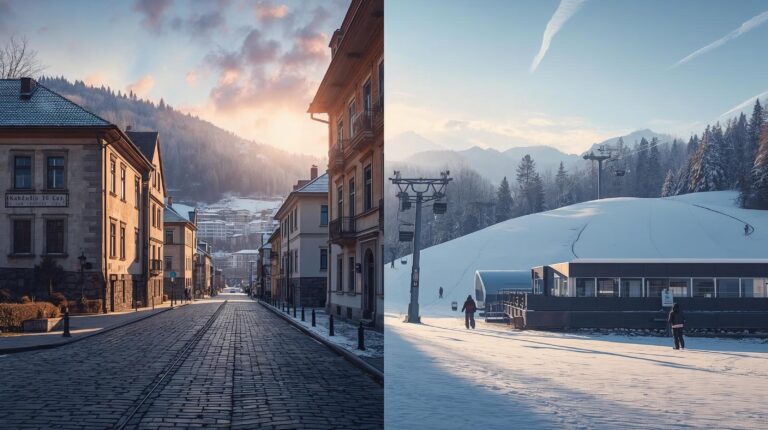
In the annals of the resort, there are periods that are remembered, and those that change everything fundamentally. The history of Bansko in 2007 undoubtedly falls into the second category. This is the watershed moment when the small mountain town with a Renaissance memory finally collides with global capital, new European regulations, and large-scale dreams of a global winter resort.
Bulgaria's accession to the EU acted as a powerful catalyst, bringing both economic euphoria and severe infrastructure challenges. Here's what the "Bansko Phenomenon" looked like during the year of the brightest contrasts.
The Gold Rush: Property Bubble and the „EU Effect“
Looking at Bansko in 2007, we see the city becoming the hottest real estate spot in the Balkans. Optimism from EU membership and easy access to credit create the perfect storm. Here are the main parameters of the market then:
| Factor | Market characteristics (2007) |
|---|---|
| Record prices | While property prices in the country are increasing by about 30%, transactions in Bansko (especially around the starting station) exceed 1500 euros per sq m. |
| Foreign invasion | The market is dominated by British and Irish people, buying en masse "green" for investment purposes. |
| City maze | Neighborhoods like "Gramadeto" are changing in a matter of days. The first malls and closed complexes appear. |
Infrastructure collapse and construction moratorium
However, the unprecedented growth comes at a price. The city's infrastructure is starting to crack at the seams:
- Water crisis: The outdated water supply network cannot withstand the pressure from the new hotels, leading to critical water losses.
- The current stops: The power grid overheats during peak times of the season.
Historical decision: The situation forced Mayor Alexander Kravarov to take extreme measures. In November, it was announced construction moratorium, effective December 1, 2007. The ban on heavy equipment in winter is an attempt to save the resort's image from dust and noise.
Tourism Evolution: From Guesthouses to 5 Stars
Despite the chaos, the development of Bansko in 2007 also marks a qualitative evolution of the hotel product:
- Lucky Bansko SPA & Relax: Opened this year, the complex becomes a pioneer in luxury aparthotels with an ultra-modern SPA center.
- Mountain Romance Hotel: An example of a quality family hotel, combining tradition and modernity.
These new properties, together with the already operating Kempinski, are transforming Bansko into a destination where world-class services become accessible.
Memory, culture and ecology
Bansko does not forget its roots. The year is key for the preservation of historical memory:
- Radenova House Museum: Opened on October 18 after a donation from Gen. Krum Radonov, the museum houses artifacts from the Thracians to the Middle Ages.
- Jazz Festival: The 10th anniversary edition of Nikola Vaptsarov Square reinforces the cultural image of the city.
In environmental terms, on March 2, Pirin Nature Park becomes part of the network Natura 2000. This ensures species protection, but also exacerbates the conflict between economic pressure for new runways and environmental norms.
Sports capital of the Balkans
The culmination of Bansko in 2007 occurs on December 15th with the opening of the 2007/2008 ski season. The event is of world-class importance:
- Star presence: The Tomba track welcomes legends Mark Girardelli, Janica Kostelic and Kietil Andre Amod.
- Technologies: The concessionaire doubles the number of cannons for snow, which allows for the holding of prestigious competitions such as the European Cup (women).


 English (UK)