


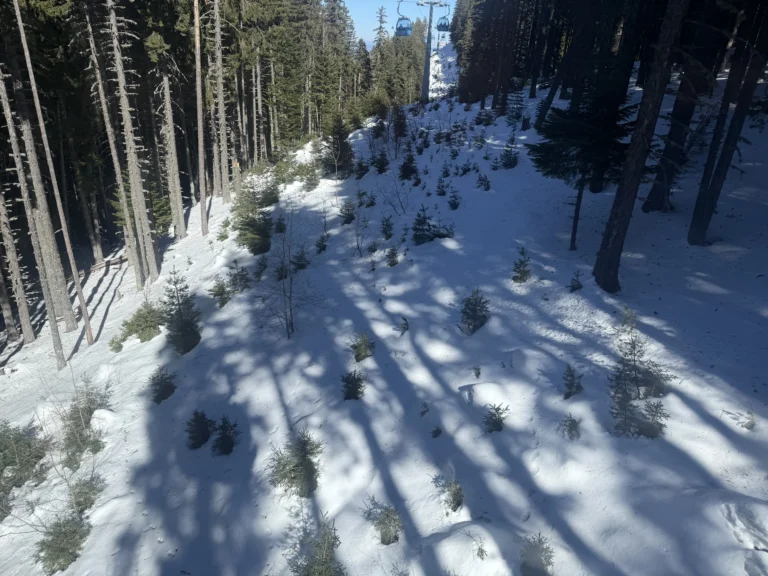
In this article we will look in detail at exactly how it is maintained. the cable car route in Bansko, what the strict environmental rules are and why the battle with the growing forest is a continuous but completely natural process.
Why does the clearing under the lift have to remain “clean”?
Contrary to many people's expectations, the construction of a cable car definitely does not end with the initial cutting of the corridor through the mountain. Pirin is an extremely living organism and the forest is constantly trying to regain its lost territory. Every spring, immediately after the snow melts, thousands of new coniferous trees sprout under the steel cables, called "self-sowing" by the foresters.
If these young trees are left to grow unchecked, they will very quickly become a serious threat to the facility. The laws of physics dictate that when dozens of cabins are filled with passengers at the same time, the massive steel cable logically “sags” (sags) downwards under their colossal weight. This is a completely normal process, precisely calculated by Doppelmayr engineers, but it requires that there is no tall vegetation under the cabins themselves.
If the branches of growing trees reach the gondola route, they can scratch the expensive polycarbonate windows, damage the sensitive electronic sensors on the poles, or in the worst case scenario, get caught on the gripping mechanism (grip) of the gondola itself.
The annual battle with vegetation: When and how does it happen?
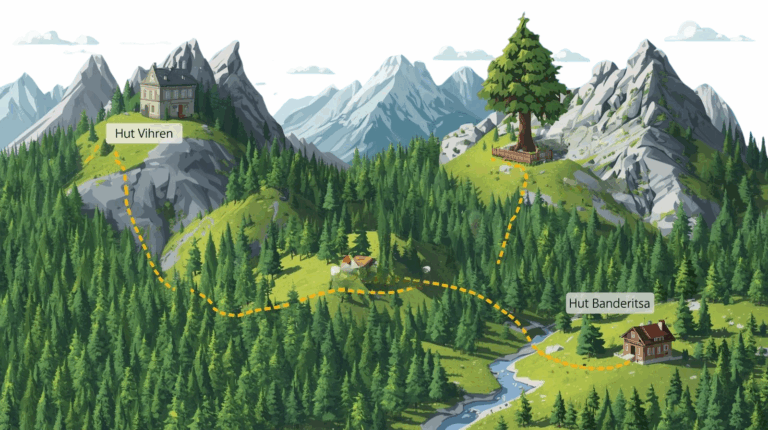
The maintenance of this long trail is a large-scale, heavy-duty operation that takes place outside the active ski season, most often in early autumn. Long before the first heavy snow covers Pirin, specialized teams from the ski area walk the entire 6.2-kilometer length of the cable car – from the town to Banderishka meadow.
Since the use of heavy tracked equipment is unthinkable on this steep terrain, the workers rely entirely on manual labor. Armed with chainsaws and professional brushcutters, they remove the overgrown tall vegetation. The cut young saplings and bushes are not thrown away – they are often crushed into fine chips and left in place to rot naturally. This ecological process enriches the soil with nutrients (biomass) and creates the perfect environment for the development of dense, low grass vegetation. And a healthy turf is the best natural protection, protecting the steep mountain slopes from dangerous erosion and landslides during the rainy months.
Strict regulations in Pirin National Park“
It is important to note that every action on the maintenance of the route is coordinated with strict environmental protection laws. The Bansko ski area is located within the boundaries of the Pirin National Park, which is a UNESCO World Cultural and Natural Heritage Site.
Marking and removing dangerous trees
Safety concerns are not limited to the ground directly beneath the rope. Maintenance teams, always in conjunction with state forest inspectors, also keep a close eye on the “century-old neighbors” – the huge, old trees that grow right on the edge of the clearing.
To prevent such a nightmare scenario, these potentially dangerous trees are marked by foresters and removed as a preventative measure in the fall. This ensures that even during the fiercest mountain storms in January and February, the trail remains completely protected from falling trees.
The green corridor for wildlife
An interesting and little-known fact for the mass tourist is that the perfectly maintained clearing under the lift creates an unexpectedly great advantage for the local mountain fauna. This open, sunny grassland, rich in berries and fresh grass, attracts a variety of herbivores.
During the spring and summer, it is not uncommon for facility staff or early risers in the gondola to spot deer, rabbits, and sometimes foxes. These animals use the cleared “green corridor” not only for grazing, but also for much easier and faster movement through the otherwise steep and dense mountain.
The enormous efforts that are made year-round to maintain the cable car route in Bansko are the clearest proof that modern tourist infrastructure and responsible care for the mountain can go hand in hand, guaranteeing both absolute safety for people and deep respect for the nature of Pirin.
Find out everything you need to know about accessing the ski area!
 English (UK)