

Bansko Property Market 2025: Skeletons, Nomads and Strategies
Between the concrete skeletons of the past and the digital nomads of the future: A strategy for saving the “pearl” of Pirin.
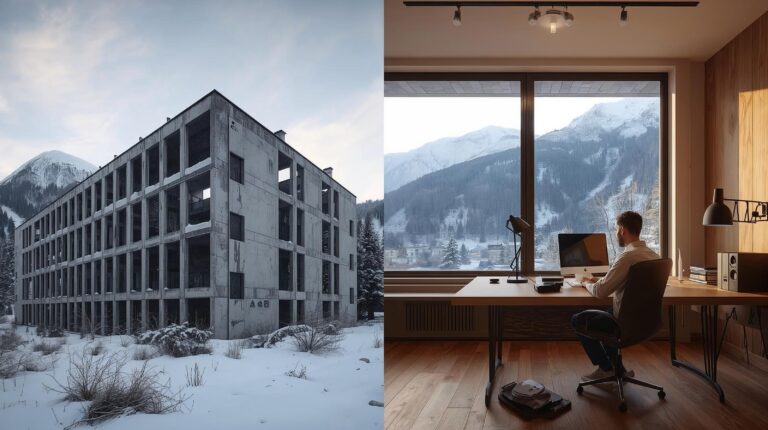
If you analyze the current property market in Bansko in early 2025, you will feel a strange duality. On one hand, there is the grandeur of Pirin, which attracts a new generation of inhabitants – digital nomads, young families and wellness experience seekers. On the other hand, there are the “scars” of the city: dozens of unfinished concrete skeletons, monuments to a long-burst illusion from 2007.
The real estate sector in the most famous Bulgarian ski resort is at a critical point. At first glance, the supply is huge. There are thousands of ads. But if you ask someone who wants to move here permanently, the answer is shocking: “There is nothing to buy.”
This is the story of a "hollow" market and the strategy that can fill it with meaning.
Part I: Archaeology of the Balloon (Why are buildings the way they are?)
To understand today's deficit, we need to go back in time. The period 2005-2008 was the era of the Gold Rush. Investors - mostly British and Irish at the time - weren't buying homes; they were buying financial instruments with a roof.
Architecture followed money. The goal was simple: maximum number of units on minimum land area. The result was the specific phenomenon of “Ski-apartment”:
- 📐 Area: 35-45 sq.m.
- 🍳 Kitchen: Symbolic (no one cooks during a 7-day ski vacation).
- 🎿 Warehouse: Missing (ski boots are kept in the hallway).
- ❄️ Heating: Cheap electric convectors (the bill doesn't matter for a week).
When the bubble burst in 2008, Bansko was left with thousands of these “boxes” and dozens of unfinished buildings (skeletons). Today, in 2025, these properties are functionally obsolete. They were designed for tourists, but the town is already being populated by residents.
Part II: The New Tribes of Pirin and the “Missing Properties”
Bansko is no longer just a winter resort. Thanks to phenomena like Nomad Fest and the global trend of remote working, the town is pulsating year-round. The new buyer is radically different from the speculator of 2007.
- The digital nomad: He wants gigabit internet, silence for Zoom calls, and an ergonomic workplace, not a kitchen table.
- The young family: He is escaping the smog of Sofia, but needs separate bedrooms for the children, a real kitchen and a yard.
- The Wellness Migrant: He seeks luxury, mineral water and tranquility on the outskirts.
The clash between their needs and the old building stock has created a vacuum. The market lacks:
⚠️ Three-room apartments (3 bedrooms): During the boom, it was believed that three studios were easier to sell than one large apartment. Today, families are forced to live in cramped quarters or not buy at all.
⚠️ Modern houses (Chalets): Paradoxically, an alpine resort lacks an alpine house with its own yard.
Part III: The “Skeletons” Dilemma – To Push or to Finish?
One of the most common mantras in public space is: “Stop new construction, finish the old skeletons!” It sounds logical and ecological. But the economic and technical reality is cruel.
The buildings abandoned at the stage "“Act 14”"(rough construction) 15 years ago, are subjected to the harsh mountain climate.
Technical and legal trap:
- Concrete dementia: Water seeps into the microcracks, freezing and expanding the concrete. Even worse is carbonation – a process in which the protective layer of the reinforcement breaks down, the steel rusts and “bloats” the concrete from the inside.
- The legal maze: Many of these buildings have dozens of owners (some long-gone foreigners). Gathering the signatures of 40 people scattered around the world to restart construction is a legal “Mission Impossible.”.
- The Shock of 2025: If you decide to finish a frame today, you have to make it legal to current standards. This means Energy Class A, expensive insulation, accessibility for the disabled and earthquake codes that did not exist when the building was designed in 2006.
Often, “saving” a skeleton costs more than demolishing it. Only those that are owned by a bank or fund and are in the ideal center to The Gondola, where land is priceless.
Part IV: The Amalgam Strategy – Real Estate Alchemy
If the skeletons are too risky and new land in the center is lacking, what is the solution for investment in Bansko property market? The answer is renovation through consolidation. This is the biggest opportunity for investors today.
The recipe is simple:
You are buying two adjacent studios in a completed building (Act 16) at a low price. You tear down the wall. You transform two non-functional boxes of 40 sq.m. into one luxurious apartment of 80 sq.m.
- Value creation: The square meter of a "livable" home sells for more than that of a studio.
- Technical upgrade: The merger allows us to solve the biggest problem – the lack of storage. The second bathroom becomes a wet room for a washer, dryer and boiler – the holy grail for every household.
- Energy revolution: During the repair process, inefficient convectors are replaced with heat pumps (high-end air conditioners). This reduces electricity bills from 400 BGN to 80 BGN in the winter.
Part V: The Future is in the Periphery (Banya and Razlog)
While the center of Bansko should focus on consolidation and renovation, “new” construction is migrating in. The valley between Bansko, Banya and Razlog is becoming the equivalent of “Beverly Hills” for the area.
Where there is land, the missing product is born: the detached house.
Smart developers are no longer building apartment buildings. They are building low-rise, gated communities, often prefabricated or wooden structures, that offer energy independence (rooftop photovoltaics) and, most importantly, a yard.
The area of Banya village is particularly valuable. There, properties with access to mineral water are creating a whole new market – that of a year-round wellness home that does not depend on the presence of snow.
Conclusion: From “Ski Bedroom” to “Mountain Home”
Bansko is going through a painful but necessary puberty. The town is growing out of its image as a cheap party destination for British students and becoming a serious European location for digital nomads and mountain lovers.
The opportunities for profit in 2025 are not in pouring more concrete into the rebuilt center. The money is in the intelligent redevelopment of the existing (uniting apartments) and in creating a quality, family-friendly product on the periphery.
The skeletons will remain as a warning from the past, but the future belongs to those who understand that a property is valuable not because of its square footage, but because of the quality of life it offers.
Investor's Guide: Key Takeaways
| Strategy | Risk | Potential | Who is it for? |
|---|---|---|---|
| Purchase of a studio “for rent” | Low | Low | For passive income, but the market is saturated. |
| Finishing “Skeleton” (Act 14) | Extreme | High (only for top locations) | Only for large funds with powerful legal teams. |
| Merge (2 in 1) | Medium | Very tall | For individual investors seeking arbitrage. |
| New construction (Banya/Razlog) | Medium | Tall | For entrepreneurs targeting the luxury segment. |
Want to know more about every “skeleton” in the city?
 English (UK)