

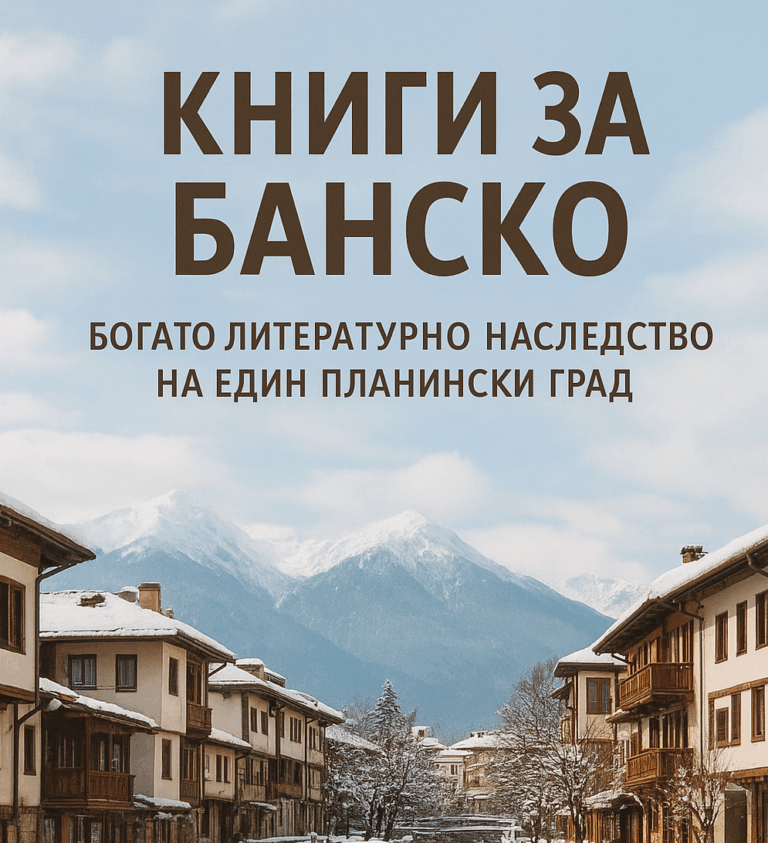
Bansko is a town that not only captivates tourists with its beauty and historical value, but has also inspired numerous authors to come up with detailed works about its past, present and development. In recent decades, dozens of publications have appeared that examine various aspects of the life of this unique town in the heart of Pirin. From historical studies to memoirs, from tourist guides to scientific monographs - the literature about Bansko is truly vast and diverse.
Historical and local history works
One of the most important publications on the history of Bansko is the monograph “Bansko – a Spiritual Center Through the Ages” by Mihail Enev, published in 2002 by the Foundation “National Cultural and Educational Traditions”. This is a voluminous book of 240 pages, which traces the deep and multifaceted history of the town of Bansko from antiquity to the modern period. Enev reveals how over the centuries Bansko has become a spiritual center of regional and national importance. The work is detailed, evidence-based and written with the author’s deep knowledge of the region. There is also an English version of the book – “Bansko: A Center of Culture Through the Ages” from 2002.
Another significant book is “Bansko” by Lyudmil Tsankov, published in 1999 by the “Irin '99’ publishing house. This edition is known for its rich illustrative material and attractive design, which makes it accessible to both specialists and the general public.
One of the oldest known works is “Bansko” by Dimitar Krastev, published in 1959 by the State Military Publishing House. This edition, divided into two parts, includes sections with resonant titles such as “Legend of the Beginning”, “Shadows and Silhouettes from the Darkness” and “Fortress of the Bulgarian Spirit”. Although it is from more than 60 years ago, the book retains its historical significance and is a valuable archival document.
Works, travels and memoirs
“About the Revival Bansko, Sofia and the World… Chronicles of a Family” by Lazar Hadzhivalchev was published in 2013 by the Academy of Sciences “Prof. Marin Drinov”. This is a memoir that tells the story of a family over 300 years, connected with the legendary family house and life in Bansko. Lazar Hadzhivalchev is not just an author, but a witness and participant in significant historical chronicles. The book is available in different editions – with hard and soft covers, which makes it accessible to different preferences of readers.
Closely related to the history of Bansko and its revival is the publication “Bansko and Mount Athos: The Mission of Hadji Valcho, the Brother of Paisii Hilendarski, on the Threshold of the Bulgarian Revival” by Ekaterina Boyadzhieva, published in 2002 by the publishing house “ARS-Millennium-MMM”. This is an in-depth study that reveals little-known facts about the brothers of the famous Paisii Hilendarski and his role during the era of the Bulgarian Revival. Ekaterina Boyadzhieva is known for her deep scientific approach and careful study of historical documents.
Another significant work is “The Foothills of Perun” by Maria Radonova, published in 2010 year from Slavina Publishing House. This is a narrative that tells the history of Bansko from antiquity to the modern period, with special attention to the portraits of legendary personalities who linked their fate with the city of Bansko. Among them are Paisii Hilendarski, Neofit Rilski, Gotse Delchev, Nikola Vaptsarov and many other significant figures of Bulgarian history and culture.
“Bansko – Research and Materials” is a collection compiled by Mila Santova and Evgeniya Mitseva, published in 1995. This collection presents a complex of scientific articles and studies dedicated to various aspects of the culture, customs, history and language of Bansko. It is a valuable resource for researchers and people interested in a deeper understanding of the local identity.
“Bansko – Literary Center” is another important collection that includes unpublished Ottoman-Turkish documents and articles about the cultural heritage of the town of Bansko. This publication sheds light on the period of Ottoman rule and shows how the local population preserved its culture and identity during a difficult historical period.
Architecture and religious heritage
For the architectural and religious heritage of Bansko, “The Church of the Holy Trinity in Bansko‘ by Stefan Stamov has been published. This publication examines in detail one of the most important historical monuments of the town of Bansko – the magnificent church, which was completed in 1835 with funds collected by pious citizens and donors. There is also an English version of this publication – ’St. Trinity Church of Bansko” – which allows an international audience to get acquainted with this historical monument.
Sports and tourism
In 2017, a small town in the heart of Pirin became famous not only for its pass, but also for the history of skiing. The first book of its kind dedicated to the history of skiing in Bansko was published – “Todorka’s Fireflies” by Dimitar Sugarev, co-authored with Maria Tsigoriina. This is a memoir that tells the personal story of the pioneer of skiing and honorary citizen of Bansko – Dimitar Sugarev. The book traces the history of organized sports events in Bansko from their beginning 60 years ago to the modern period, when Bansko has been transformed into one of the most modern winter resorts in the Balkans and Europe.
The title of the book – “Todorka’s Fireflies” – symbolizes the snow groomers who glow like fireflies at night as they groom the slopes. They are a symbol of the achievements of Sugarev and other like-minded people who have dedicated almost 60 years to the development of skiing in the region.
Narrow Gauge Encyclopedia
One of the newest and most grandiose publications concerning the region is “The Rhodope Narrow Gauge Railway Septemvri-Dobrinishte” by Kristian Vaklinov, published in 2025 by the “Biblioteka Bulgaria” publishing house. This is the first encyclopedia of its kind dedicated to the glorious narrow gauge railway. Vaklinov, whose name is synonymous with the work of preserving this historical monument, has collected in 364 color pages rich historical material, archival photographs, memories of people connected with the railway, as well as technical data on the development of the rolling stock.
The encyclopedia traces the construction of the line, which began in 1915, overcoming the experiences, interruptions and excavations of individual sections. For each stop, including the highest station in the Balkans - Avramovo, there is a description with drawings and diagrams. Kristian Vaklinov has surprisingly collected rare archival photos from descendants of employees and passengers connected to the railway. Through the narrative, the memories of the people for whom the narrow-gauge railway was the only connection to the world come to life.
Literary works and poetry
Bansko is associated with the work of the famous Bulgarian poet Nikola Vaptsarov (1909–1942), born in the town of Bansko. Vaptsarov is known for his social and humanistic themes. The only collection of poems published during his lifetime by Vaptsarov – “Motor Songs” – was published in 1940 and was subsequently translated into a number of languages. A memorial museum dedicated to Vaptsarov operates in his home in Bansko, which attracts many devotees of Bulgarian literature and history.
Other publications that touch on the work of writers associated with Bansko include works by Paisii Hilendarski, who was born in Bansko in 1722. Paisii is the author of “History of Slavs and Bulgarians”, written in 1762, which is considered one of the most important works of Bulgarian literature. His work has been published in numerous editions and reprints over the years, including an academic edition “250 Years of History of Slavs and Bulgarians 1762. Zografska chernova”, published in 2012 by the Bulgarian Bestseller Publishing House.
Contemporary literary publications
In 2024, in celebration of The day of Bansko, two new books were presented. “Crossroads” by Georgi Malchev is a collection of verbal sketches related to friendship, love of words, woodcarving and love for Pirin and Bansko. “Chronicle” by Konstantin Ikonomov is a collection of poems and wood sculptures dedicated to Bansko and the region. The two editions, presented in the Bansko Town Museum, show how even today Bansko continues to inspire contemporary authors.
Travel guides and reference books
For tourists and travelers who wish to get to know Bansko, there are various tourist guides available, including bilingual editions with maps and information about ski slopes. These editions usually include detailed maps of the town and the region, information about attractions, hotels and restaurants.
Historical documentation
Of historical importance is the publication “A Brief Description of the Settlement of Bansko, Collected from the Traditions of Old People” by Ivan D. Chuchulain, published in 1928. This is a rare publication that preserves memories of the experiences of the old people of Bansko regarding the origin and development of the city.
Conclusion
Literature about Bansko is a testament to the rich history, culture and significance of this small town in the heart of Pirin. From ancient times to the modern period, Bansko has attracted the attention of historians, writers, poets and researchers. The long-published books about Bansko are not only scientific works, but also memoirs, literary works and documents that preserve the memory of the past and highlight the path to the future. For anyone who wishes to understand the deep historical and cultural significance of Bansko, such publications represent an invaluable resource and inspiration





 English (UK)