


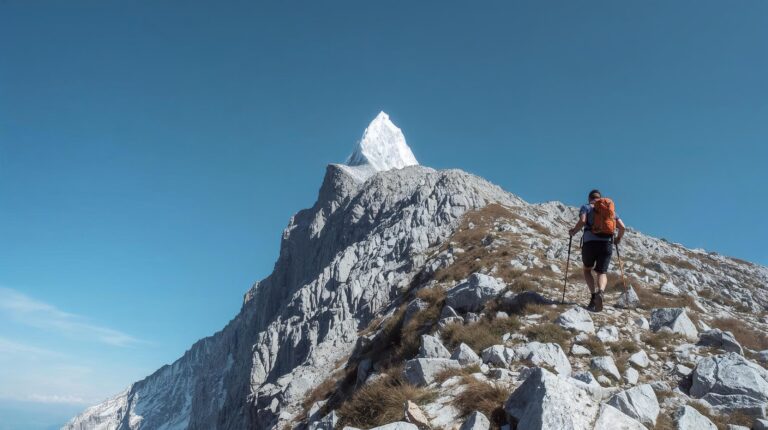
Why is the oxygen in Pirin different?
As you climb above 2,000 meters, atmospheric pressure drops. Although the percentage of oxygen in the air remains the same (about 211% by volume), the “partial pressure” decreases. This means that fewer oxygen molecules enter your lungs with each breath. This is why your breathing technique is critical to your survival and comfort.
1. The Physiology of Proper Breathing: Nose or Mouth?
This is the fundamental question that every beginner asks. The right breathing when climbing peaks it depends on which aerobic zone your body is in at the moment.
Aerobic Zone and the “Golden Rule”
Your goal is to maintain a pace where you can say a short sentence without pausing for air in the middle. If you start to get out of breath while speaking, you've entered anaerobic mode, where your body builds up lactic acid much faster than it can clear it.
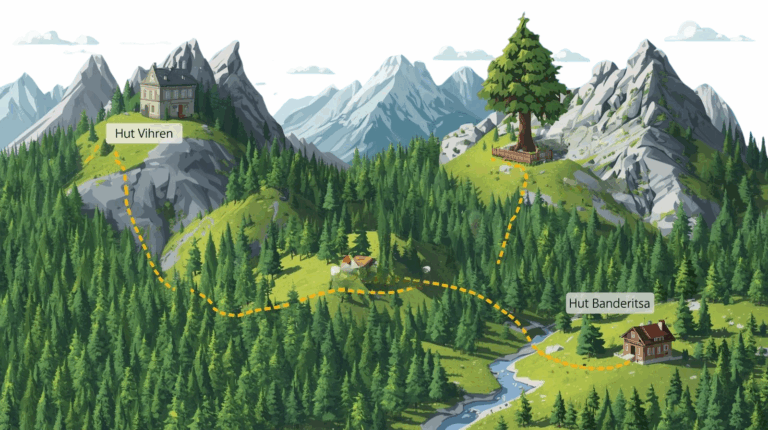
- Breathing through the nose (Low intensity): Applicable at the beginning of the path (e.g. from The Shiligarnika to the lakes). The nose filters dust, humidifies and warms the air. This is the “economy mode” of your body.
- Mouth breathing (High intensity): When you attack the “Pyramid” of Vihren or the steep sections towards The Kazanites, the nose cannot provide the necessary volume. Use the technique “Fish mouth” – slightly open lips that allow for a large flow of air but do not dry out the throat as aggressively.
2. Synchronization: How to Enter “Mountain Trance”
The secret of experienced mountain guides in Bansko is the absolute synchronization between breathing and every step taken. When you automate this process, you stop thinking about fatigue.
| Terrain slope | Rhythm (Steps : Breathing) | Effect on the body |
|---|---|---|
| Lek (Along Banderishka River) | 3:1 or 4:1 | Minimum pulse, high endurance. |
| Middle (Towards Okoto/Muratovo) | 2:1 | Classic work rhythm. |
| Very steep (Vihren Wall) | 1:1 | Maximum power at every step. |
3. The “Rest Step” Technique (Alpine Rest Step)
This is the most valuable skill for breathing when climbing peaks and moving on scree. “Rest Step” is not just a way of walking, but a muscle survival strategy.
How to perform it correctly?
- With each step up, fully extend the knee of your back leg (“lock” it for a moment).
- Thus, the entire weight of the body is transferred to skeleton, and not on the quadriceps muscle.
- Take a micro-pause (about 0.5 – 1 second). During this time, the muscle rests, and the heart manages to make one more beat.
- Move the front leg and repeat.
4. The role of walking sticks for better breathing
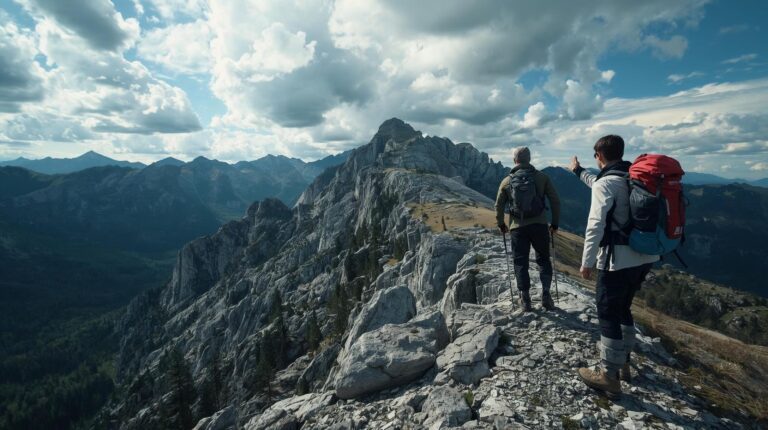
Many people think of trekking poles as a tool only for the knees. This is a huge mistake. Trekking poles are directly related to your capacity for breathing when climbing peaks. When you use them, you keep your body upright. This prevents you from hunching over under the weight of the backpack, which otherwise compresses the chest and restricts the movement of the diaphragm.
Professional advice: Adjust their length so that your elbow forms a 90-degree angle on flat ground. When climbing, shorten them by about 5-10 cm.
5. Hydration and Nutrition: Fuel for the Lungs
Breathing in the mountains dries out your mucous membranes. The higher you are, the more fluids you lose just by exhaling water vapor. Dehydration causes your blood to thicken, making it harder for oxygen to reach your muscles.
- Drink in small sips: Every 15-20 minutes, even if you don't feel thirsty.
- Electrolytes: Pirin water is very clean, but poor in minerals. Add soluble tablets with magnesium and potassium to avoid cramps.
Frequently Asked Questions (FAQ)
Do walking sticks help with better breathing?
Yes, they keep the chest open and allow the diaphragm to take in up to 20% more air compared to the hunched posture.
What should I do if I have palpitations at high altitude?
Stop immediately, stand up straight, and take a series of deep breaths through pursed lips. Drink water and wait for your pulse to calm down.
Can a smoker climb Vihren?
Yes, but it is vital that you do not try to keep up with the pace of non-smokers. Your rhythm should be slower and more rigorous to compensate for the reduced capacity.
Note: This article is for informational purposes only. Always consult a doctor before engaging in strenuous physical activity in the mountains, especially if you have cardiovascular problems.
 English (UK)