


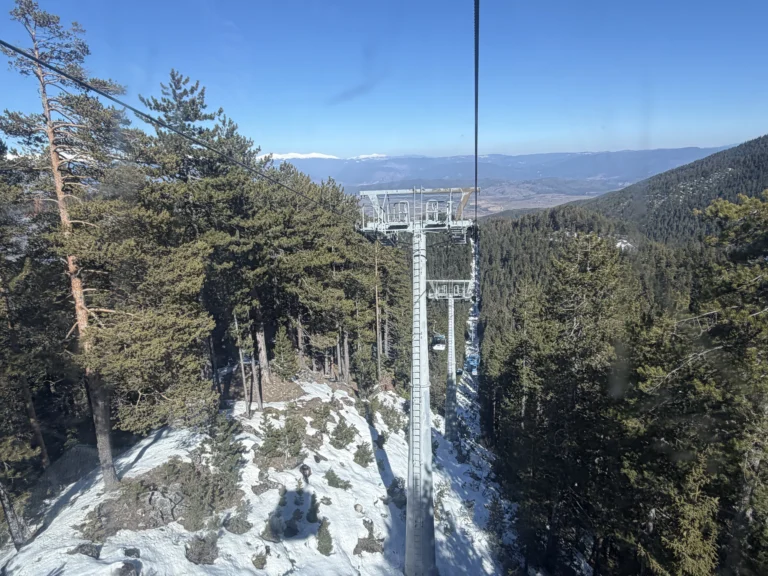
The answer lies in the massive metal columns, or more precisely in the professional terminology of cable cars – the lift poles. In this article, we'll dive into the details and reveal the secrets of these steel backbones that make modern ski touring possible, looking at the iconic cable car poles Bansko.
Doppelmayr's engineering masterpiece
Designed and manufactured by the world leader in cable car construction - the Austrian-Swiss company Doppelmayr, the lift in Bansko was put into operation at the end of 2003. With a total length of over 6.2 kilometers (6233 meters), this is one of the most important and busy transport arteries in the entire region.
Number and location along the route
To keep this huge system absolutely stable in all weather conditions, on the steep slopes of Pirin, total of 60 metal poles. They are strategically distributed in two main sections, as the facility technically consists of two independent circuits:
- First section (36 pillars): It starts from the starting station in the town of Bansko (998 m above sea level) and reaches the intermediate station in the area of “Chalin Valog”.
- Second section (24 pillars): It leads the rope from the intermediate station to the end point of the famous "“Banderishka meadow”"(1620 m above sea level).
Types of structures: Are they all the same?
Absolutely not. Although the cabins share a common visual design, each pole along the route is unique. It is designed, calculated and manufactured specifically for its specific location in relation to the microrelief of the mountain. According to their technical function in relation to the rope, they are divided into three main types:
- Load-bearing pillars: These are the most massive structures on the route. Their role is simple but vital – they support the steel cable from below through so-called “roller batteries”, ensuring a smooth passage of the cabins over the rugged terrain.
- Pushing poles: They are used for steep slopes or depressions in the mountain terrain. In them, the roller batteries are installed backwards - so that they press the rope from top to bottom. This prevents the rope from "flying" upwards under strong tension.
- Combined pillars: They perform both functions simultaneously. They are installed on the most difficult sections of terrain where a serious break in the riding angle is required, ensuring that the rope remains perfectly centered.
Logistics and extreme installation in the mountains
All the elements are manufactured in ultra-modern factories in Austria, where the steel is cut and welded with robotic precision. But how do these giants get to the steep and inaccessible slopes of Pirin?
The assembly is a real logistical challenge. The elements are delivered disassembled to base camps in the mountains. For accessible areas, high-altitude mobile cranes and specialized “walking” excavators are used. But for the steepest and most forested terrain, heavy aviation intervenes. Specialized cargo helicopters (such as the powerful Super Puma) carry tons of steel through the air. Pilots hang meters above the ground while ground crews precisely align the sections to match the millimeter-scale holes in the flanges. This process requires perfect timing, complete calm, and nerves of steel.
Why are there steps on the metal columns?
Many tourists notice the small metal steps and platforms (catwalks) that wind along the length of each pillar. Their sole and critically important function is to provide physical access for mechanics to the top of the column, where the roller batteries and vital electronics are located.
The ladders are used extremely frequently during the annual maintenance (in spring and fall). Then, mechanics climb each of the 60 ladders to check structural welds, tighten bolts with a torque wrench, grease bearings, and replace worn rubber tires on the small wheels.
Uncompromising protection: Paintwork and sensors
The poles are subjected to the harshest elements of nature – freezing cold, heavy snow, acid rain and strong UV radiation. To prevent rusting, before leaving the factory, they undergo a hot-dip galvanizing process, then are coated with high-tech industrial polyurethane paints. This anti-corrosion protection is so effective that a complete repainting in the mountains is almost never necessary.
In addition to being structurally sound, the columns are also “smart.” The system is secured with hundreds of electronic sensors (wind anemometers) and so-called “breakaway switches” next to the rollers. If, due to a strong storm, the steel cable deviates even by millimeters from its correct position, the sensor breaks and automatically stops the entire lift in a split second, preventing derailment.
The Bansko cable car has been operating flawlessly for over two decades thanks to the uncompromising engineering quality of these steel giants and the tireless, often invisible work of the people who take care of their maintenance. The next time you glide silently over the tops of the Pirin pines, look up at the massive columns and remember the intricate symphony of mechanics and human effort that keeps you safe.
Are you ready for your mountain adventure?


 English (UK)