


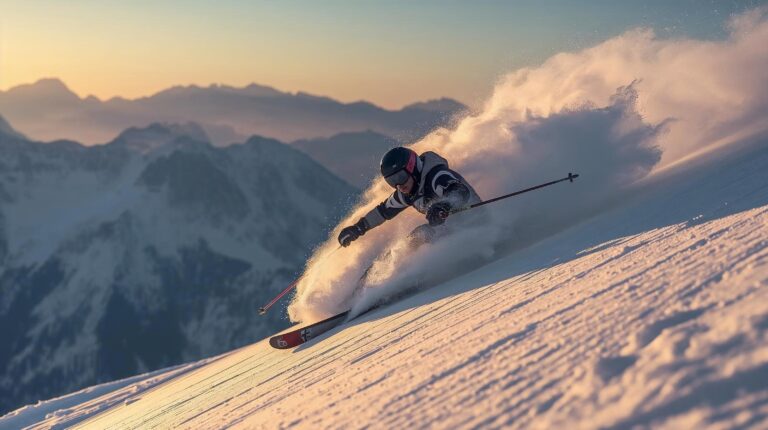
In this detailed analysis, we will disassemble the technique step by step, based on the specialized lesson from the professionals in Stomp It Tutorials. These 5 techniques will help you control speed through turn shape, extreme edge angles, and proper body biomechanics.
The video below shows key exercises. To make it as easy as possible for you, turn on the automatic Bulgarian subtitles:
- Click on the icon Subtitles (CC) in the lower right corner of the player.
- Click on Settings (the gear) next to her.
- Choose Subtitles/CC ➔ Auto-translate (Automatic translation).
- Find and select Bulgarian (Bulgarian) from the list.
Video: How to carve on steep slopes. Source: Stomp It Tutorials
Physics of Skiing: Why does steepness scare us?
Before we start with the exercises, we need to understand our main enemy in the mountains: Gravity. On a gentle slope like the “Platoto” in Bansko, the force pulling you straight down is relatively small. But when you step onto a red or black run, gravity and the parallel forces acting on your skis increase dramatically.
To avoid accelerating out of control, you need to create resistance (friction and drag). Most inexperienced skiers do this by skidding their skis to the side in panic. We'll teach you how to do it elegantly and effectively by clean carving.
1. Beat gravity through the shape of the bend
The most important method of controlling speed is not mechanical braking, but the direction of travel itself. To control speed on a steep slope, you should end your turns completely perpendicular to the fall line, or even slightly up the slope. The shape of your turn is your best friend.
Turn Shape Drills
- Drill 12-6 hours (Drill 1.1): Imagine a giant clock face on the snow. You enter the turn at 12 o'clock (pointing down) and end it at 6 o'clock (looking straight across the track), crossing the entire slope.
- Drill 1-5 hours (Drill 1.2): For an even more aggressive deceleration, close the turn even further, pointing your skis almost back to the top. This is the moment when you defeat gravity for a split second, allowing you to start the next turn with zero initial speed.
Many skiers try to make very short, fast turns on steep slopes out of fear. The problem is that they keep their skis pointing mostly down the slope the entire time, which leads to extreme acceleration. For real control, widen the radius of the turn (Long Radius Turns).
2. Increase friction: Extreme edge angles
Low edge angles are completely useless on black piste – they will cause your skis to slide on the hard snow. You need a high edge angle to cut deep into the ice. The higher the angle, the greater the friction and the lower your speed.
Exercise with poles (Incline Pole Drags): To get a feel for how much you should lean your body towards the center of the turn, try dragging your inside pole across the snow while carving. This will physically force you to lower your center of gravity and increase your lean.
3. Cross-Under Transition
On a steep track, you don't have the luxury of time to slowly and sluggishly transfer your weight. If the transition between two turns is slow, gravity will immediately accelerate you into the line of fall. The solution is called technique. “Cross-Under”.
In this, your upper body remains stable and constantly pointed down towards the valley (towards the town of Bansko), while your legs and skis move rapidly beneath you like a pendulum from one edge to the other. This ensures that your skis are in contact with the snow and the edges work through the 95% from the weather.
4. The “Cheat Code” of the Pros: The Stivot
If the track is absurdly steep and icy (as is often the case in the final part of “Tomba” after lunch), even perfect carving may not be enough. This is where the help comes in. “The Stivot” – a hybrid technique between Steer and Pivot.
In this World Cup technique, you intentionally slide your skis in the first third of the turn to kill momentum at the steepest point, then sharply edge and finish the second part of the turn in a clean, cutting carve. It requires extreme leg strength and perfect timing.
Don't attack Tomba from day one. Start practicing your turn form on blue runs like #10 (The Shiligarnika). When you have mastered the edge, move on to a red run like “Balkaniada” (#4). Only when you start to feel confident in aggressive edge there, move on to the black sections.
5. Equipment Preparation (The Hidden Factor)
Finally, don't forget that carving on steep slopes is physically impossible with blunt edges. The black runs in Bansko often require edges sharpened to 88 or even 87 degrees. If your skis are sliding uncontrollably, the problem may not be in your technique, but in the lack of service.
Are you ready to upgrade your skills?
Perfect carving requires perfect equipment. Make sure your skis are serviced and your boots are stiff enough (flex index) before you attack the mountain.
 English (UK)