


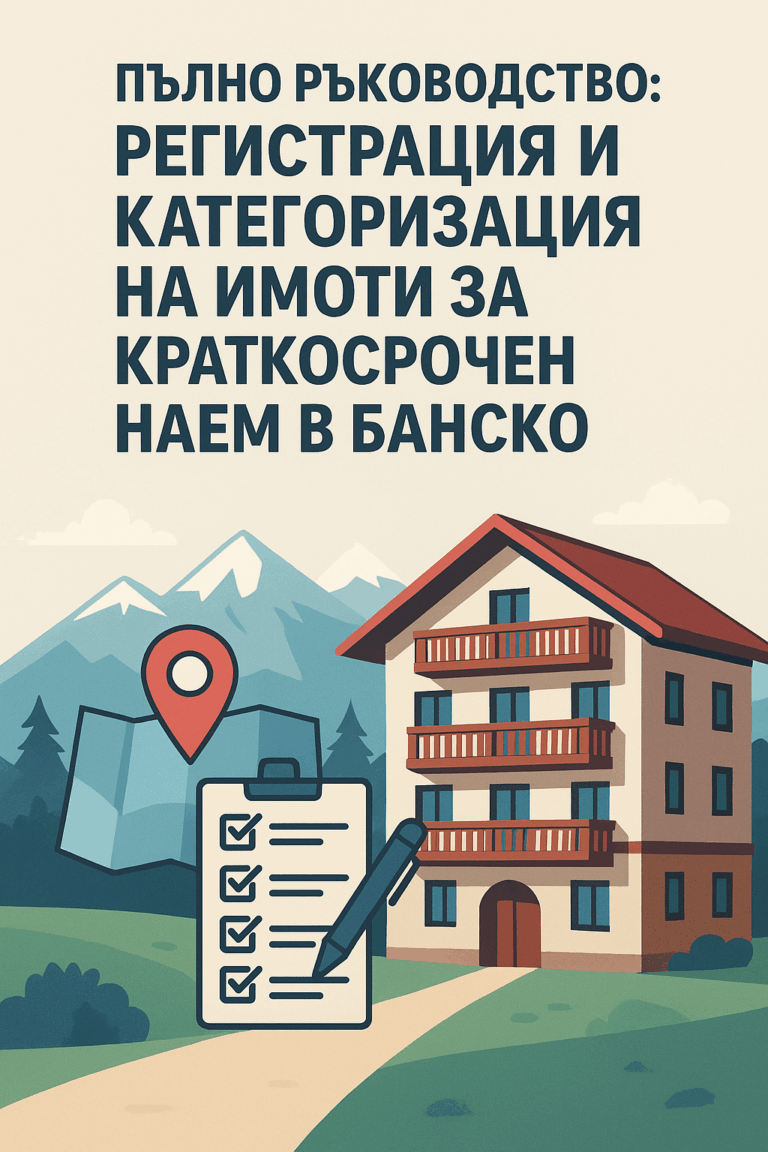
The time when properties could be rented out informally is over. With the introduction of the European DAC7 directive, booking platforms now automatically exchange data on your income with the National Revenue Agency (NRA). Failure to register carries the risk of severe administrative sanctions and permanent deactivation of your account on global platforms.
This comprehensive guide will guide you step by step through the entire administrative process - from the Bansko Municipality registry to the mandatory integration with the Unified Tourist Information System (USTI) and taxation.
Step 1: Categorization of the property in Bansko Municipality
According to the Tourism Act in Bulgaria, any property offering the service of “short-term accommodation” is subject to state categorization. For owners of independent dwellings (apartments, studios or houses), these are most often objects of Class "B" - "Guest Apartments"„ or „"Guest rooms"“.
Where and how are the documents submitted?
The procedure officially starts at the registry office of the Municipality of Bansko. The documents can be submitted personally by the owner or through an authorized person, for which an explicit notarized power of attorney is required. It is recommended to set aside at least one day to collect the documentation before visiting the municipality.
Full list of required documents
To start the property categorization procedure in Bansko, you must prepare the following set of documents (we advise you to make a preliminary inquiry on site or on the municipality's website for possible minor changes in the regulations):
- Sample application-declaration: It can be obtained directly at the counter at the Bansko Municipality or downloaded from their official website.
- Property document: Copy of the property's notarial deed.
- Property sketch: Current sketch issued by the Agency for Geodesy, Cartography and Cadastre (AGCC).
- Certificate of commissioning (Act 16): A mandatory copy proving that the building is fit for habitation.
- Document for paid state fee: The fee for reviewing documents is determined by the Municipal Council. Its amount varies depending on the capacity (number of beds) of your facility.
- Current status information (for legal entities only): Document with a UIC.
- Written consent from co-owners: If the property has more than one owner, the consent of all other persons listed in the notarial deed is required.
How does the administrative process of the procedure proceed?
- Login: After submitting the complete package of documents, the municipal employees will issue you an incoming number with which you can track the status of your file.
- Issuance of a Temporary Certificate: Within the statutory period (usually within 7 to 14 working days) you are issued Temporary certificate for an open categorization procedure.Important: With this document, you now have the full right to legally operate, create profiles on the platforms, and receive your first guests in Bansko while the final procedure is underway.
- On-site inspection: The Municipal Expert Commission for Categorization (OEKK) reserves the right to conduct a physical inspection of your property. The purpose is to verify that the apartment meets the minimum requirements for area, furnishings and safety for the requested category (e.g. 1, 2 or 3 stars).
- Final Categorization: After a positive opinion from the commission, the Mayor of Bansko Municipality issues the official Certificate of Categorization. This document is valid for 5 years, after which it must be renewed.
Step 2: Mandatory registration with ESTI
Obtaining a category and stars from the municipality is only the first stage of legalizing your business. The second, and equally critical, step is connecting with ESTI (Single Tourist Information System). This is the national centralized system of the Ministry of Tourism, created to ensure transparency and real-time data exchange between accommodation establishments, the Ministry of Interior, the National Revenue Agency and local municipalities.
The old paper registers, notebooks and address cards are now history. Today, every landlord is legally obliged to register every single guest in the electronic system within 24 hours after his physical check-in at the property.
Process for providing access and working with the system
To start working with ESTI, you need to go through several technological steps:
- Request to create an account: When submitting the categorization documents to the Municipality of Bansko (or immediately upon receiving the temporary certificate), you also fill out an official application for registration with ESTI.
- Get an account: The municipal administration creates a profile for your tourist site in the national database and provides you with a unique username and password.
- Login and cryptographic identification: The system is accessed through the official web portal. To ensure the security of tourists' personal data and to sign their monthly statements, the system requires the use of Qualified electronic signature (QES).Advice for individuals: You don't need to buy a hardware flash drive. You can use a cloud-based QES (via mobile apps like Evrotrust or B-Trust), which is a much more convenient, fast and economical alternative.
Operational activity in the system: With each reservation, you are required to enter your guests' details: Names, Personal Identification Number (PIN/LNC) (or international passport/ID card number for foreigners), date of birth, gender, citizenship, as well as the exact dates of arrival and departure.
Calculation of tourist tax: One of the biggest advantages of ESTI is its automation. The system automatically calculates the resort (tourist) tax due to the Municipality of Bansko based on the realized and registered overnight stays. You simply generate a statement at the end of the month and pay the amount due to the local treasury.
Frequently Asked Questions (FAQ) from landlords in Bansko
Is the consent of the neighbors (Condominium Ownership) required?
When categorizing objects of the type “Guest Apartments” (class B), the Tourism Act currently does not explicitly require 100% consent from the General Assembly of the condominium, which is mandatory, for example, for hostels. However, The Condominium Management Act (ZUES) applies in full force. It is highly recommended that you inform your neighbors, pay your common area maintenance fees correctly (which are often inflated for rental properties) and require your guests to strictly adhere to the house rules. Good relations with neighbors are a guarantee against malicious complaints and extraordinary inspections.
What are the sanctions for illegal activities and violations?
Bulgarian legislation provides for strict sanctions for violators. Fines for providing tourist services in an uncategorized facility start at 500 BGN and can reach 5,000 BGN for individuals. For legal entities (companies) the financial sanctions are significantly higher. Additionally, concealment of income and failure to submit mandatory data in the ESTI are subject to separate, very severe administrative penalties from the NRA and the Ministry of Interior.
Do the platforms (Airbnb/Booking) pay taxes for me?
This is one of the most common misconceptions among new hosts. It is very important to differentiate between the different types of fees and taxes. Platforms automatically deduct their service fee from each booking and sometimes charge VAT on top of this fee. However, they DO NOT pay your tourist tax to the municipality, nor your income tax (or patent tax to the local government). These obligations remain the sole responsibility of the property owner or the company managing the site.
Conclusion: An investment in peace of mind
The administrative procedure for property categorization in Bansko may seem daunting at first glance, but it is actually a one-time process (renewable every 5 years) that creates a stable and legal legal framework for your tourism business. Once registered with the municipality and ESTI, you will be able to operate with complete peace of mind. The legal status allows you to build long-term trust with your guests, openly partner with cleaning and property management companies, and completely eliminate the stress and risk of surprise inspections by the National Revenue Agency and municipal control authorities.


 English (UK)