

Main types of skis: Which model is used for what?
Before we calculate the ideal ski length for you, we need to understand what types exist and what terrain they are intended for.
1. Piste / Carving
These are the most common skis you will find in the lockers around the base station of the Bansko Gondola. They are narrow in the middle (under the boot), which allows them to move from edge to edge on hard, packed snow with lightning speed.
- Slalom Skiing (SL): They are very short (usually reaching somewhere between the skier's chin and nose). They are designed for very fast, short and sharp turns. They are excellent for technical skiers on runs like "Tomba".
- Giant Slalom (GS): They are longer (reaching the forehead or top of the head). They are designed for long turns and very high speed, giving tremendous stability when flying down the runway.
2. Universal skis (All-Mountain)
If you see someone with skis that reach somewhere around their eye level and look a little wider than standard, those are All-Mountain skis. This is the “golden mean” for resorts like ours.
They are stiff enough for morning “suede” runs, but are wider underfoot (usually between 80 and 95 mm) to easily handle the plowed snow and the baboons that inevitably form in the afternoon.“The plateau”"or the ski slope.".
3. Off-piste skiing (Freeride / Powder)
These are those huge, massive skis that are often higher than the skier himself.
Their purpose is to ski in deep, unpaved snow. Their large area and length prevent the skier from sinking into the snowdrifts, but help him “surf” on top. However, on hard or icy slopes, they are extremely cumbersome, difficult to control and put a strain on the knees.
4. Park and Pipe (Freestyle / Twin-Tip)
You'll recognize them right away - they're curved up both front and back (twin-tip). Their length is usually around eye level. They're designed specifically for jumping, tricks, switching, and fun in snow parks.
How to determine the perfect ski length?
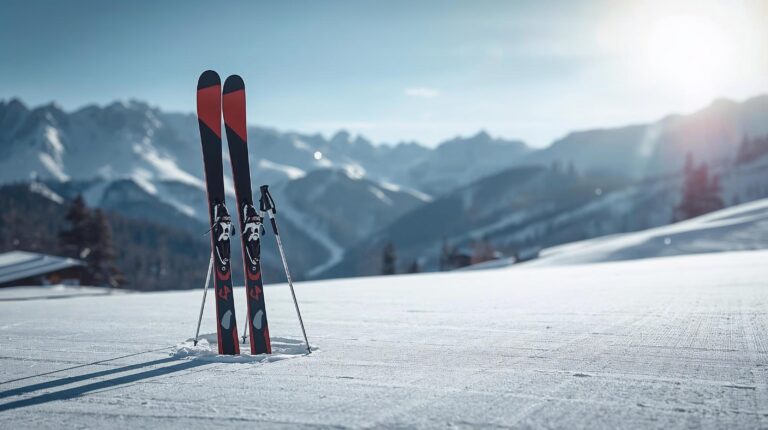
Choosing the right length is not an exact mathematical formula, but there is one established golden rule: Your skis should reach somewhere between your chin and the top of your head when you hold them vertically next to you.
Here's how to figure out exactly where in this range to aim for your individual needs:
Choose SHORTER skis (to the chin or lips) if:
- You are a beginner. or you've been skiing for a while. Short skis are much easier to turn, require less physical effort, and are more forgiving of mistakes.
- You weigh less for your height.
- You prefer to ride slowly, calmly, and make many, but short turns on the blue runs.
Choose LONGER skis (to the forehead or top of the head) if:
- You are advanced or expert. The long ski does not “shake” (vibrate) at high speed and holds much more firmly on ice.
- You weigh more for your height (you need a larger surface area to support and distribute your weight).
- You love high speeds and aggressive, long turns on red and black tracks.
- You plan to ski mostly off-piste in deep snow (then the skis may even be above your height).
Reference table: Ski length according to height
| Your height (cm) | Beginners (short skis) | Advanced (medium/long) |
|---|---|---|
| 150 cm | 135 – 140 cm | 145 – 150+ cm |
| 160 cm | 145 – 150 cm | 155 – 160+ cm |
| 170 cm | 155 – 160 cm | 165 – 170+ cm |
| 180 cm | 165 – 170 cm | 175 – 180+ cm |
| 190 cm | 175 – 180 cm | 185 – 190+ cm |
Specifics of the terrain in Bansko: What to rent?
If you are coming to Bansko for a weekend or a week-long vacation and are wondering what skis to rent from the local lockers, we recommend that you choose All-Mountain profile with length around your nose/eyes. Weather in Pirin it can be changeable – in the morning the slopes are hard as concrete, and around 2:00 p.m. on trails like No. 1 (the ski road) the snow softens and forms heavy piles. A slightly wider ski (about 80-85 mm waist) will save you from unnecessary fatigue in your legs.
Finally, don't forget that ski equipment is strictly individual. Consult with the professionals in the ski lockers - they know the current conditions in the mountains very well and will give you the most accurate advice on the spot.
 English (UK)