


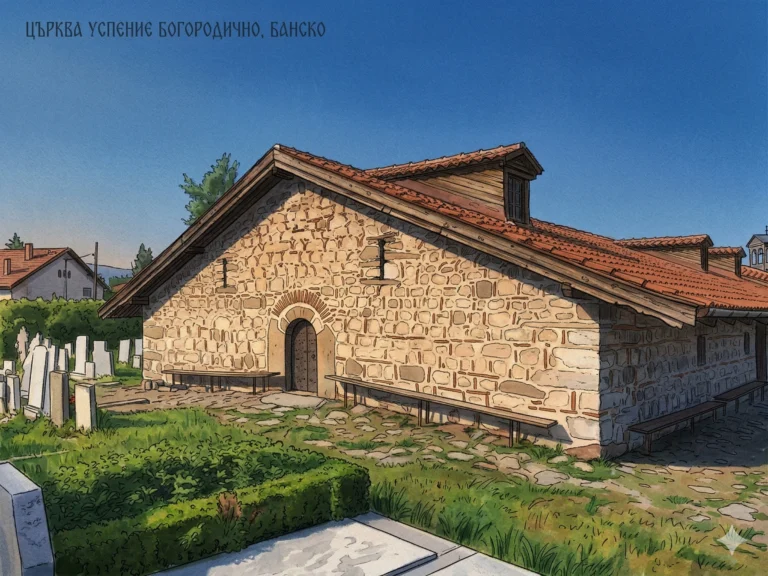
This modest at first glance temple is a true keeper of memory, carrying through the centuries the history of the city from the Middle Ages to the present day. If you are looking for an authentic spiritual experience and want to touch the roots of the Bansko art school, this place is a must-see on your itinerary.
The Assumption of the Virgin Mary Temple in figures and facts
- ⏳ Date: The end of the 18th and beginning of the 19th centuries (restored in 1774 and 1808).
- 🏛️ Basics: Built on the ruins of a medieval church.
- 📍 Location: In the old cemetery park of Bansko (the former Buga neighborhood).
- 🎨 Significance: It is connected with the birth of the Bansko Art School.
- 📜 Status: Architectural and construction monument of culture of national importance.
History and Origins: On the Foundations of the Middle Ages
Unlike the newer Bulgarian Renaissance churches, which were built on a bare meadow, the Church of the Assumption of the Virgin Mary rests on much older foundations. During archaeological and architectural research, a massive wall up to 1.2 meters thick was discovered across the church hall. Historians are categorical that an older church existed on this site since the weather of the Second Bulgarian Empire, which was probably destroyed during the Ottoman invasion.
The building in its present form was built in the 18th and early 19th centuries. Its walls are built with stone blocks from earlier constructions, some of which have preserved graffiti and inscriptions dating from 1593, 1711 and 1741. The final reconstruction, in which a gallery was added, took place in 1808 with the funds of local donors.
Architecture: Why is the church deeply dug in?
Seen from the outside, the church impresses with its low profile. It is a single-nave building with a gable roof, which is partially but deeply dug into the ground. Its longitudinal walls rise only about 2 meters above the terrain, while the transverse walls reach 4 meters. This architectural feature is not accidental - it is a direct result of strict Ottoman laws that forbade Christian churches from towering and dominating the landscape.
The construction is massive, made of stone and flat bricks. Light enters sparingly through a few small windows and openings resembling battlements, which gives the interior a mystical and muted atmosphere. The temple has two heavy doors – one iron and one wooden, studded with massive nails.
The mystery of the carved iconostasis
One of the most valuable elements in the interior is the carved iconostasis. An interesting fact is that its dimensions do not exactly correspond to the width of the current temple - on the southern side it had to be additionally extended. This leads researchers to the idea that this exquisite masterpiece was made for the older building or was brought from elsewhere. Its carving is the work of an unknown but extremely talented master, whose style is reminiscent of the school that worked in Rila Monastery.
Toma Vishanov and the Bansko School
The Church of the Assumption of the Virgin Mary is inextricably linked with the name of Toma Vishanov – Molera, the founder of the famous Bansko School of Painting. It was here that he and his son Dimitar created some of their earliest and most impressive icons, weaving Western European influences (brought from Thomas's travels to Vienna) into traditional Orthodox icon painting.
How to get to the temple?
The church is located in the northern part of the town of Bansko, in the cemetery park area (near the intersection of Bulgaria and Patriarch Evtimii streets), very close to the building of the Directorate of Pirin National Park. The place is easily accessible on foot from the town center or by car, and there is free parking in the area. Access is free.
A visit to this ancient temple is a journey back in time that will enrich your understanding of the cultural and historical heritage of the region. Be sure to take time for silence and reflection under the centuries-old arches of the building.
Continue your historical walk in Bansko!

 English (UK)