


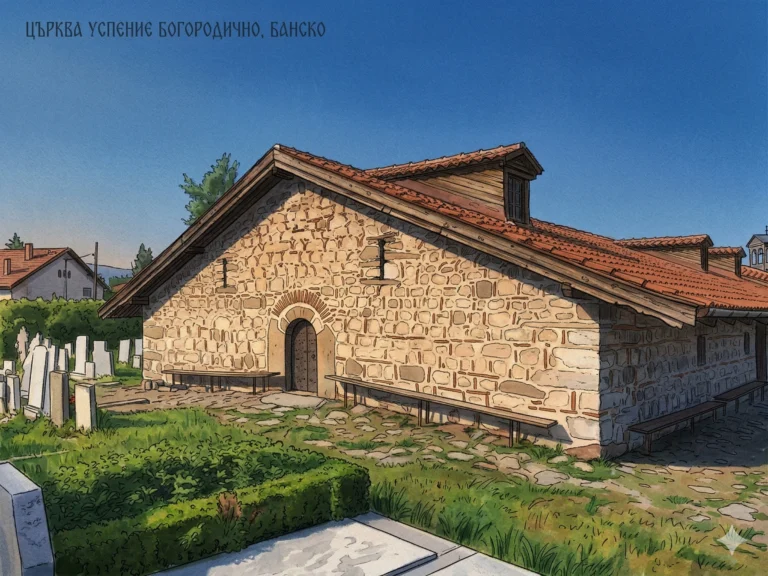
The Assumption of the Virgin Mary Temple in figures and facts
| ⏳ Date: | The end of the 18th and beginning of the 19th century (restored in 1774 and 1808). |
| 🏛️ Basics: | Built on the ruins of a Christian temple from the weather of the Second Bulgarian Empire. |
| 📍 Location: | The old cemetery park, Bansko. |
| 🎨 Significance: | Epicenter of the Bansko Art School. |
| 📜 Status: | Architectural monument of culture of national importance. |
History and Origin: The Ancient Foundations of the Church of the Assumption of the Virgin Mary in Bansko
Unlike the later Renaissance temples, which were built on new terrain, Church of the Assumption of the Virgin Mary in Bansko lies on much older and more sacred foundations. During extensive archaeological research, a massive stone wall up to 1.2 meters thick was discovered across the present-day church hall. This data categorically confirms that there was an impressive medieval church here, probably destroyed in the early years of Ottoman rule.
This spiritual center, however, was never forgotten. The thick stone walls of today's temple incorporate blocks from earlier constructions, bearing authentic graffiti and inscriptions dating from 1593, 1711, and 1741. The final reconstruction of the building, during which the gallery was added, took place in 1808 with the funds of influential local donors who wanted to preserve the Bulgarian spirit in the then "Buga Mahala".
Architecture: Why is the temple dug so deep?
The first thing that strikes you when approaching Church of the Assumption of the Virgin Mary in Bansko, is its low silhouette. The building is a typical example of a „buried temple“ – an architectural technique imposed by the strict laws of the Ottoman Empire. Christian houses of prayer were not allowed to be higher than mosques or even than a horseman on his horse, so as not to stand out in the landscape of the settlement.
As a result, the longitudinal walls of the church rise only about 2 meters above the ground. The construction is extremely solid - stone and flat bricks, designed to withstand the weather. The lack of large windows and the subdued light entering through narrow openings like "loopholes" give the interior a mystical atmosphere. This is a place where history is literally felt in the air, and the silence is saturated with centuries-old faith.
The mystery of the carved iconostasis
The iconostasis in the temple is a true masterpiece, but also a great mystery for researchers. It turns out that its dimensions do not exactly match the width of the current building - it was additionally built on the south side. This supports the theory that this exquisite altar was brought from the old medieval church or from another large monastery center in the region. The style of the carving is reminiscent of the filigree work of the school that worked in Rila Monastery, which makes the church even more valuable.
Toma Vishanov and the flourishing of the Bansko School of Painting
We can't talk about Church of the Assumption of the Virgin Mary in Bansko, without mentioning the name of the legendary Toma Vishanov – Molera. He is the man who brought the spirit of the European Enlightenment to Bulgarian icon painting. After studying painting in Vienna, he returned to Bansko and began to paint icons that were radically different from anything seen before in the Balkans.
In this temple, Toma and his son Dimitar created some of their earliest works. Their images are more human, brighter and full of life, combining the Eastern canon with the Western Baroque. It was here that the foundations of the famous Bansko art school were laid, which to this day is a source of pride for the entire region.
The 1958 fire and the surviving relics
Unfortunately, much of Vishanov's original legacy has been destroyed. On September 7, 1958, in Church of the Assumption of the Virgin Mary in Bansko a fire breaks out. Thanks to the dedication of the local residents, two priceless original icons were saved from the flames: the Saint Ivan of Rila and on Holy Mother of God. Today, in place of the burned icons, precise copies have been placed, allowing visitors to experience the original intent of the masters.
How to organize your visit?
A visit to this temple is a must for anyone who wants to see Bansko beyond the ski slopes and modern hotels. Here are some practical tips:
- 📍 Location: The northern edge of the city, next to the old cemetery park and the Directorate of Pirin National Park.
- 🚶 Accessibility: The temple is easily accessible on foot from the center. The atmosphere here is much quieter and more secluded than the main square.
- 🚗 Parking: There is ample free parking space in the entrance area.
- 🕘 Working hours: It is usually open during the day. Admission is free, but it is customary to leave a modest donation or purchase a candle.
„"The Church of the Assumption of the Virgin Mary in Bansko is a place where time has stopped to remind us who we are and where we come from."„
Continue your historical walk!



 English (UK)