


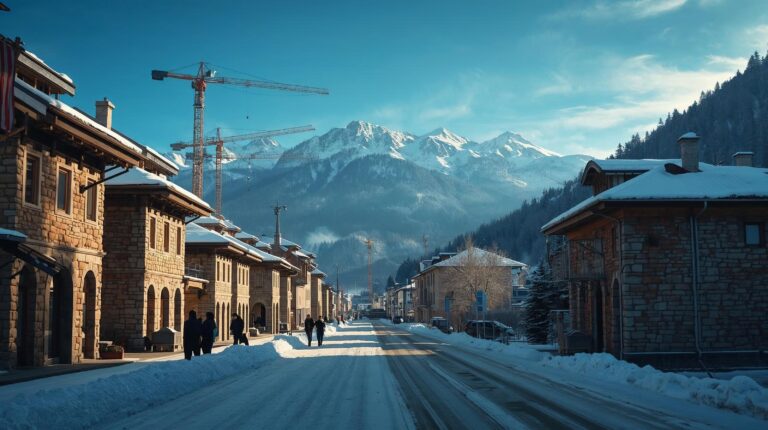
Why did the construction boom in Bansko change everything?
In 2006. Bansko lived in its own microeconomic climate. While in the rest of the country, property prices were rising steadily and predictably, there was real hysteria in the foothills of Pirin. The main driver was British and Irish investors, armed with cheap loans from the Island and the belief that they were buying in the "next Alps", but at a quarter of the price of France or Austria.
Greenfield purchases (before Act 14) dominated the market. The investment model was simple but risky: you buy an apartment in a project that only exists on paper and resell it for a 30% profit before the building is even finished. This speculative cycle fueled the construction boom in Bansko, attracting thousands of small investors who had often never set foot in Bulgaria.
Expert View: The Drivers of Growth
- The expectation for the EU: Bulgaria's upcoming entry into the European Union (January 1, 2007) created a sense of security and guaranteed growth.
- Liquidity: Banks offered extremely easy access to financing for construction entrepreneurs.
- Marketing: Bansko was advertised in all leading British media as “the best ski destination for investment in the world”.
Price anomalies and the “Property Bubble”
In 2006, construction developers were trying to impose prices of 2,500–3,000 euros per square meter for luxury complexes in the area of The Gondola. Despite aggressive marketing, actual transactions were happening at levels around 1200–1600 euros for fully furnished apartments. This imbalance between “offer price” and “real value” was the first clear signal of the forming property bubble.
| Area / Neighborhood | Offer price (sq.m) | Real deal (avg.) | Construction type |
|---|---|---|---|
| The Big One (next to the Elevator) | €1800 – €2400 | €1550 | Aparthotels |
| Saint John / Bonnare | €1500 – €1900 | €1300 | Gated complexes |
| Central part | €1100 – €1400 | €1050 | Residential buildings |
The Chaos of Growth and the Historical Moratorium
The economic boom, however, came at a high price. In 2006, Bansko looked more like a giant construction site than a place to relax. The building permits issued for the year exceeded a record 590,000 sq m of gross floor area (GFA). The goal was aggressive – to reach 15,000 beds, which de facto meant doubling the capacity within 12 months.
The streets, designed for a small mountain village, could not withstand the heavy machinery. The electricity grid and sewage system were working at their limits. This forced the then mayor Alexander Kravarov to take an unprecedented step. On December 15, 2006, a historic construction moratorium.
“We had to stop the cranes to save the season. Bansko could not take in any more concrete without losing its soul and its tourists.” – from the archives of the Bansko Municipality.
The Birth of Modern Tourism: The Kempinski and Golf Projects
Despite the urban planning challenges, 2006 also brought the assets that define Bansko today. It was the first full year of operation for the iconic „"Kempinski Hotel Grand Arena"“. Its presence put the city on the map of 5-star luxury tourism and attracted a new class of solvent guests from Eastern Europe and the Middle East.
In the same period, in the neighboring Razlog Valley, large-scale excavations began for Pirin Golf & Country Club. The idea was revolutionary – to transform Bansko from a winter destination into a year-round sports and lifestyle center. This project gave a breath of fresh air to the property market, expanding the focus of investors beyond the city itself.
📊 Analysis for today's investors
Why is it important to know about 2006 today? Because it teaches us three main things:
- Infrastructure is the key: A property without a secured road and power loses 50% of its value in a market shock.
- The location is eternal: The properties near the Gondola Lift, purchased in 2006, are the only ones that have retained and even increased their value in the long term.
- Sustainability: Overdevelopment leads to a decline in rental prices. Always look for projects with low density.
The Reckoning: The Legacy of the Gold Rush“
The year 2006 left a contradictory legacy. On the one hand, it eliminated unemployment in the region and turned local residents into entrepreneurs. On the other hand, it created the phenomenon of „empty beds“ and overdevelopment, the consequences of which the local government is still fighting today through new urban development plans and green initiatives.
For investors and analysts, this year remains a textbook example of an economic boom in an emerging market. It is a reminder that in the world of real estate, emotion often trumps math, but only those who bet on quality survive when the bubble bursts.
Want to learn more about current market trends? Check out our section Property and Investments for current analyses.

 English (UK)