


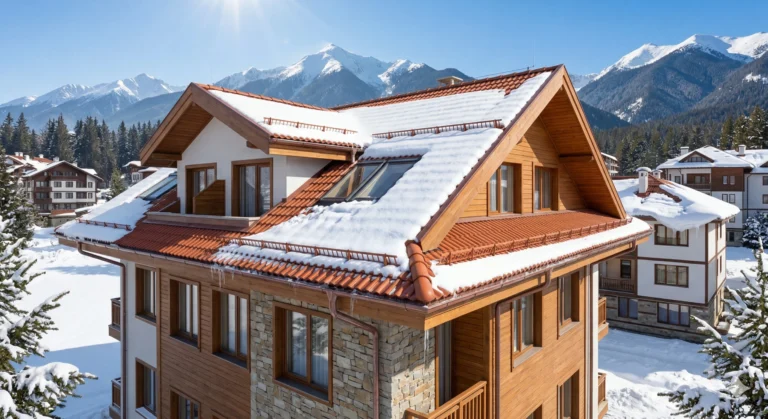
The specific climate in Bansko and why it destroys roofs
To understand why the roof is such a critical element here, we need to look at the climate. Bansko is not a typical town – it is located at the foot of the mountain and the weather here there is no compromise on building materials.
- Heavy snowfall and snow retention: In winter, tons of snow can accumulate on roofs and stay there for weeks.
- Extreme temperature amplitudes (Freezing and melting): During the day, the sun can melt some of the snow, turning it into water. At night, temperatures drop sharply below freezing, the water freezes, expands, and literally tears through weak waterproofing and seals.
- Intense UV radiation in summer: The mountain sun in July and August “bake” the bitumen coatings, making them brittle and susceptible to cracking before the next winter season.
Types of roofs for buildings in Bansko: Advantages and disadvantages
1. Classic pitched (sloped) roof
This is the most traditional, logical and reliable type of roof for mountain conditions. It can be gable or gable. The covering is most often made of ceramic or concrete tiles (e.g. Bramac), metal profiles (sheet metal with a rebate) or, less commonly, bitumen tiles.
- Advantages: Snow and water drain naturally thanks to gravity. When the slope is correctly calculated, the snow slides off on its own without weighing down the structure. It has a very long service life if it is executed qualitatively.
- Disadvantages: Requires regular inspection and maintenance of gutters and snow retention elements (to prevent a block of ice from falling on a car or pedestrian).
2. Flat roof (Roof terrace)
Commonly found in more modern minimalist buildings or as part of large penthouse terraces, this type of roof relies entirely on artificial waterproofing membranes (bitumen rolls, PVC or TPO membranes) to stop water.
- Advantages: It allows 100% use of the attic space (no bevels in the rooms) and allows for huge panoramic terraces on the top floor.
- Disadvantages: Water and snow are retained directly on it. It relies entirely on internal or external siphons for drainage. In Bansko, these siphons very often freeze, turning the roof into an ice pool.
3. Mansard roof (Apartments with bevels)
This is an extremely popular option among investors for maximizing space utilization. The apartments have steeply pitched ceilings, an alpine feel, and often rely on skylights (Velux type) for natural light.
- Advantages: It creates a unique mountain feeling. Usually these apartments are offered at a slightly lower price per square meter.
- Disadvantages: If the insulation under the roof is insufficient (which is a common practice), the apartment overheats terribly in the summer and loses heat quickly in the winter. Skylights are the most critical points for leaks.
What is the best and worst choice for the buyer?
Search for an apartment under a simple pitched roof with a good slope and massive, wide eaves. The absence of complex bends means fewer weak points. Large eaves keep the facade dry. The absolute ideal is if there is a cold air pocket (uninhabitable attic) between your ceiling and the roof itself. This buffer guarantees excellent insulation and directly protects against leaks.
What to Strictly Avoid (Red Flags)
1. Flat roof in a building from the construction boom: This is a recipe for disaster. Cheap waterproofing is already worn out. When the drains freeze, water finds its way through the microcracks directly into your living room.
2. Multi-pitched roof with complex architectural geometry: Some architects design roofs with multiple converging slopes for aesthetics. The place where two slopes meet is called an “ulama.” In Bansko, these ulama become traps for meters of snow. When the sun warms up, the snow melts from below, but because of the ice in the gutters, the water has nowhere to run off. It starts to climb up, gets under the tiles, and enters the apartment.
3. Mansards with multiple skylights at a slight slope: When 50 cm of snow accumulates on a skylight, the glass is slightly warmed by the heat in the room. The water runs down to the bottom frame, freezes there, and gradually destroys the seals. The result? Dripping water directly onto your bedroom in February.
Bansko's Hidden Problem: Condominium Ownership
Many buyers say: “Even if the roof leaks, we will get together with the neighbors and repair it. It’s a common area, right?”. According to the Condominium Management Act (ZUES), this is exactly the case. All owners are required to contribute financially to roof repairs, regardless of which floor they live on.
However, the reality in Bansko is different. A huge part of the apartments are owned by foreigners (English, Irish, Greeks, Israelis) who come for 1-2 weeks a year or do not visit their properties at all. Many complexes suffer from a lack of functioning condominiums or a professional property manager. Raising funds for a major roof repair (which can cost tens of thousands of leva) turns out to be mission impossible. In 90% cases, if the roof above your apartment leaks, you will have to pay for the repairs entirely out of your own pocket., to save your property.
Expert Tips: What to Check During an Inspection
If you liked a property on the top floor, don't rush into making a down payment before doing the following:
- Look at the ceilings and corners with a “magnifying glass”: Look for yellowing spots, swollen paint, peeling putty, or suspiciously freshly painted areas. Unscrupulous sellers often “cover up” problem areas just before viewing season.
- Check critical areas: Water most often leaks around chimneys, vents, and skylight frames. Carefully inspect the silicone and seals around them.
- Leak or Condensation? Many problems on the top floor are not due to a hole in the roof, but to a lack of ventilation. If the roof does not have a good vapor barrier, warm air from your apartment hits the cold slab and condenses. This leads to the formation of black mold on ceilings and in corners.
- Ask about condominium ownership: Request a meeting with the property manager. Ask if maintenance fees are collected regularly, if there is a “Repair and Renovation” fund, and if any partial roof repairs have been made so far.
- Require an inspection after rain or snowmelt: The best time to view an attic is not on a sunny August day, but in March, when the snow is actively melting.
Buying a top-floor apartment in Bansko is not necessarily a mistake – as long as you approach it with awareness and caution. Choose buildings with a clear and simple pitched roof structure, avoid flat roofs, and always research how the complex is managed.


 English (UK)