

Why was 2007 the “Big Bang” for Bansko?
The combination of low taxes, expected EU membership, and aggressive marketing to the British market turned Bansko into the number one construction site in the Balkans. Investors saw the town as the „new Courchevel,“ and locals had to adapt to the change in a matter of months.
The Gold Rush: Property Bubble and the „EU Effect“
In 2007, Bansko became the hottest spot on the real estate map. Optimism from EU membership and easy access to credit created the perfect storm for a speculative market bubble. While the average growth in property prices in the country was around 30%, in Bansko, deals in the luxury segment reached levels of 1500 euros per sq.m.
| Indicator (2007) | Value / Growth |
|---|---|
| Average price per sq m (Gondola) | €1200 – €1550 |
| Growth of new construction | over 45% per year |
| Main foreign buyers | Great Britain, Ireland, Russia |
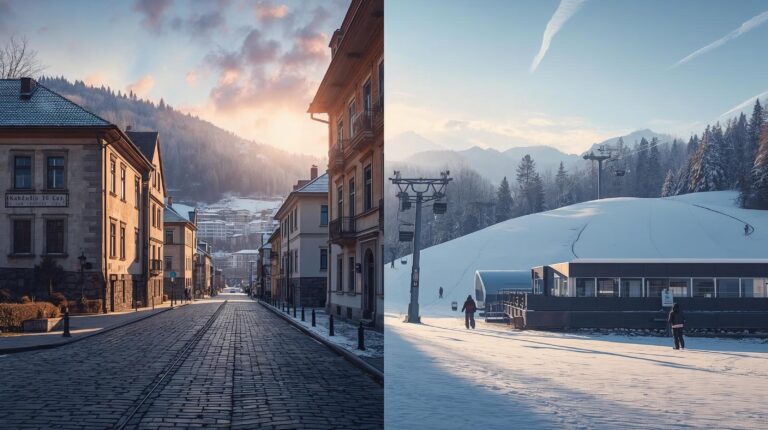
The market is dominated by British citizens who are buying up homes en masse "on the green". The city resembles a maze of cranes, and neighborhoods like "Gramadeto" change their appearance literally in days. Ambitious projects are being launched that are forever changing the visual code of Bansko.
Infrastructure collapse and construction moratorium
However, the unprecedented growth has come at a price. In 2007, the city's infrastructure began to crack at the seams. The most acute problem turned out to be the water supply. The outdated water supply network could not withstand the pressure from the new hotel mastodons.
The situation forced the then mayor, Alexander Kravarov, to take an unprecedented step. In November 2007, it was announced construction moratorium. The ban on heavy construction activities during the active winter season is a desperate but necessary attempt to save the resort's image from dust and noise.
Tourism Evolution: From Guesthouses to 5-Star Luxury
Despite the chaos, 2007 was the year in which Bansko firmly asserted its claim to be a luxury destination. Properties appeared that redefined the market:
- Lucky Bansko SPA & Relax: Opened in 2007, it became a pioneer in the luxury aparthotel segment.
- Mountain Romance Hotel SPA: Representative of the intimate approach with high quality and authentic coziness.
- Kempinski Hotel Grand Arena: Although opened earlier, in 2007 it established the presence of the global brand as a standard for the region.
Interesting fact:
In 2007, the bed capacity in Bansko increased by nearly 4,000 in just one season, which presented the city with the enormous challenge of finding qualified staff outside the region.
Memory and Roots: Cultural Renaissance
Amidst the economic turmoil, Bansko managed to preserve its spirit. On October 18, 2007, it was officially opened. Radenova House Museum„. This event is made possible thanks to the donation of General Krum Radonov.
The cultural calendar reaches its peak with 10th Anniversary International Jazz Festival. The stage at Nikola Vaptsarov Square welcomes world stars, proving that jazz and folklore can coexist in harmony under the peaks of Pirin.
Ecology: Natura 2000 and the Battle for Pirin
The ecological theme in 2007 is key. On March 2, Pirin Nature Park becomes part of the European network Natura 2000. This guaranteed the protection of 1,315 plant species. At the same time, the debate with UNESCO regarding the expansion of the ski area began - a conflict that remains relevant to this day.
Sports capital of the Balkans
The culmination of 2007 comes on December 15th with the opening of the new ski season. The Alberto Tomba slope welcomes legends such as Mark Girardelli, Janica Kostelic and Kiethil Andre Amod. Their presence legitimizes Bansko's ambitions for the World Cup.
Conclusion: The Lesson of 2007
Looking back, 2007 was the moment of the „Big Bang“ for Bansko. It transformed the village into a modern European resort, but it also left open questions about sustainable development. Bansko 2007 is a lesson in economics and resilience, the fruits of which we are still reaping today.

 English (UK)