


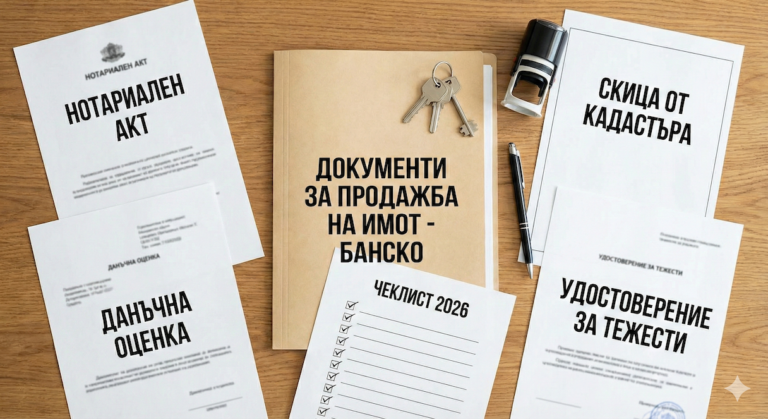
Without a complete, up-to-date and legally correct set of documents, no notary has the right to confess the transaction. It is important to know that even if your property is located in Bansko, the transaction will most likely be confessed by a notary in the town of Razlog, since Bansko falls under the District Court - Razlog. The procedure here has its local specifics, especially with regard to the municipal administration, the Cadastre and the management of condominiums in holiday complexes.
This detailed guide will guide you through the documentary maze, help you organize the process step by step, and save you unnecessary panic, wasted time, and failed deals at the last minute.
1. The “Holy Trinity” of sales documents
These are the three fundamental documents without which you cannot even begin preparing for the transfer of ownership. They are the basis of every real estate transaction in Bulgaria.
A. Title deed (Notarial deed)
This is your main legal identity. You must present the original of your notarial deed (or contract for the sale of state/municipal property) before the notary on the day of the transaction itself.
B. Tax assessment (From Bansko Municipality)
The tax assessment certificate is issued by the Local Taxes and Fees Department of the Bansko Municipality. This document shows the administrative value of the property according to the state and serves as the basis for calculating notary fees and the local acquisition tax (which in the Bansko Municipality is 3%).
- Issue condition: To receive this document, absolutely all amounts due to the municipality for this property (building tax and household waste fee) must be paid to the nearest penny.
- Validity period: The tax assessment is valid only until the end of the current half-year (until June 30), unless you have paid your taxes for the entire calendar year - then it is valid until December 31 of the relevant year.
- Critical detail: In the certificate itself mandatory there must be a text (stamp) stating that the owner has no outstanding tax liabilities for the property under Art. 264, para. 1 of the DOPK.
C. Sketch of the property (From the Cadastre / AGKK)
It is issued by the Agency for Geodesy, Cartography and Cadastre (AGKK). For the Municipality of Bansko, the competent office is in Blagoevgrad, but the fastest and most convenient way is to apply for it online through the KAIS portal, if you have an electronic signature (ESP).
- Scheme or Sketch: If you are selling an apartment/studio, you need a “Scheme of a separate object”. If you are selling a plot of land or a house with land – a “Sketch of a land property/building”.
- Validity: By law, these sketches are perpetual unless there is a change in the boundaries or details of the property. However, practice shows that most notaries and absolutely all banks (if the buyer is using a mortgage loan) require that the sketch be current – issued or re-certified within the last 6 months.
2. The hidden “pitfalls”: Additional documents
The above three documents are just the beginning. Depending on your personal status and the history of the property, the notary will require additional documentation, the lack of which can delay the transaction for weeks.
Marital status certificate
The notary is required to establish whether the property constitutes Community Property (CPP).
- If you purchased the property during marriage: According to Bulgarian law, even if only your name is recorded in the notarial deed as the buyer, the property is joint (unless you have a registered marriage contract with a separation regime). Your spouse must be present in person at the transaction or expressly authorize you with a notarized power of attorney and declarations.
- If you are divorced: You must present a final divorce decree to prove who was awarded the property.
- For foreigners: A declaration of citizenship and marital status is required, and in some cases a certificate from the relevant country, translated and legalized.
Certificate of Encumbrances (CEO)
Although the buyer (or his lawyer) usually requests and pays for this document to protect his interest, it is highly recommended to obtain it in advance. The UVT shows the entire history of the property for the last 10 years and proves its “cleanliness” – lack of registered mortgages, foreclosures, legal claims or right of use. It is issued by the Property Register at the Registry Agency and takes between 3 and 7 business days.
3. Financial Cleanliness: Specific Requirements for the Bansko Market
If in Sofia selling an apartment in an old brick building requires a simple payment of the last electricity bills, in Bansko things are far more complex. Local buyers (and their brokers) are extremely sensitive to the topic of “hidden obligations”.
- Electricity Bills (Domestic vs. Industrial): Prepare the last paid invoices to Electrohold. If the building does not yet have Act 16 or the lots are not individual (you pay industrial electricity to the investor), you must present a note from the investor that you have no outstanding electricity debts.
- Water and Internet: The same rule applies to utility bills and contracts with local internet providers. It is advisable to terminate your internet and television contracts on time to avoid accumulating penalties.
4. Distance selling: What do we do if we are not in Bansko?
A huge percentage of property owners in Bansko live abroad (UK, Ireland, Greece, Israel) or in other cities in Bulgaria. If you cannot be physically present at the notary in Razlog on the appointed day, you can sell your property through an authorized person (lawyer, broker or relative).
For this purpose, a special package of documents is required, which are strictly formal:
- Explicit Power of Attorney: It must describe in detail the property, the rights of the attorney-in-fact (to sell the property, negotiate the price, receive the money in a specific bank account) and requires simultaneous notarization of the signature and the content.
- Declaration under Art. 264, para. 1 of the Code of Civil Procedure: You declare that you have no outstanding public state and municipal obligations.
- Declaration under Art. 25, para. 8 of the Law on the Protection of Personal Data: You declare your citizenship and marital status.
Next step: Post-deal taxes and fees
The documents are perfectly collected, the deal is successfully concluded and the money is in your bank account. But does the entire amount remain for you? In some specific cases, the state will require you to pay 10% tax on the profit made. Find out if you fall into this category!



 English (UK)