


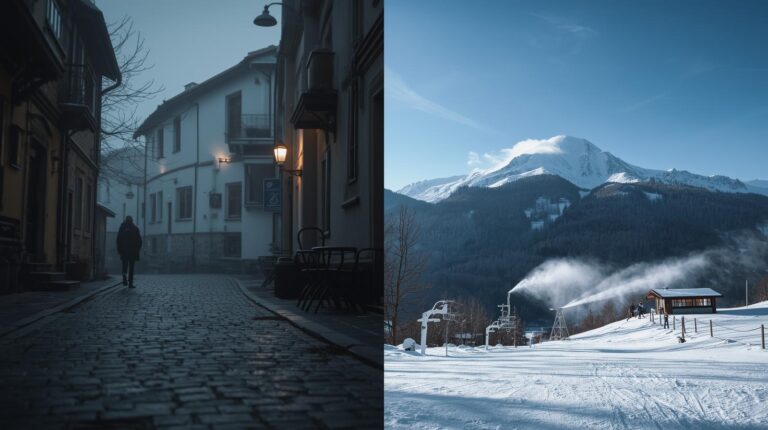
It's December. You open your laptop, pour yourself a glass wine and with slightly trembling fingers you load the webcams on Bansko. The screen lights up and your stomach clenches. Down in the city – dry asphalt. On Banderishka meadow – sad white stripes in a sea of brown grass. And your vacation is planned for three weeks. Or for mid-January.
The same disturbing scenario starts to play in your head: „"I paid a deposit for the hotel, paid for equipment, took a vacation... to walk in mud?"“
This state is familiar to every skier and snowboarder. But panic at this moment is the worst advisor. The truth is that the winter mountain is a dynamic organism, capable of complete transformation in less than 48 hours.
In this detailed guide, we'll put emotions aside and look at the facts. We'll take a historical look at how the snow cover in Bansko changes week by week - from December to April - so you can understand what realistic to expect when you arrive, regardless of what you see on the cameras today.
Why "today" doesn't matter for "tomorrow"„
Before we look at the calendar, we need to understand why the lack of snow right now (especially in early December) is not a sentence for your vacation in January or February.
The magic of the 72 hours
Bansko has one of the most modern technical snowmaking systems in Eastern Europe (TechnoAlpin). In order to cover the main arteries of the ski area (Kolora Road, The plateau, Banderitsa), the teams only need 72 hours (three days) with suitable temperatures. Even if the mountain looks bare today, a cold front a week before your arrival is enough to transform the resort.
Temperature inversion and the "hidden cold"„
Often, when you look at the forecast from your couch in Sofia, Varna or abroad, you see warming. However, Pirin has its own microclimate. The geographical location of the slopes (northern slopes) allows snow to remain, even when the thermometers in the city show 10 degrees.
-
The key lesson: What you see on the camera today is just a snapshot. It has no predictive power for conditions 20 days from now.
Winter timeline: What to expect week by week?
Let's dissect the season based on historical data from the last 15 years. This will help you position yourself for your arrival date.
PERIOD 1: „The Big Bet“ (First 3 weeks of December)
-
If you are traveling then: You are optimistic and rely mainly on technology.
-
Historical reference: This is the most unstable period. In a large percentage of years, natural snow is scarce.
-
The scenario: The official opening is usually around mid-December. Even if it hasn't rained heavily, the concessionaire concentrates all its resources on runways #1 (Platoto) and #5/10 (The Shiligarnika).
-
What will you weld: They usually work between 30% and 50% of the slopes. The snow is hard, technical (artificial) and requires well-sharpened edges.
-
The advantage: There are no crowds (before the 24th), accommodation prices are lower, and the hunger for skiing makes every descent sweet.
PERIOD 2: "The Holiday Lottery" (Christmas and New Year)
-
If you are traveling then: You come for the atmosphere, and the skis are a nice bonus.
-
Historical reference: By the end of December, at least one serious cyclone (often Mediterranean) usually passes through, laying a natural foundation.
-
The scenario: Even if there isn't a meter of snow, temperatures are already permanently low. All the guns are working around the clock.
-
The risk: Queues. If there is little snow and only the main slopes are open, the concentration of people is huge. This leads to the slopes being broken and queues forming around 2:00 PM.
PERIOD 3: "The Siberian Express" (Second half of January)
-
If you are traveling then: This is the smartest choice for serious riders.
-
Historical reference: Statistically, the heaviest snowfalls occur in Pirin between January 15th and 30th.
-
The scenario: The base is already built up (from technical and natural snow). Even if you've been watching brown cameras in December, by mid-January the picture is almost always radically different – a real white fairy tale.
-
Bonus: Cold. Temperatures in the highlands drop to -15°C, which keeps the snow "dry" and fast.
PERIOD 4: „The Gold Standard“ (February)
-
If you are traveling then: You're betting on safety.
-
Historical reference: February is the month with the thickest snow cover (accumulated from December and January).
-
The reassurance: If you are worried about your February vacation today (in December) – stop. The chance of not having good conditions in February in Bansko is less than 5%. Even in the worst winters, the slopes are in top condition by this point.
-
Attention: This is the weather during school holidays (including English ones), so the resort is full, but all the slopes are open, which distributes traffic more evenly.
PERIOD 5: „The Velvet Season“ (March)
-
If you are traveling then: You are a connoisseur.
-
Historical reference: In recent years, winter has been „shifting.“ March often offers more snow than December.
-
The scenario: Long days, lots of sun. In the morning the slopes are hard ("concrete"), and by noon they soften and become pleasant (so-called frozen snow).
-
Why not worry: The base from January and February is so thick that even in warm weather it lasts until April.
The tools of calm: How to monitor the situation correctly?
Stop looking at the standard weather apps for the location „Bansko“. This is a forecast for the town, which is located at 925 meters above sea level. You will be riding at 2000–2600 meters. Here’s what to do in the weeks before departure:
1. Monitor the Freezing Level
On specialized sites like Snow-forecast.com, monitor the "Freezing level" parameter.
-
If you see that the freezing level is 1500 m, and in the city it is +5 degrees – calm down. This means that it is below zero in the ski area and the cannons are working.
2. The Science of Wet Bulb Temperature
This is the secret knowledge of mountaineers. Snow machines are not only affected by air temperature, but also by humidity.
-
Example: If it is +2°C but the air is very dry (low humidity), the machines DOING snow.
-
Conclusion: Don't panic about positive temperatures in the forecast if you don't know the humidity. The technology in Bansko is set up to capture every possible window for work.
3. The right cameras
When checking the cameras a week before departure, ignore "Chalin Valog" or "Banderishka Polyana" (the lower parts) if they look bad. Look at the camera on The plateau (2200 m). This is the main indicator. If it is white and groomed there – there will be skiing. This is the guarantee of Bansko – even if it is spring down below, up on the Plateau winter is jealously guarded.
Plan B: If nature still betrays us
Let's assume the worst and most unlikely scenario. You arrive in 3 weeks, there's been an unseasonable warm-up, only two slopes are open and they're icy. Is your vacation ruined?
Not if you change your mindset from "just skiing" to "mountain experience.".
-
Ski touring / Panty (If there is snow only at the top): Rent touring gear and a guide. Even if the slopes are in poor condition, the higher parts of Pirin (towards Muratov Vrah) often have good snow. This is a chance to try something new.
-
SPA and thermal waters: Instead of getting angry at the slush, take a tour of the mineral springs in the village of Banya and the town of Dobrinishte. The warm water cures disappointment better than anything.
-
Gastronomic tourism: Bansko is a culinary capital. Make a list of the top 5 taverns to visit. The real "Banska Kapama" and a jug of red wine are an excellent consolation when the weather is not on our side.
Conclusion
The anxiety you feel now, watching the green cameras, is an illusion. It is based on the assumption that time is static. But in the mountains, the only constant is change.
The history of winter seasons in Bansko shows a recurring pattern: the beginning is difficult, social networks are buzzing with headlines "No snow!", and then a cyclone comes in January and covers everything by April. Or the temperatures drop for 5 days and the cannons save the day.
So, if you’re traveling in weeks or months – breathe easy. Don’t cancel your reservation. Sharpen your edges, check your gear, and trust Pirin. When you step on the track, the likelihood of riding in great conditions is much greater than your fears today allow.
 English (UK)