

What is edelweiss? Biological features
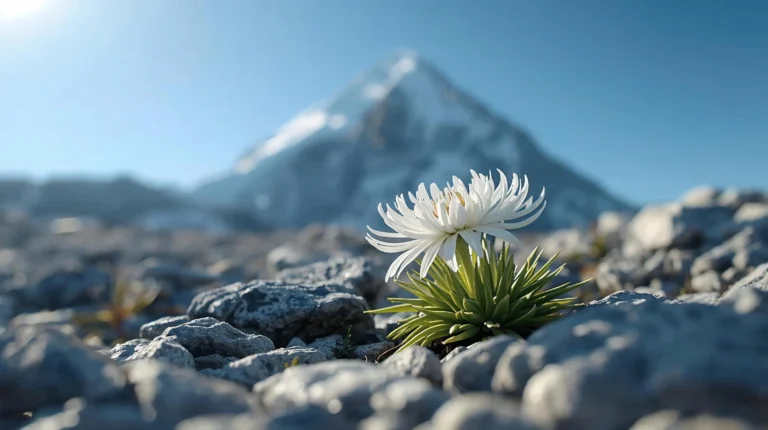
The scientific name of the flower is Leontopodium alpinum. Its botanical name is derived from the Greek words leon (lion) and podion (paw). If you look closely at the shape of its inflorescence, it truly resembles a small lion's paw, gently curled up among the harsh rocks.
One of the most striking features of the edelweiss is its “silvery defense.” The characteristic white “petals” that we all recognize are actually not the plant’s true colors at all. They are modified leaves (called bracts) that are densely covered with fine, soft hairs.
The Secret Origin: Where Does the Flower Come From?
Many of us associate edelweiss exclusively with the Alps, Pirin and European mountain ranges, perceiving it as an emblem of local mountaineering. But here is an extremely curious fact: the ancestors of edelweiss are actually “emigrants”. They originate from the distant, harsh and high mountains of Central Asia and Tibet. The plant migrated to Europe during the ice ages, finding salvation and perfect living conditions on the inaccessible limestone peaks of our mountains.
Where is edelweiss found in Bulgaria and Pirin?
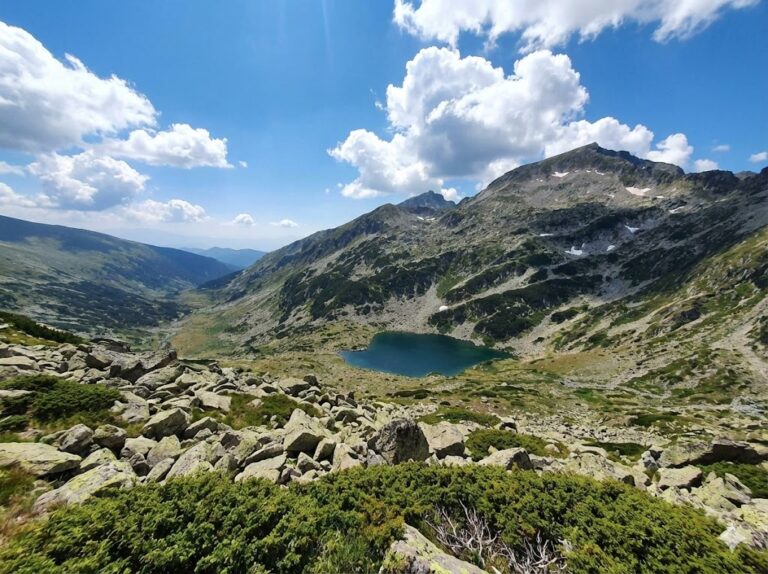
This amazing flower is extremely rare in Bulgaria. It grows in hard-to-reach rock crevices, scree, and stony alpine pastures at an altitude of usually over 2000 meters. Its favorite soil is limestone.
The localities in Pirin National Park“
For guests of Bansko and mountain hikers, Pirin is the best place to see edelweiss in its natural habitat. The main locations include:
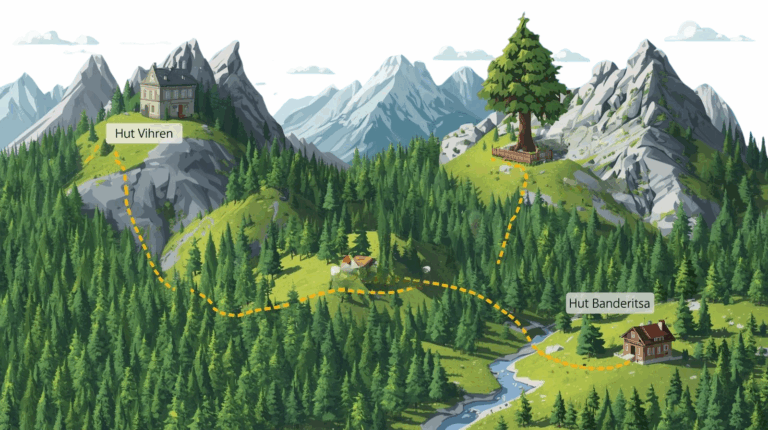
- The area of The Kazanites: The marble circuses of Golemiya and Malkia Kazan, located at the foot of Vihren Peak, are the most popular home of edelweiss in our country. From the Banderitsa hut up, along the path to the Premkata saddle, the rocks are often decorated with silvery “stars” during the months of July and August.
- The wall of Vihren Peak: Some of the most beautiful specimens can be seen on the steep and difficult-to-access eastern and northeastern slopes of the Pirin peak. However, going outside the marked trails there is dangerous and strictly prohibited!
- Jamdzhievi Rocks: The ridge that connects Banderitsa hut to the summit also hides these wonderful plants, although the route is only for very experienced tourists.
Deposits in the Balkan Mountains
Although Pirin is the “kingdom” of edelweiss in Bulgaria, the flower also has a small but very valuable population in the Balkan Mountains. It is found mainly within the „Steneto“ biosphere reserve, as well as on the sheer cliffs in the area of Kozya Stena peak. There it is also subject to strict protection.
Status, conservation and rules for tourists
The edelweiss is much more than a beautiful flower – it is a fragile organism whose survival depends entirely on our awareness and behavior in the mountains. Its habitat is highly limited, and its natural reproduction is an extremely slow and difficult process.
If you are lucky enough to encounter an edelweiss during your walk above Bansko, enjoy it with your own eyes. Take beautiful photos from a safe distance, without trampling the surrounding vegetation. Each plucked flower means thousands of unscattered seeds and a step closer to the disappearance of this species from our nature.
Legends about edelweiss
Such a mystical flower is bound to be shrouded in myth. The most famous Alpine legends tell of brave young men who risked (and often lost) their lives climbing sheer cliffs to pluck an edelweiss and prove their love for their chosen ones. Another legend says that edelweiss are the tears of the Snow Queen, fallen on the rocks because of unrequited love for a mere mortal. These stories perfectly capture the spirit of the flower – beautiful, elusive and demanding respect for the mountain.
Conclusion
The edelweiss remains one of the most sought-after “trophies” for the lenses of photographers and nature lovers who visit Pirin National Park in the summer. Let us be responsible guests in the home of wild flora and fauna. Only in this way will the silver star of the mountain continue to welcome future generations on the marble slopes above Bansko.
 English (UK)