


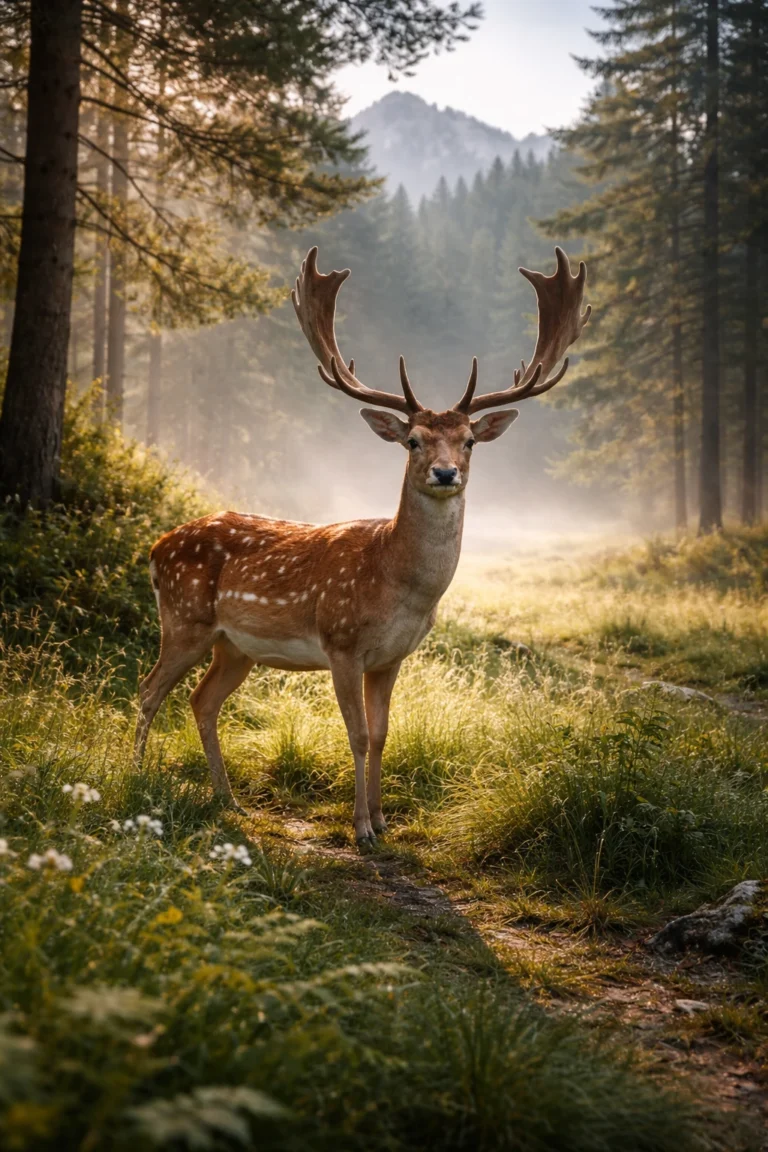
How to recognize a fallow deer (Dama dama)?
Recognizing fallow deer among other forest dwellers is relatively easy, thanks to a few extremely distinctive features. This species is medium-sized – adult males reach a weight of between 60 and 100 kilograms, while females (called hinds) are significantly smaller, finer and more graceful, usually weighing around 30 to 50 kilograms.
The characteristic shovel-shaped horns
The most striking feature of the males, which practically gives them their name, are their magnificent shovel-shaped horns. Unlike the typical branched and sharp antlers of the red deer, those of the fallow deer are greatly expanded at the top. They form wide, flat plates (resembling shovels) with numerous small spikes along their rear edge. These antlers fall off every spring (most often in April or May), and in their place new ones, covered with fine “skin”, almost immediately begin to grow, reaching their full impressive size by the end of summer.
The spotted summer outfit
The coat of the fallow deer undergoes a dramatic and beautiful change with the seasons. During the warm summer months, it is a light rusty brown, studded with distinct white spots on the back and flanks. This specific coloration acts as a perfect camouflage among the colorful shade of the forest. In winter, the spots almost disappear, and the coat takes on a darker, gray-brown and dense shade, which protects the animal from the harsh cold of the Pirin Mountains.
Habitat: Where in Pirin does the fallow deer live?
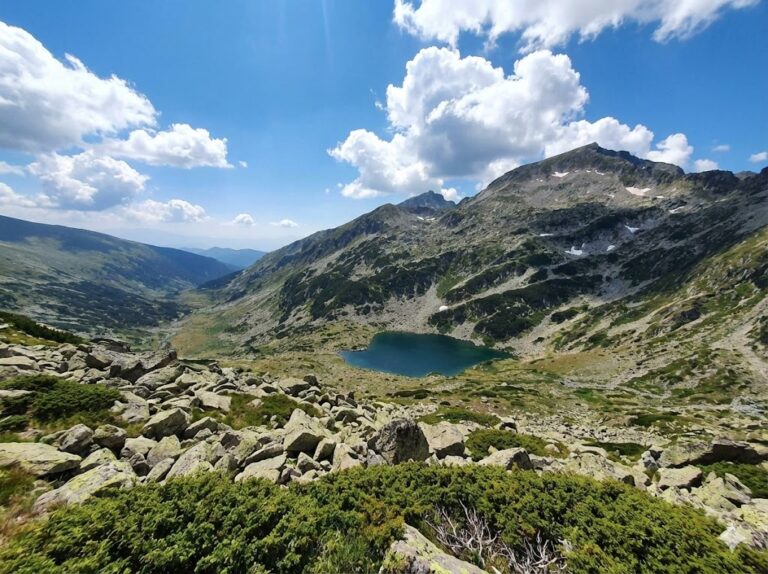
The fallow deer in Pirin mainly inhabits the lower forest belts of the national park. It avoids the harsh alpine peaks and prefers light deciduous and mixed forests, which alternate with open meadows, rich pastures and dense undergrowth. The area around Bansko, Dobrinishte and Razlog, with their smooth transition zones between the mountain and the valley, offer ideal conditions for this species to flourish.
The diet of the fallow deer is extremely diverse. As a typical herbivore, it feeds on fresh mountain grasses, aromatic herbs, leaves of young trees and shrubs. In autumn, its menu is significantly enriched with acorns, wild chestnuts, berries and mushrooms. This high-calorie food is vital to help it accumulate fat for the long and snowy mountain winters.
When is the best time to observe?
If you are an avid photographer or just a nature lover and want to catch a glimpse of a fallow deer, you need to set your watch to its strict biological rhythm. This species is extremely active dawn and dusk (crepuscular activity).
- Dawn (early morning): Just before sunrise and in the first hours after, deer come out into the open forest glades to graze undisturbed. While the morning dew is still on the grass, they are at their most peaceful and photogenic.
- In the evening (at sunset): When the sun begins to hide behind the jagged peaks of Pirin and temperatures drop, animals once again leave their dense forest hideouts in search of their evening meal.
During the day, especially in the hot summer months, fallow deer retreat deep into the coolest shadows of the forest, where they forage and rest, making them virtually invisible to passing tourists.
Autumn Wedding: The Natural Spectacle of Pirin
One of the most exciting periods in the life of fallow deer is the breeding season, called by foresters wedding. It takes place in October and early November. During this time, mature males become extremely territorial and vocal. They make characteristic, deep, snorting, and echoing sounds to attract females and to intimidate potential rivals.
If you are lucky, spectacular battles can be witnessed at this time, where the males interlock their massive spade-shaped antlers in a show of strength and dominance. Hearing the roar of deer in the golden autumn forest above Bansko is an experience that literally takes your breath away.
Important safety and ethics rules:
- Keep a serious distance: If you spot a deer, do not try to approach it on foot. Use binoculars or a camera with a powerful telephoto lens (zoom). Any approach will cause severe stress to the animal and it will run away.
- Maintain absolute silence: Deer have extremely keen hearing. Any snapping of a dry twig, rustling of a jacket, or loud speech will immediately scare them away.
- Never feed them! Feeding wild animals human food (bread, pickles, fruit) seriously damages their digestive system and dulls their natural instincts for survival in the wild.
- Special attention in autumn: During the breeding season, males are full of testosterone and can be unpredictable. Only observe them from a distance and do not cross their path.
Conclusion
The presence of fallow deer in Pirin is yet another strong proof of the exceptional and preserved biodiversity that surrounds the Bansko region. This graceful inhabitant of the forest belts is a true symbol of the wild and untouched nature of Bulgaria. With a little luck, a desire to get up early and a deep respect for the unwritten rules of the mountain, you too can witness the magic of meeting the Dama dama in its natural home.
 English (UK)