


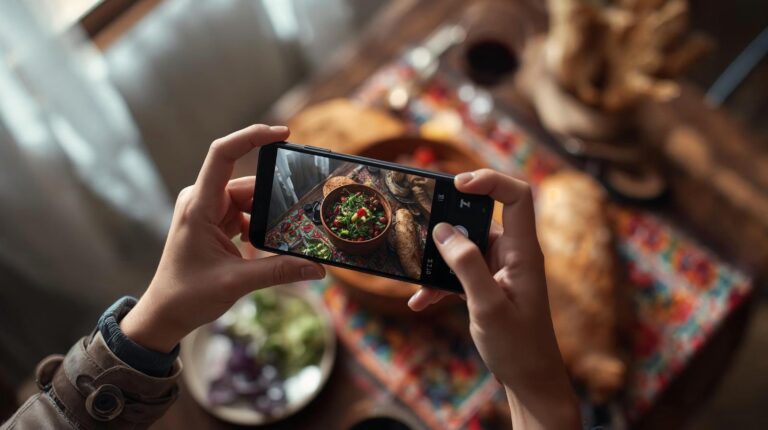
We live in times when the camera “eats” first. Before the tourist in Bansko to step into your tavern and order the famous sach or kapama, he has almost certainly already seen them on Instagram, Facebook or Google Maps. If the photo there is dark, blurry or with bad color, he will simply pass by your establishment and go to the competition.
The good news for small and medium business owners is that you no longer need an expensive BGN 5,000 SLR camera to take great photos. Modern smartphones are powerful enough to do the job brilliantly. The Secret of Professionalism taking pictures of food with a phone it's not about technique, it's about understanding light and composition.
Today we will show you how to turn your dishes into a customer magnet by following 5 simple but proven rules.
Rule #0: Clean the lens!
It sounds trite, but 80% of the poor quality photos in restaurants are due to greasy fingerprints or steam on the phone's camera. The kitchen is a greasy environment. Before you start taking pictures of food with a phone, be sure to wipe the lens with a microfiber cloth or (as a last resort) with a soft cotton t-shirt. The “fog” around the dish is not an artistic effect, but dirty optics that kill contrast.
1. Light is Everything (And Why Lightning is Enemy #1)
The biggest mistake we see in the online profiles of many taverns in Bansko are photos taken at night in yellow artificial light or, even worse, with the phone's built-in flash.
⚠️ Why is Flash prohibited?
Phone flash is direct and harsh. It makes food look greasy, “flat” and unnaturally colored. Green salad turns gray and sauce on meat looks like oil. Never use it on food!
The solution: Daylight.
Take the plate and take it to the largest window in the restaurant or even outside on the terrace if you the weather allows. Natural light is soft and makes colors true. The best time to take photos is in the morning or late afternoon, when the sun is not too strong (the so-called “Golden Hour”). If the sun is directly shining, put a thin white napkin on the window – it will act as a professional diffuser.
2. The angle: From above or from the side?
Not every dish is photographed the same way. You need to choose the angle according to the “geometry” and height of the food.
| Type of dish | Best angle | Why does it work? |
|---|---|---|
| Pizza, Salads, Soups, Capama (in an open container) | Flat Lay (Directly from above, 90°) | These foods are “flat.” The photo above shows the arrangement of all the ingredients clearly and is very trendy on Instagram. |
| Burgers, Cakes, Steaks, Sausages | At eye level or 45° | The goal here is to show the height, the layers of the cake, the juiciness of the meat, or the steam rising from the pan. |
3. Don't just photograph the plate (Styling)
A lonely plate of moussaka on an empty table looks boring and industrial. To make the client dream, you need to create a “story.” In professional photography, this is called styling.
Use the atmosphere of Bansko:
- Add depth: Put a glass of red wine in the background (slightly out of focus).
- Texture: Casually toss a cloth napkin or traditional towel next to your plate. Wooden boards are more photogenic than white tablecloths.
- Freshness: Sprinkle some fresh herbs, coarse salt, or colorful pepper around the plate.
- Human element: Use your hands! Have someone hold the fork, break the homemade bread, or pour wine into the frame. This breathes life into the photo and makes the viewer put themselves in the customer's shoes.
4. The Processing: From “Manja” to “Insta-hit”
Even the best photographers process their photos. But be careful – don’t use the pre-made, heavy Instagram filters (like Clarendon or Valencia), they are already outdated and look cheap.
Download free apps like Snapseed (on Google) or Lightroom Mobile. Here are the 4 steps for quick processing:
- Brightness: Slightly increase the amount to make the dish “brighten” and look fresh.
- Contrast: Add a little contrast for depth so the photo doesn't look "blurry.".
- Saturation: Turn up the colors just a little. The green should be fresh, but be careful – the tomato shouldn't turn neon red and radioactive.
- Structure/Sharpening: This is the most important thing about food. Add sharpness to make the textures stand out – the crispy crust of bread or the caramel of cream.
Bonus: Think Vertically (Reels & TikTok)
In 2026, video is king. Still photos are important, but Facebook and Instagram algorithms prioritize video content (Reels). While you taking pictures of food with a phone, also make a short 5-second video: how the sauce is poured over the meat, how you cut the dessert or how the wine is poured into the glass. This increases engagement by over 200%.
Do you need more help with your business?
You already have mouth-watering photos. Now it's time to take care of the atmosphere and mood in the establishment.


 English (UK)