


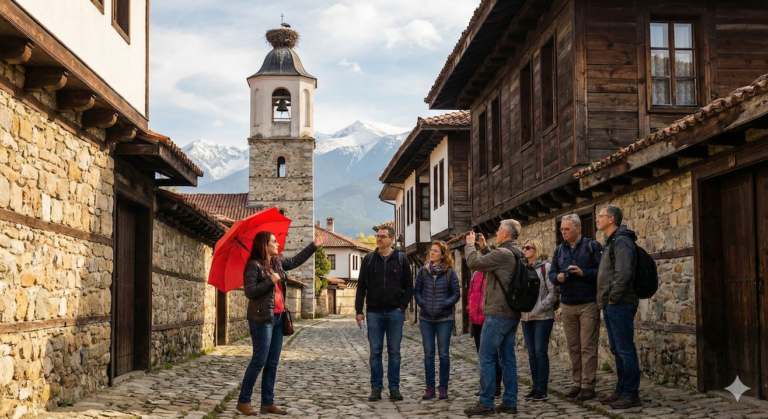
You think you know Bansko? Ski slopes, taverns, hotels – that's the visible part. But behind the stone walls of the Old Town lies another story. A story of rebellion, faith and secret tunnels.
Today we invite you on a different adventure. This is not just an article, but your preliminary virtual Free Tour Bansko. Before you put on your comfortable shoes and meet your live guide, let us take you through the cobblestone streets to feel the spirit of times gone by.
This is the most popular way to explore a city worldwide. It works on the principle of tipping.⚠️ IMPORTANT: The official “Bansko Free Tour” is conducted ONLY IN ENGLISH, as the groups are international. If you don't speak English, this virtual tour here will help you learn the stories in advance!
🗺️ Virtual walk route:
- 📍 Stop 1: The symbol of faith – “Holy Trinity
- 📍 Stop 2: Fortress houses and their secrets
- 📍 Stop 3: Velyanova House and the “Blue Room”
- 📍 Stop 4: The Alley of the Great Bulgarians
- 📍 Stop 5: The language and taste of Bansko
📍 Stop 1: Meeting in front of the “Holy Trinity”
Our Free Tour Bansko always starts here. Stand mentally in front of the massive church gate. Can you smell the pine and burning candles? This is the heart of the city.
How do you build a temple taller than a mosque?
The guides will tell you one of the most impressive legends. In 1835, during the Ottoman rule, it was forbidden to build tall churches. They were not supposed to exceed the height of a Turk riding a horse.
However, the people of Banska Bystrica were known for their stubbornness and cunning (“banski inadet”). They bribed the authorities, and in the evening secretly buried ancient icons and crosses in the ground. In the morning they “accidentally” discovered them and declared: “There was an ancient temple here, we are just restoring it!”.
“Thus was born the 'Holy Trinity' – the symbol of freedom, built with the donations of the entire city and the labor of over 350 craftsmen.‘
Pay attention to the stork's nest and the clock on the tower - they are an integral part of the Bansko skyline, which you will see live.
📍 Stop 2: Fortress houses
We enter the labyrinth of the Old Town. The cobblestones become uneven, and the streets narrow. There are no sidewalks here. What immediately strikes us are the high stone walls – over two meters high, hiding everything from prying eyes.
Why do homes look like bunkers?
During your Free Tour Bansko, you will understand why the architecture here is unique to Bulgaria. It was not just for beauty. In the 18th and 19th centuries, times were dangerous - bandits and robbers attacked the rich trading cities.
The Bansko fortified house has several levels of protection:
- The walls: Over a meter thick, built of river stone.
- The Mazgals (The Fighters): There are no large windows on the first floor, only narrow openings through which one can shoot.
- The secret tunnels: Perhaps the most exciting part of the guide's story. Houses were often connected to each other by hidden doors and corridors. If your home was attacked, the whole family would run to the neighbors, then to the next, until they reached the forest or the fortified church.
📍 Stop 3: Velyanovata House
We stop in front of an architectural masterpiece. Velyanova's House is an example of how rich and cultured the Bansko merchants were. While it looks austere from the outside, inside it is a real palace.
The story tells of master Velyan Ognev, who came to paint the church, but fell in love with a local girl (or with the town – versions differ) and stayed. He turned this house into a work of art. The frescoes inside are not inferior to the European palaces of that era – Viennese style, intertwined with Bulgarian traditions.
Tip: During the walking tour, you usually only see the courtyard and the architecture from the outside, but we highly recommend that you come back and go inside after the tour!
📍 Stop 4: Small Town Great Minds
As we walk towards Vazrazhdane Square, we can't help but ask ourselves: How is it possible for a small mountain town to give birth to so many titans of Bulgarian history?
Your guide will introduce you (virtually and in person) to:
- Paisius of Hilendar: The man who ignited the spark of the Bulgarian Renaissance with his "Slavonic-Bulgarian History". The dispute over his birthplace is eternal, but the people of Banska Bystrica are categorical - he is theirs!
- Neofit Rilski: The patriarch of the new Bulgarian education. Did you know that he drew the first globe in Bulgaria?
- Nikola Vaptsarov: The poet, whose poems have been translated into dozens of languages. His birthplace is now a museum, located right in the center.
This one Free Tour Bansko It's not just a walk, it's a lesson in pride.
📍 Stop 5: Language and the Tavern (Final)
Finally, we get to the most delicious part. But before you sit down at the table, you have to pass the language test.
The Bansko dialect is a phenomenon.
“"Let's go up to the balcony to rest."” – that's easy.
But do you know what it is? “"will"”, “"ka"” or “drawer” (joker: isn't that in the cupboard)?
The tour usually ends near one of the authentic taverns. The guide will give you invaluable advice on what to order. Forget about the standard grill. Here you can eat:
- 🥘 Chomlek: Veal shank with potatoes, stewed for hours in a clay pot.
- 🍖 Banska Kapama: Several types of meat, sauerkraut and rice – a symphony of flavors.
- 🍷 Old man from Bansko: A dry appetizer that goes perfectly with the local red wine wine.
Are you ready for the live walk?
The virtual tour is just the beginning. Nothing can replace the feeling of the Pirin wind and the smile of the local guide.
📅 Useful information about Free Tour Bansko
| When: | Usually Saturday and Sunday (check the current schedule) |
| Time: | Often starts at 2:00 PM (winter season) |
| Meeting point: | In front of the Holy Trinity Church“ |
| Language: | ⚠️ Only in English (Only in English) |
| Price: | Tip-based (Free Walking Tour) |


 English (UK)