

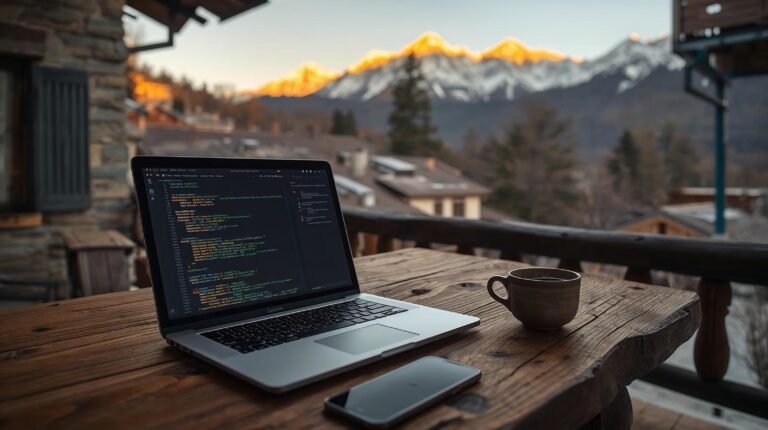
Close your eyes and imagine your ideal office. You probably don't see a glass skyscraper in the gray center of a big city, right? Now imagine a wooden table with the scent of pine, a glass of Mursalski tea and a laptop, from whose screen you look up directly at the snow-capped peaks of Pirin. Your morning started with “first powder” under Todorka or a quick hike to Banderishka Polyana, and the working day ends in a tavern with people from four continents.
This is not a still from an advertisement. This is everyday life in Bansko today. The city, which we knew only as the winter capital of the Balkans, has undergone an incredible metamorphosis and has become the “Silicon Valley” of mountaineers.
In this article, we will take an in-depth look at the phenomenon of "digital nomadism" and why exactly our city ended up on the map alongside tropical giants like Bali and Chiang Mai.
What is a "Digital Nomad"?
The term digital nomad describes people who have broken the chain between this how they make their money and where They use technology to work from anywhere in the world, as long as there are two things:
-
Reliable internet connection.
-
Electricity for the laptop.
These are programmers, graphic designers, marketing experts, e-commerce entrepreneurs and consultants. For them, “office” is a concept devoid of geographical coordinates. They are not classic tourists, because they stay in one place for months, but they are not emigrants either, because they rarely settle down permanently. Their philosophy is freedom – to spend the summer on the Portuguese coast, and the winter – at the foot of Pirin, without it affecting their bank account.
The Bansko Phenomenon: How did it all happen?
Until a decade ago, Bansko followed the classic seasonal curve – crowded in winter and quiet, almost ghostly in summer. The change began around 2016, when visionaries like Matthias Zeitler recognized the town’s potential. They saw beyond hotels and ski lockers. They saw the perfect ecosystem for remote work.
The creation of the first coworking space in the city center started the avalanche. Today, several large coworking centers operate in Bansko, which not only offer a desk and internet, but also create a community.
“The ”Holy Four” of Benefits
Why do hundreds of foreigners (and increasingly Bulgarians from big cities) choose Bansko? The reasons are complex:
1. Community
This is the beating heart of nomadic life here. In megacities like London or Berlin, alienation is the norm. In Bansko, the size of the city predisposes to socialization. The nomads here are close-knit – they organize weekly evenings, hikes, board games, seminars and even volunteer mountain cleaning campaigns. The culmination is the annual Bansko Nomad Fest, which brings together hundreds of people and lecturers from all over the world in the meadows near the city.
2. Accessibility and quality of life
For a Western European or American, the standard of living in Bansko is extremely attractive. Apartment rents – whether in the neighborhood around the cable car station or in the quieter parts around the park – are many times lower than in Western Europe. The quality food – from the homemade products at the Sunday market to the restaurants – allows for a high standard of living without financial stress.
3. Tax haven
Bulgaria, with its 10% flat tax, is a magnet for entrepreneurs. Bansko offers an easy entry point for registering tax residency within the EU. Many nomads choose to register their companies here, taking advantage of the favorable conditions and low insurance premiums.
4. Nature as an office
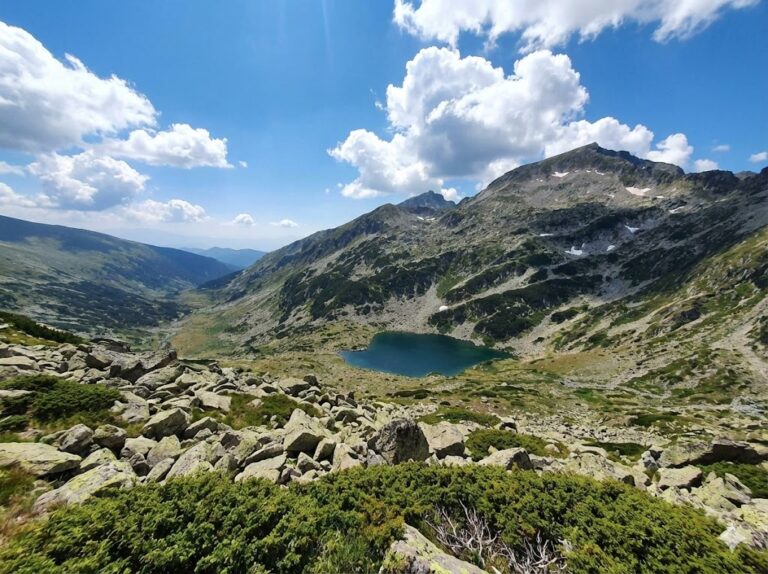
The ability to close your laptop at 5:00 PM and be in the forest by 5:15 PM is a luxury that few places in the world offer. Winter offers world-class skiing and snowboarding, and summer offers mountain biking, trails to lakes and peaks, and of course, the healing mineral waters in neighboring Banya and Dobrinishte.
The other side of the coin
As an objective media outlet, we are obliged to point out the challenges as well. Life in Bansko is not just an idyll.
-
The air in winter: Solid fuel heating and the specific relief of the valley often lead to air pollution and smog during the cold months, which can be a problem for people with respiratory problems.
-
Infrastructure needs: Although the fiber optic internet is excellent (often faster than in Germany), the urban environment – sidewalks and street lighting in some neighborhoods – still needs rehabilitation.
-
Clash of cultures: The contrast between modern "digital" people and the more conservative lifestyle of the local elderly population is visible, although over the years the two groups have learned to symbiosis.
Conclusion: The future is here
Bansko is no longer just a resort. It is a global village in the best sense of the word. Here you can meet a programmer from Japan discussing blockchain technology with a copywriter from Canada while they eat kapama.
The history of our city proves that in the digital age, geography is no longer destiny. To be successful, you don't need to be at the center of the world - it is enough to have a good connection to it. And Bansko offers exactly that - a quick connection to the world and a deep connection to nature.
 English (UK)