


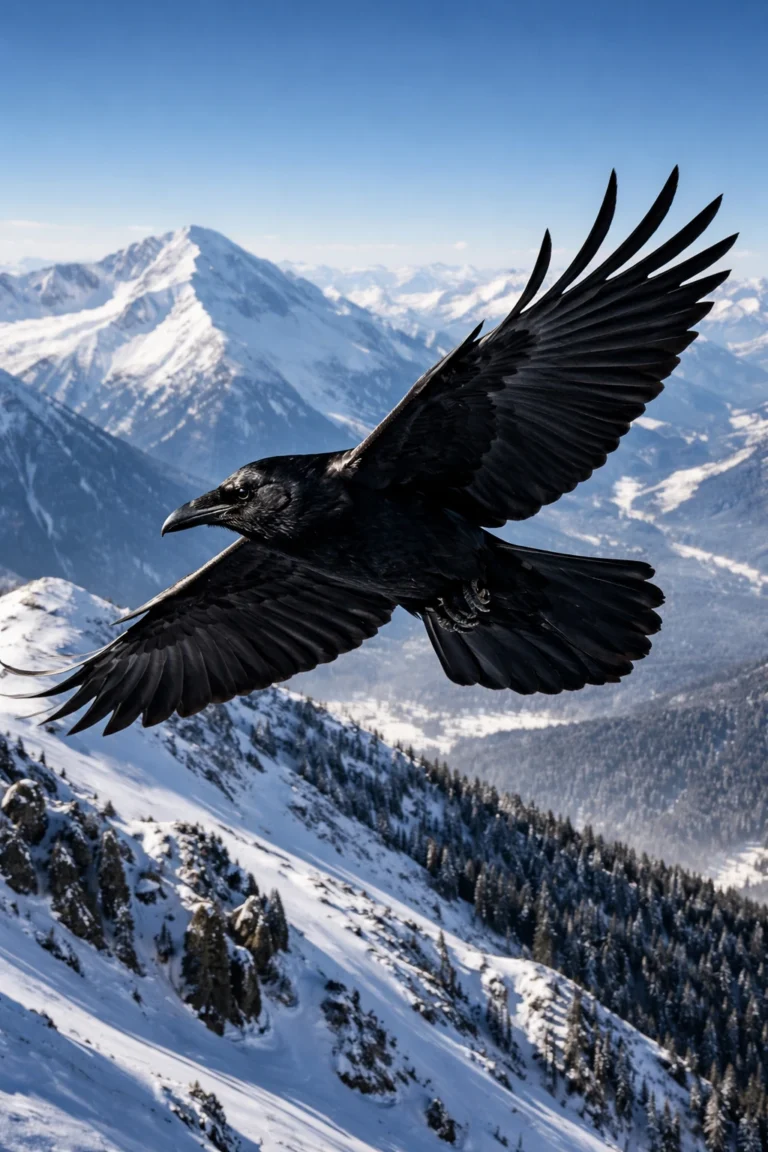
Why is he called a "gravedigger" and what is his role in Pirin?
The name "undertaker" often evokes associations with mysticism, darkness, and folk superstition. In fact, in ornithology and ecology, this name reflects its extremely important role as the chief "sanitary officer" in wildlife.
In winter, when Pirin National Park is frozen by thick ice and deep snow, finding food becomes a matter of life and death for all forest dwellers. The raven is omnivorous, but during the long cold months a huge part of its menu consists of carrion. It has an incredible instinct to follow the tracks of predators such as wolves or foxes, waiting patiently high in the branches for its share of the remaining prey. By quickly cleaning up animal remains, ravens practically prevent the spread of dangerous infections and maintain a healthy balance in the mountain environment.
How does the carrion crow survive in extreme winter conditions?
While many other bird species choose to migrate south to warmer latitudes, the carrion crow remains faithful to the Pirin heights above Bansko. Evolution has turned it into the perfect survival machine in extreme conditions. Here's how it copes with the cold:
- Perfect insulation: Its plumage is incredibly dense and thick. The dark, pitch-black color is not just a visual camouflage in the deep shadows of the ancient forest – it physically attracts and retains the scarce solar heat during the frosty days of January and February.
- Flight energy efficiency: Instead of wasting precious calories aimlessly flapping its wings, with a span of up to 1.5 meters, the raven uses warm air currents (thermals). This allows it to soar for hours above Mount Todorka and Banderishka meadow, scanning vast territories with their keen eyesight.
- Creating food reserves: These birds have a phenomenal spatial memory. They regularly hide surplus food in crevices in rocks or under certain stones in the snow. When the fiercest blizzards strike and hunting is impossible, they return unerringly to their hiding places.
💡 Did you know? (Facts about intelligence)
Ravens have intelligence comparable to that of great apes. They can recognize individual human faces, use primitive “tools” (such as sticks to pluck insects), and even plan their actions for the future by hiding objects that might be useful to them later.
The Gravedigger Raven and Skiers in Bansko: A Smart Neighborhood
The high intelligence of ravens makes them extremely adaptable to the changing environment. In the ski area above Bansko, they have long since decoded human behavior and understood that the presence of tourists means easily accessible calories.
It is not uncommon to see a large black silhouette patiently and silently watching skiers around the huts and outdoor facilities in areas such as The Shiligarnika or the Plateau. They wait for someone to drop a piece of sandwich, a biscuit or a French fry. Ravens quickly learn the daily rhythm of people and even sense when the end of the ski day is approaching. Then, when the crowds retreat to the gondola, the birds descend to search the snow for forgotten scraps of food.
⚠️ Important for all tourists and skiers!
Although it's tempting to throw a piece of salt or bread to these majestic birds, Please do not feed the wild animals in Pirin! Human food, especially pasta and salty foods, seriously damages their digestive system and dulls their natural instincts to seek out real food in nature.
How to distinguish a gravedigger from a common crow?
Many tourists in Bansko confuse the raven with the carrion crow or the gray crow, which are often found in the lower parts of the city. However, the differences are significant. The raven is significantly larger - it is the largest representative of the Corvidae family. Its beak is massive, thick and slightly curved downwards. In flight, the raven's tail has a characteristic wedge-shaped (rhomboid) shape, while that of crows is straight or slightly rounded. In addition, the sound they make is completely different - instead of the familiar "kra-kra", the raven makes a deep, guttural and resonant sound, similar to "korr-korr".
Winter Games in the Sky
Ravens are one of the few wild animals that have been proven to play simply for fun, without it being related to their survival. If you look up at the sky above Bansko on a clear and sunny winter day, you may witness breathtaking aerial acrobatics. They roll upside down in the air, dive sharply downward with whistling wings, or compete in pairs.
Even the snow itself entertains them - biologists and experienced mountaineers have repeatedly observed ravens in Pirin, literally sliding down the snowy slopes on their backs, repeating the action over and over again, just like children with sleds on a slide.
The symbol of the wild mountain
The raven is not just another bird in the ornithologists' catalog; it is the living symbol of the wild, raw and unruly spirit of the Pirin Mountains. In the stark contrast between the dazzling white snow and its iridescent raven-black feathers lies a millennia-old story of adaptation, superior intelligence and indomitable endurance.
The next time you are skiing on the slopes above Bansko, walking in the forest or simply drinking hot tea on the terrace, look around. If you hear their characteristic deep throated cawing, know that you are being greeted by the true, ancient lord of the winter mountain.






 English (UK)